clasp

Translator: 
Euphrosyne Rizopoulou-Egoumenidou
Author: 
Euphrosyne Rizopoulou-Egoumenidou
Description: 

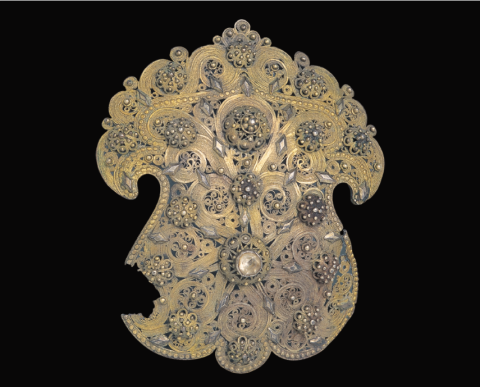
Ind. no. 103: Part of a silver-gilt, filigree clasp. It has a curved outline and, in terms of its tulip-like shape, it resembles the central element of tripartite clasps. The openwork filigree surface, composed of very dense scrolls, is encrusted with domed rosettes, granules, and tiny lozenges, as well as a clear paste (glass stone), set at the top of a large rosette. The lower part of the object is framed by beaded wire, which also extends between the filigree scrolls at the upper part, thus surrounding the largest section of the filigree surface. A small piece of the object is missing.

From Istanbul. Dimensions: 11.2 x 9.3 cm.               

Translator: 
Euphrosyne Rizopoulou-Egoumenidou
Author: 
Euphrosyne Rizopoulou-Egoumenidou
Description: 

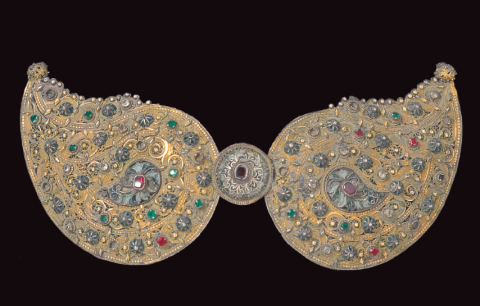
Ind. No. 100: Gilded, filigree clasp, composed of three elements: two large, almond-shaped panels, and a smaller, round piece in the center. The almond-shaped panels comprise two rows οf dense, openwork filigree scrolls around a central, almond-shaped element of sheet silver with applied filigree enamel and a red paste (glass stone) set in the centre. The filigree surface is adorned with rows of applied elements: pastes of various colours (red, green and clear), alternating with domed rosettes bearing filigree enamel. The latter are affixed onto the filigree surface with wire. A short strip of open filigree scrolls, decorated with alternating rosettes and pastes, extends along the top edge of the almond-shaped elements. A border of granules extends along its top edge, and a filigree spherical bead adorns its tip. The central, round element of the clasp is also adorned with filigree enamel, as well as with a red stone set at its centre. The fastening element is cast. This elaborate type of Cypriot clasp is described in 18th-early 19th-century ecclesiastical records as: “pair of almond-shaped filigree clasps with enamel and stones.” Variants of the same type are also found in Cyprus (see Papadimitriou 1996, 61, fig. 79, and Rizopoulou-Egoumenidou 1996, 228). A similar clasp is preserved in the Monastery of Chrysorrogiatissa, in Paphos, and in the Leventis Municipal Museum of Nicosia (Rizopoulou-Egoumenidou and Loizou-Hadjigavriel 2003, 54-55, with further bibliography; see also Ohnefalsch-Richter (1913) 1994, pl. 61: 9, 18th / 19th century).

It belonged to Loukis Pierides.

Dimensions: Total length: 27cm. Almond-shaped elements: length: 14.5 cm, width: 9.2 cm. Round element diameter: 3.3 cm.
 

Translator: 
Euphrosyne Rizopoulou-Egoumenidou
Author: 
Euphrosyne Rizopoulou-Egoumenidou
Description: 

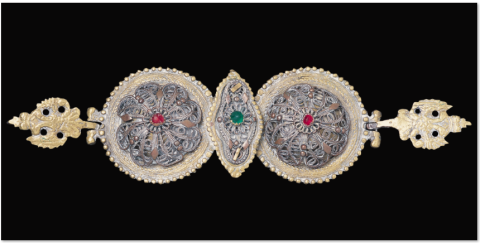
Ind. no. 107: Tripartite clasp consisting of two discs, each with a central boss, and an oval element in the middle. At each end, there is a cast two-headed eagle attached with a hinge joint. The clasp is set with stones and further decorated with applied elements: filigree motifs, small lozenges and granules. Partial gilding is discernable. This is a small chest clasp that formed part of the Karagouna costume, and was imported to Cyprus. Among other examples of the same type, there is an identical specimen in the Museum of Greek Folk Art in Athens (Kaplani 1997, 119, no. 4167) and another in the Ethnographical Historical Museum of Larissa (Ethnographical Historical Museum of Larissa 1996, 48, no. 87).

Dimensions: Total length 20.5 cm. Diameter of the discs: 5.3 cm. Height of the central part: 5 cm.