C/1996/1233
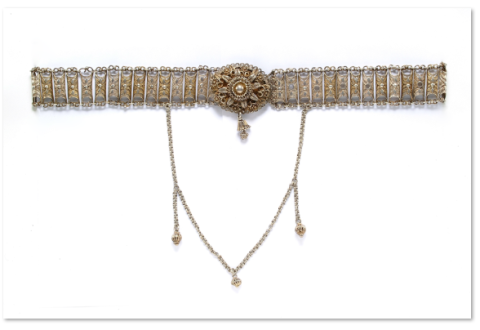
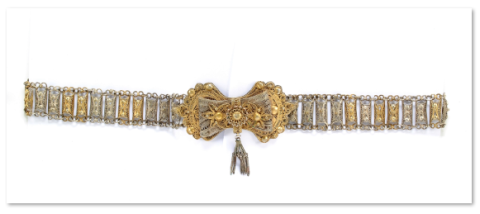
Articulated filigree belt of 56 vertical rectangular links, joined with rings. The links are made with filigree and adorned with applied granules. The belt closes with a composite bow-shaped clasp of filigree on a sheet silver background. A rosette decorates the centre of the clasp, from which hangs a wirework ornament.
Two rings connect one side of the clasp to one end of the belt, while on the other side of the clasp there is a hook that fits into a small hole in the centre of the last link at the other end of the belt. Certain parts of the clasp are gilded, as are half of the belt links, in a pattern of alternating single then double links. This creates a two-tone colour, while the filigree surfaces and the empty in-between spaces give the impression of lace.
Similar belts are found in various areas of Greece, such as Epirus and Thessaly (Kaplani 1997, 117, No. 5134, Hatzimichali 1983, 90, fig. 85-86, Papantoniou 1991, 66, 67, 70, 85, Gourgioti 1996, 38-39, fig. 69-72). The same type of belt, which has been attributed to the late period of modern Greek silversmithing, was also produced during the 20th century by craftsmen in Ioannina (Zora 1981, 30, fig. 60, Hatzimichali 1983, 130, fig. 135). Similar examples are also found in Cyprus, for instance in the Pierides Foundation Collection in Larnaca, and in the House of Hadjigeorgakis Kornesios in Nicosia. Identical 19th-century specimens also come from Vidin in Bulgaria (Blagoeva 1977, 64, fig. 22) and Lebanon, where they are considered Ottoman (Kassatly nd., 60). The widespread distribution of this type of belt reflects its prevalence.
Total length: 80 cm. Height: 4 cm.
Donation from the Association of Friends of the Leventis Museum.