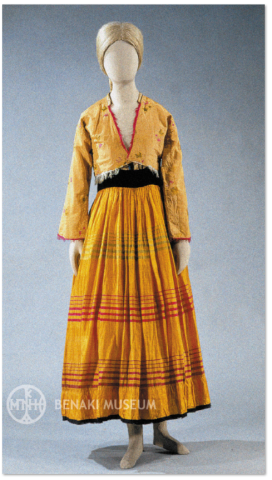
Incomplete female costume (Inv. No. 127), consisting only of a skirt (EE 1588) and a sarka (EE 1422). Donated by Fokion Tanos, Cairo 1948. Publication: Rizopoulou-Egoumenidou 1996, 108, fig. 93b.
Inv. No. EE 1588: Skirt/foustani (dress) of an urban costume, made of silk fabric (sattakrouta) in bright orange colour, with three horizontal bands at intervals. Each band comprises six stripes, three narrow and three wider, in light green, lilac and purple colours (from top to bottom). The skirt consists of five fabric panels, each 42-44 cm. wide, gathered in rich folds at the waist. The lower part of the hem has a lining of white cotton fabric sewn with red and black thread in a running stitch, while the edge is trimmed in the round by a black cord.
With the addition of the bodice, the skirt acquired the form of a dress. Most of the bodice remained covered, thus it was made of white cotton fabric. Its back consists of two pieces and has a vertical opening all the way down, while the front is made of a single piece. At the front, the cotton fabric was used as a lining for an imported silk fabric, with wide vertical and horizontal bands containing flowers in blue, green, yellow, gold, orange, and light blue colours. The deep opening at the bust leaves most of the chest uncovered. This is probably where the shirt would be visible, while the sarka would cover the bust.
At the waist the bodice has a sewn-on band of black velvet, 7 cm. wide, with fastening strings at its ends. Another such string is found behind the neck. At the back below the waist, in the extension of the back opening, the skirt has a slit of 24 cm. Total length of dress: 128 cm. Length of skirt: 88 cm. Width of bust: 38 cm.
Inv. No. EE 1422: Sarka, short waistcoat made of imported silk fabric, decorated with a woven design of lilac flowers in a bouquet, tied at the base with a green ribbon. This pattern alternates with a similar one in reverse colours (the bouquet has green flowers, and the ribbon is purple). The back consists of a single piece, continuing to the front. The sleeves, sewn vertically to the shoulders, narrow down to their edge, with an additional strip lengthwise. Movement is facilitated by the addition of two diagonally joined, triangular pieces of fabric at the armpits. Side seams of the garment are connected to the seams on the inner side of the sleeves. The ends of the front pieces are joined above the waist, forming a V-shaped opening at the chest. This opening, as well as the sleeves, are decorated with a lilac tasselled cord, while a blue-green cord trims the edge of the waist round. A beige fabric with a green line at its base adorns the low collar. The whole sarka is lined with white cotton cloth.
The silk fabric has been arranged and sewn in such a way, so that at the front side and on one sleeve the bouquets of the design appear inverted, while at the back and on the other sleeve they are upright. Length: 36 cm. Width at the shoulders: 45 cm. Width of sleeves: 16 cm. Rizopoulou-Egoumenidou 1996, 150, fig. 129.