
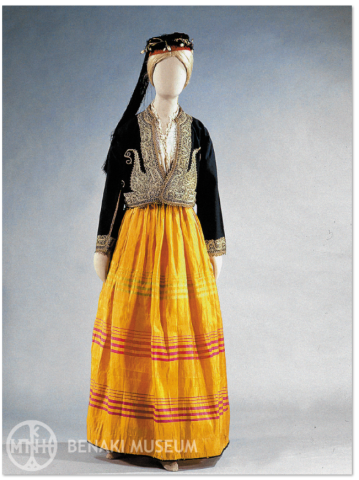
Female costume
Gender information of the object:
Color:
Type:
Place:
3D object:
Code:
512
Translator:
Euphrosyne Rizopoulou-Egoumenidou
Petroula Hadjittofi
Description:
Female costume (dress cat. no. 215) comprising a trachilia (collar, EE 3340), a skirt (EE 3341), a sarka (EE 3342) and a fez (EE 3343).
Inv. No. EE 3340: Trachilia (collar) made of silk woven, taiston fabric in the natural colour of silk, with wide and narrow bands in the warp. It consists of two strips 19-20 cm. wide, joined lengthwise at one end to form a square, leaving an opening 75 x 35 cm. The trachilia is adorned with silk-thread, needle-made lace, again in the natural colour of silk, with delicate floral motifs. The trachilia is usually accompanied by matching sleeve cuffs, maniketta (see i.e. Papademetriou 1995, 153). A similar trachilia and sleeve cuffs are shown in: The Cypriot Costumes 1999, 87. Publication: Rizopoulou-Egoumenidou 1996, 77, fig. 40.
Inv. No. EE 3341: Long, wide skirt made of sattakrouta (woven silk fabric), dyed in bright orange colour. It consists of four sewn fabric panels, each 48 cm. wide. Stripes are formed in the weft at intervals. These are arranged in three groups, each consisting of three narrow and three wider stripes, in light green, lilac and deep purple colours (top to bottom). In the middle of the skirt, a sewn-on band of stamped cotton fabric is decorated with maroon patterns on a beige background. A black braid of woven wool trims the hem. The skirt has undergone conservation treatment, including lining, as it was damaged. Apart from the colours, it resembles the skirt of the costume EE 1590 (cat. no. 91). Length: 99 cm.
Inv. No. EE 3342: Sarka, short waistcoat made of black felt, with a low upright collar and narrow, long sleeves, sewn vertically to the shoulders. The seam at their inner side is covered by a double cord. The back consists of a single trapezoidal piece of fabric, 41 cm. and 31 cm. wide at the top and bottom respectively. A seam at the shoulders joins it to the two front pieces, which have a maximum width of 28 cm. The front pieces are joined down at the waist, leaving a vertical opening above. Under each armpit, triangular pieces of fabric, joined at their base, offer ease of movement. The sarka is richly adorned with goldwork: the edges of the chest opening and the waist round, as well as the collar are trimmed by a double cord of gold thread and a wide sewn-on band with scroll patterns of twisted gold thread. The latter is repeated at the edges of the sleeves. A large paisley adorns both front pieces, right and left, while the back is decorated with a vertical, stylized floral motif. All edges are bordered by lace knitted with gold thread.
Although it is similar to the waistcoat EE 1423 of the costume cat. no. 91, this sarka has a more extravagant decoration. The paisley pattern is repeated in other waistcoat specimens (Rizopoulou-Egoumenidou 1996, 107, figs. 92, 137, 151). Length of sleeves: 45 cm. Width of sleeves: 13-16 cm.
Inv. No. EE 3343: Fez of red felt without lining, externally covered by a black tassel sewn to the top of it. Fringes made of black silk are scattered around the front half, where they are held in place by fkiora, lace buds and leaves of green and white silk thread. The stems of flowers, emerging from a thin strip attached to the fez, are fixed internally by means of a thin fabric. Over the back part of the fez falls the 58 cm. long tassel. Height of fez: 10 cm. Diameter (opening): 18 cm.
Fezzes with fkiora are depicted in photographs of the early 20th century, while a wreath made of pearls and silk thread is kept in the National Historical Museum in Athens (The Cypriot Costumes 1999, 80-83). Similar is the garland of Iouliani Voditsianou (19th century), currently on display at Hadjigeorgakis Kornesios House in Nicosia (for all the above, see Rizopoulou-Egoumenidou 1996, 150-152).
Bibliography:
Ριζοπούλου-Ηγουμενίδου, Ε. 2010: Η Κυπριακή Εθνογραφική Συλλογή του Μουσείου Μπενάκη, Αθήνα, p. 138