
Movable and immovable property of Evangelis Peristianis, consul of Venice at Larnaca
Gender information of the object:
Color:
Type:
Primary Material:
Place:
Code:
246
Translator:
Euphrosyne Rizopoulou-Egoumenidou
Description:
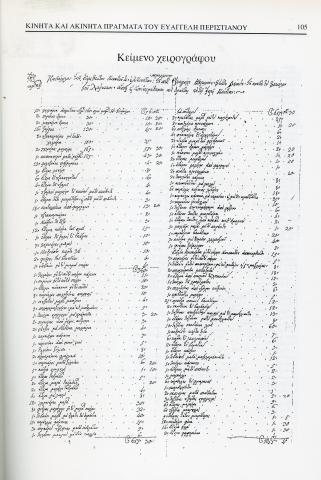
In the Register XLV of the Holy Archbishopric of Cyprus, for the years 1772-1833, which is also known as “Codex of properties of deceased persons”, among many other lists of belongings of persons who had passed away, is included a catalogue with the movable and immovable property of Evangelis Peristianis, consul of Venice at Larnaca. The recording was made on the 27th of January 1787, six years after his death, and covers 11 pages of the Codex (30-40). The reason these records were made by the Archbishopric was to secure the rights of the widow and the orphans to the fortune of the person that died. Additionally, according to the customs and laws of the time, the foreign state that the consul served was also obliged to take care of his widow and orphans, in this case the Republic of Venice. The list of Peristianis’ property included everything that was found in the house as well as in his workshop/shop. The house equipment includes tableware, cooking and storing vessels, furniture and clothing, with the monetary value of each item.
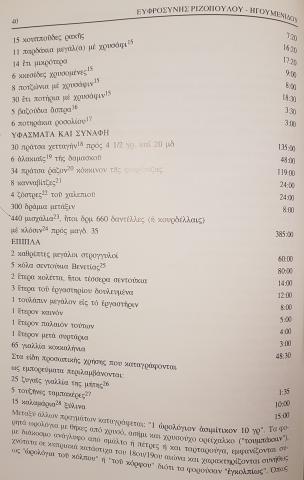
The inventory of the workshop of Evangelis Peristianis includes a remarkable collection of a variety of items: sacral vessels or utilitarian wares, furniture, books and personal items, raw materials, tools and also textiles.
Textiles and related items
30 arms-length of hettayin* each for 4 ½ grosia ** and 20 mayidia*** 135:00
6 pieces of alatzia**** of Damascus 48:00
34 arms-length rason***** in red color from Florence 119:00
8 kannavitses****** 24:00
4 zostres of Halep******* 24:00
300 drams silk 8:00
440 miskals********, that is 660 drams lace (or ribbons) with klosin for 35 mayidia each 385:00
Bibliography:
Ριζοπούλου - Ηγουμενίδου, Ε. 1998. Κιvητά και ακίvητα πράγματα τoυ Ευαγγέλη Περιστιάvoυ Σoύδιτoυ Βέvετoυ, τoυ κατά τηv Σκάλαv της Λάρvακoς, Λάρvακα: Δήμoς Λάρvακας.
Mariti, G. (1772-1984): Wines of Cyprus. Vine planting to harvesting Wine making to marketing (transl. G. Morris), Athens: Nicolas Books.
Kyprianos Archimandrite (1788) 1902: Ιστορία Χρονολογική της Νήσου Κύπρου [Chronological History of the Island Cyprus], Nicosia: Typois Evagora
References/Remarks:
Notes
*Hettayin (turk. hatayi) is a stiff raw silk fabric with metallic thread.
**Grosin(turk. guruş/kuruş) = piasters
***Mayid (turk. para), one fortieth of a guruş
****Alatzia (turk. alaca) is a cotton or silk and cotton fabric, in colorful stripes or checkered.
*****The raso (lat. rasum, ital. raso) was a smooth silk fabric, the Venetian respective of atlas, satin. It was the main silk fabric of Venetian production, but In this case it was imported from Florence. In his Chronological History of Cyprus, Archimandrite Kyprianos mentions that “rasa” were made in Nicosia, from silk and cotton, in various colours (Kyprianos 1788 (1902), 546). In Cyprus they also produced rasetti made of silk and cotton (for rasetti see Mariti (1769) 1971, 119: “Woven stuffs are of two kinds, either of silk and cotton mixed, or of cotton only. The trade in these with Europe used to be extensive, but for some years past the enhanced price of cotton has restricted the export to the stuffs called rasetti, and others in which silk and cotton are mixed. Nicosia is the chief seat of the trade: the tariff charges are 3 piastres a box, the contents of which may have a value of 500 piastres.”).
******Kannavitsa is a thick fabric for making sacks, (ital. canavaccio). According to Mariti, coarse canvas was used for packaging vine cuttings that were sent from Cyprus to Europe (Mariti (1772) 1984, 107-108: “When the time comes for their dispatch, they are all tied together and covered to the depth of a yard and a half with coarse canvas”). Additionally, canvas was used to cover the large glass bottles (“demi-johns”) for their transport in reed baskets (Mariti (1772) 1984, 86-87). Fabrics of the canavaccio type were made in Cyprus during the Venetian period. In a document located in the archive of Ragusa, dated to 1541, the captain of the ship “Santo Nicolo” was on a trip to Cyprus taking with him 1365 ducats, from which the 95 represented the value of textiles of canavaccio type (Αριστείδου 1980, 78).
*******Zostres are the wide striped sashes wrapped around the waist. They were imported in Cyprus not only from Syria and Palestine but also from North Africa and Chios.
******** The miskalin (arabic miskel), a weight equal to 1 1/2 drams, was used for weighing precious stones, gold and silver but also laces and ribbons (turk. şerit) (Galons, en miscals, d’ une drachme et demi l’ un, y compris en 1780 pour 45 piastres d’ oripeau: Pouradier Duteil-Loizidou 1991, 320, table IV, VII, galons d’ argent, table IV, galons d’ oripeau, table IV, VII, galons de Constantinople et d’ Alep, table II, galons de France, table X).
*********Klosin is the fringe of the fabric.