
Village woman with festive dress
Gender information of the object:
Type:
Place:
Source:
National Historical Museum
Code:
96
Translator:
Euphrosyne Rizopoulou-Egoumenidou
Description:
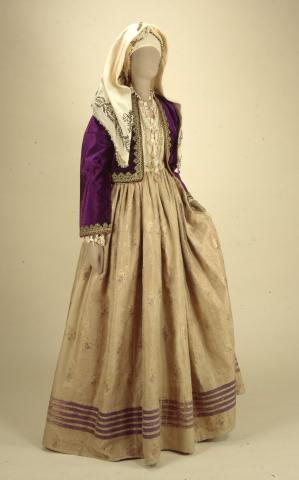
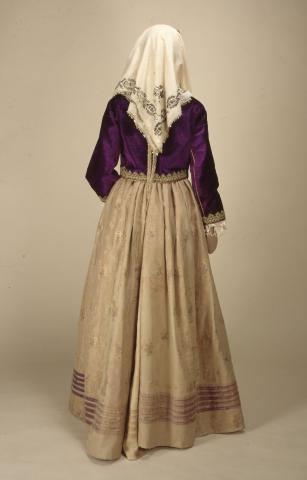
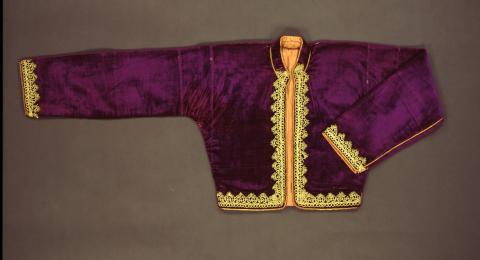
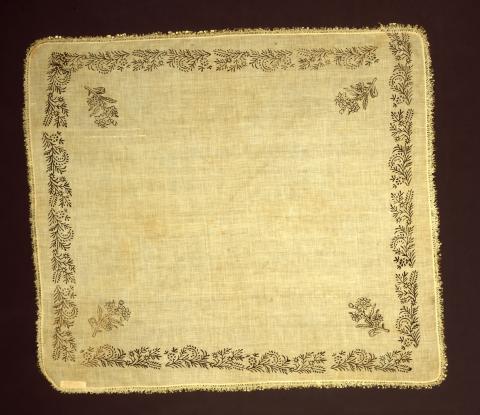
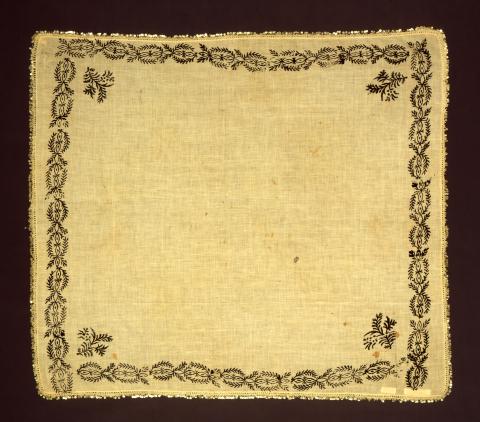
The costume of the village woman with festive dress consists of: the fustani (dress), the ypokamison (chemise), the sarka (sleeved jacket) and the headdress comprising two scarves.
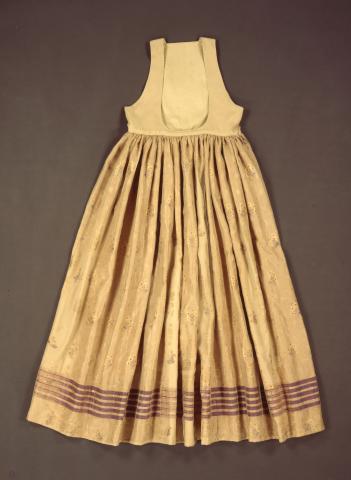
In the case of this costume, too, the basic garment is the long fustani (dress). It is made of beige silk brocade with bouquets of delicate flowers interwoven here and there in gold-yellow and mauve colours. Is has a sleeveless narrow bodice, a deep round opening at the breast, and a heavily pleated skirt gathered at the waist. The hem of the skirt is decorated with five parallel mauve velvet ribbons around the edge.
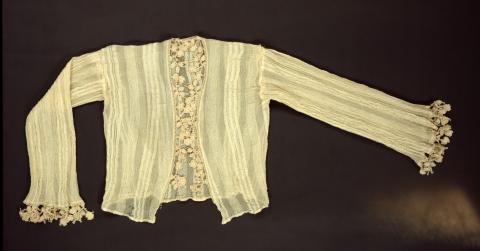
The short chemise is made of pure silk material woven on the loom, interwoven with stripes of natural colour. The openings on the chest and the sleeves are adorned with rich pipilla of the same colour, with delicate styled flowers.
The sarka, a short mauve velvet jacket is worn over the chemise. It has sleeves sewn vertically to the body, a small upright collar, and a vertical opening at the front. The decoration is confined to a thin band of gold braids sewn to it, forming harmonious floral patterns at the edges of the openings.
The headdress, which indicates the social status of the woman wearing it, consists of two printed kerchiefs. The inner one, which is folded carefully around the head, is made of thin mauve cotton material decorated with delicate flowers in dark colours. The outer one, which is folded into a triangle and worn loosely and casually above it, is made of kouroukla (white cotton material), with black (karakalemi) printed floral decoration consisting of continuous, narrow wreaths of printed patterns around the borders (kenarin) and branches with flowers in the corners. Around the edges it is decorated with needlework pipilla (lace) made of silk thread in its natural colour, with a row of sequins (poulia) on the finish of the pipilla.
Bibliography:
Rizopoulou-Egoumenidou, E. 1999: ‘Cypriot Costume at the End of the Nineteenth Century’, In Cypriot Costumes in the National Historical Museum. The World of Cyprus at the Dawn of the Twentieth Century. Athens, 192-201.
References/Remarks:
In G.S, Frangoudis’ words, this costume comprises: ‘‘… half-length shoes, socks, a fustani made of European silk, a sarka like that worn by Cypriot town ladies, and on the head, instead of fez, a kerchief, that is they wear two kerchiefs, like all village women, one worn as a cap and the other thrown carelessly over it. Gold coins adorn the breast. This costume is worn by village women at weddings, festivities, and church festivals, and can be found in different parts of the island… as for the shoes, the village women wear shoes or light footwear for formal occasions, and on work days they have heavy shoes with nails, like men’s shoes’’. Φραγκούδης, Γ.Σ., Ο Ριζοσπάστης, Εν Αθήναις, 1901, σελ. 37