

Woman from Karpasia with sayies
Gender information of the object:
Type:
Place:
Source:
National Historical Museum
Code:
94
Translator:
Euphrosyne Rizopoulou-Egoumenidou
Description:
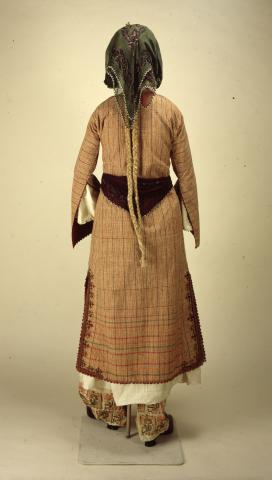
The costume consists of a silk ypokamison (chemise), elaborately embroidered vrakia (pantaloons), a sayia made of alatzia, printed kerchiefs for headdress, several pieces of jewellery and leather shoes.
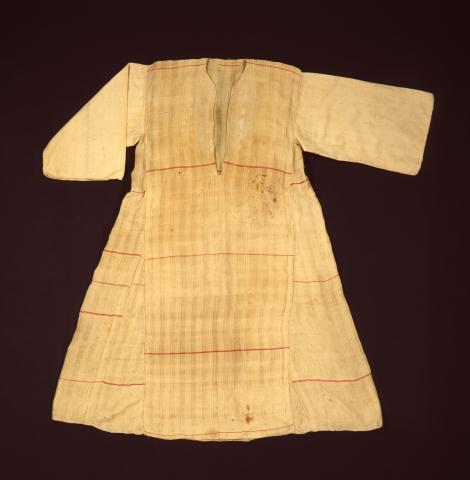
The chemise, made of taisto striped cotton-silk with single or double red stripes woven into it, has separately made striped cotton sleeves sewn vertically to the body. The back and front are made of a single piece, with no stitching at the shoulders. On the chest there is a vertical opening. All the stitching is by hand. The neck is trimmed with a handmade braid of red, yellow and green cotton thread.
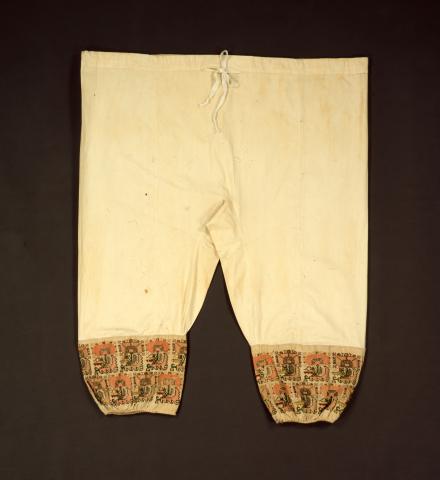
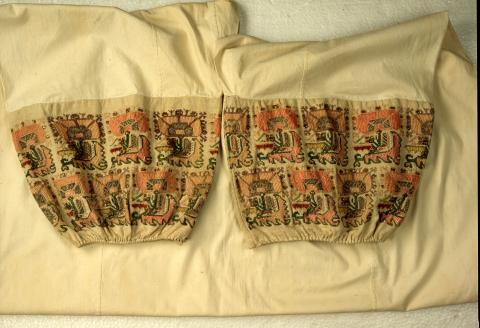
The vrakia (pantaloons) are made of white calico. They are gathered at the waist, and the podinaria reach down the ankle, where they, too, are gathered. The povratzia are made of a separate piece of thick cotton material woven on the loom and embroidered with gold and silk threads of dark and light red, green and terracotta-red. The pattern is embroidered with different stitches (typical of the tsevres embroidery) and consists of large and small stylised flowers and leaves. The pattern is repeated in two bands extending the full width of the material, leaving very little of it undecorated.
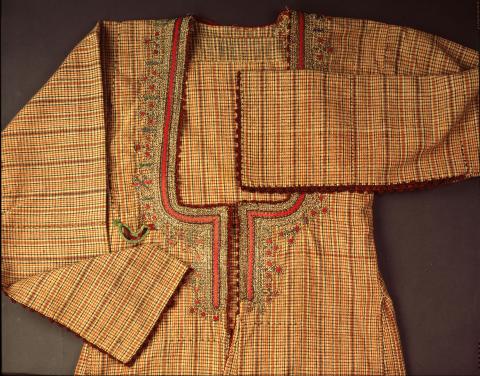
Above the chemise and pantaloons was worn the main garment, the sayia, which is made of thick cotton material (alatzia), in which are woven stripes and checks of multi-coloured threads. A different pattern is woven into a single piece at the bottom of the back. The back and the front of the sayia are made of a single piece of material. There is a semi-circular opening on the chest. The sayia is open vertically at the front and both sides. The long narrow sleeves are sewn vertically to the body, are open from the elbows down, and are lined with red cotton material. On the right side, beneath the breast, there is a semi-circular opening forming a pocket. All openings of the sayia are adorned with small needlework loops of twisted red cotton and silk threads, a simple form of papilla (lace). The chest and side openings are trimmed with a band of bright red felt, which is sewn on and flanked by gold and wool embroideries in the form of flowers and crosses.
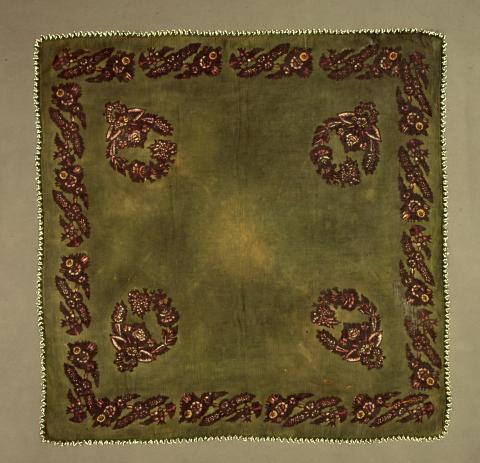
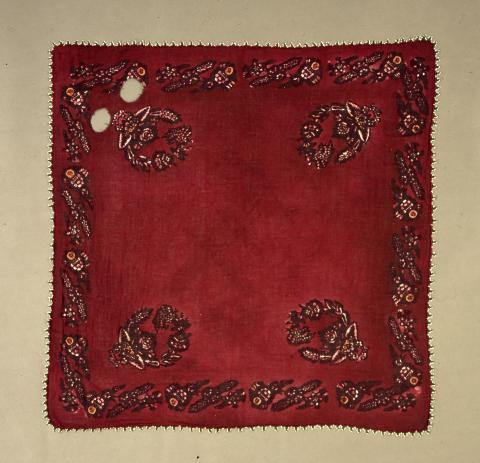
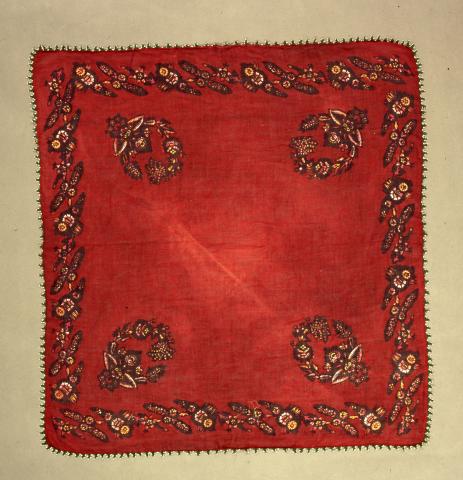
The headdress consists of two square kerchiefs, wound skilfully around the head. They are made of fine cotton material called kouroukla, one bright red and the other green. They are decorated with a row of printed floral motifs all around the edges, with a bouquet of flowers in each of the four corners. The outlines of the pattern are printed in black colour (karakalemi), and the flowers and leaves in red (tekkirin) and yellow colour. All around the edges, the kerchiefs are decorated with pipilla (lace) with the design of a cypress tree (kyparissoudi), worked in green and white silk thread. The slim waist is emphasised by a similar kerchief of a red colour.
The jewellery comprises the following:
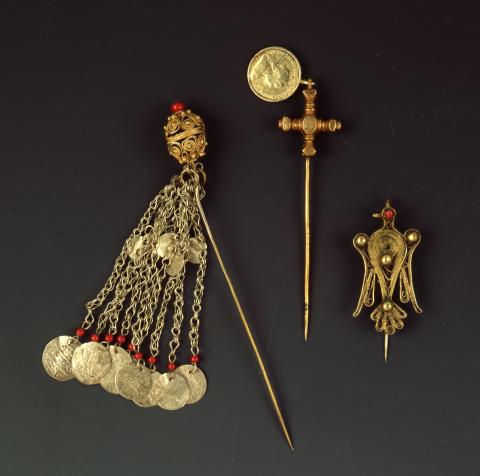
A gold-plated splinga (pin), which might be worn either on the kerchief or on the chest to close its opening. It has a head in the shape of a cross with stepped arms, with a ring at the end, from which a gold coin (grossi, piaster) was suspended. One side of this coin has a bust of the Queen Victoria and the other a crown and the date 19… Around the circumference can be seen the inscription CYPRUS (at the top) and PIASTRES (below).
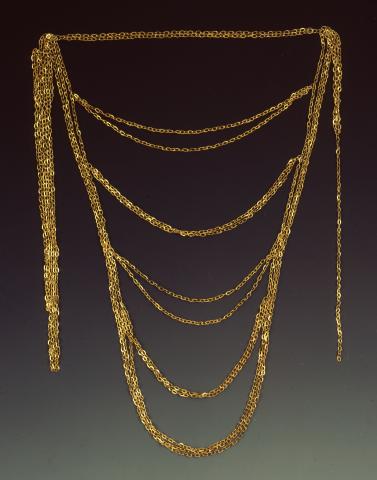
The breast is adorned with a myrmidi, a pectoral ornament consisting of interlinked thin gold chains. From the neck hangs a gilt filigree cross with toutounia , small hollow filigree balls, which alternate with coral-coloured beads. The cross itself consists of a central rosette with an inlaid glass stone at the centre and four teardrop-shaped arms with the pointed end outwards. Tiny totouunia are suspended from the ends of the three arms of the cross, and the spaces between them are adorned with red beads attached to calyx-shaped settings.
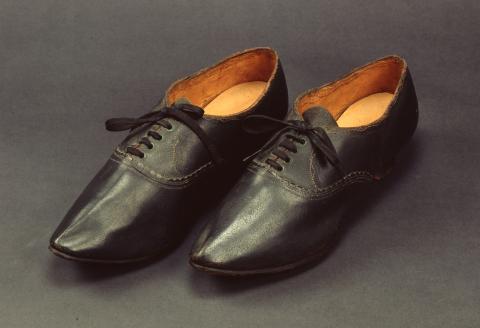
The costume is completed by black leather shoes. They have a low curved heel and pointed toes. The sole is nailed around the edges with wooden nails and the heel has little iron nails. The front part of the shoe ends in a row of delicate decorative tongues. On the inside there is a tongue with its left side sewn to the top of the shoe, where side pieces join and are fastened with a black lace. At the stitching and the openings there are hand-sewn stitches in straight and wavy lines.
Bibliography:
Rizopoulou-Egoumenidou, E. 1999: ‘Cypriot Costume at the End of the Nineteenth Century’, In Cypriot Costumes in the National Historical Museum. The World of Cyprus at the Dawn of the Twentieth Century. Athens, 170-181.
References/Remarks: