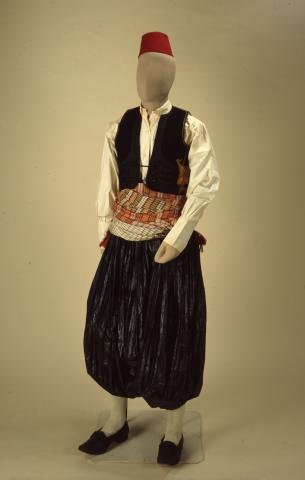
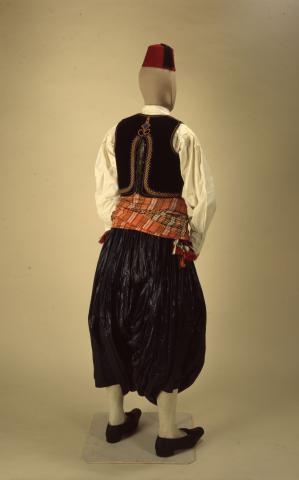
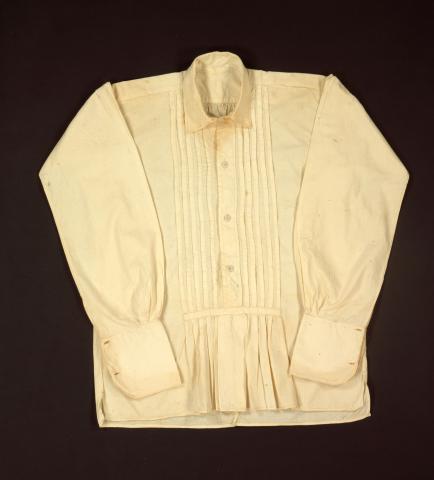


Townsman with starched vraka
Gender information of the object:
Type:
Place:
Source:
National Historical Museum
Code:
88
Translator:
Euphrosyne Rizopoulou-Egoumenidou
Description:
The costume consists of ypokamison (chemise), vraka (baggy trousers), yileko (waistcoat), kontogouni (sleeved jacket), ttalapouzi (sash), fez and shoes.
The chemise is made of white cotton material and has an upright collar and cuffs. The front consists of a single piece of material with an opening down to the waist, which is closed by four buttons. It is decorated with five vertical pleats on either side of the opening. The back consists of two pieces of material sewn together, gathered slightly where they join the shoulder.
The sleeves are sewn vertically to the body and end in six free pleats to which are attached cuffs fastened by two buttons. There are slits on both sides.
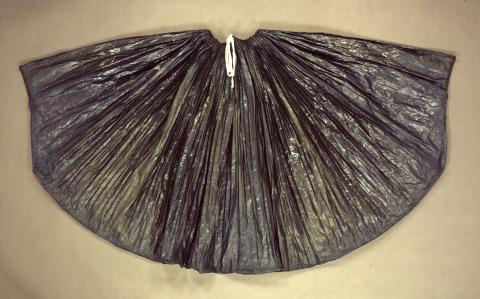
The broad, heavily pleated vraka is made of fine black starched cotton material. The lower parts of the podinaria are lined with white cotton cloth. The inside of the hems is trimmed with a striped silk seiriti, and there are three rows of black silk gaitania on the outside.
A multi-coloured sash, called ttalapouzi, encircles the waist and hips. It consists of three pieces of cloth sewn together with twisted orange silk thread. The use of different colours for the warp and the weft creates check-patterns set in a series of horizontal stripes. The ends of the sash have long multi-coloured fringes.
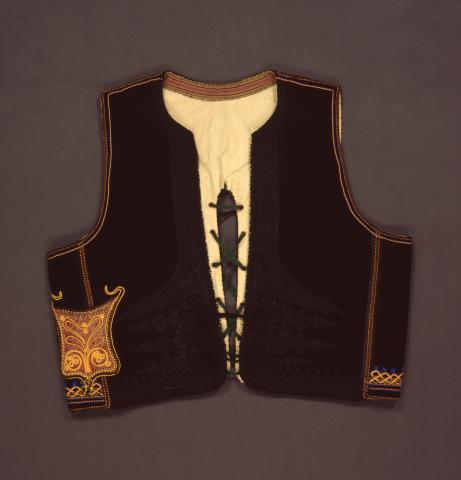
A velvet yileko is worn above the chemise. It is made of dark blue velvet at the front and black at the back, with a vertical opening at the front. The back and sides are made of a single piece of black velvet. The vertical slit in the back is cross-fastened by two ribbons, of blue and green colour. The front consists of two equal pieces of dark-blue velvet. At the bottom are three button holes trimmed with gaitania, to which are attached two loops made of gaitania and buttons braided of silk threads and ending in tassels. There is a semi-circular opening at the neck, around the inside of which is a striped silk seiriti like the one on the starched vraka. On the right side is a vase-shaped pocket made of mauve velvet decorated with silk braid in the form of a stylised floral pattern. Gold gaitania, multi-coloured twisted silk braids, seiritia and silk threads are used to create a variety of decorative motifs, scrolls, spirals, lozenges and wickerwork embroidery, which fill every surface. The yileko is fully lined with white cotton material, and the opening at the front is lined with black velvet. On the inside of the right side is an old pencil marking: ‘‘D. Savides’’ and ‘‘12 Ellinikon’’ a little lower down.
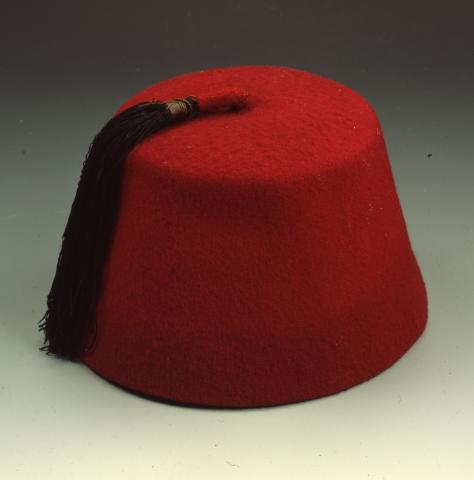
On the head is worn a fez of bright red felt with a black silk tassel.
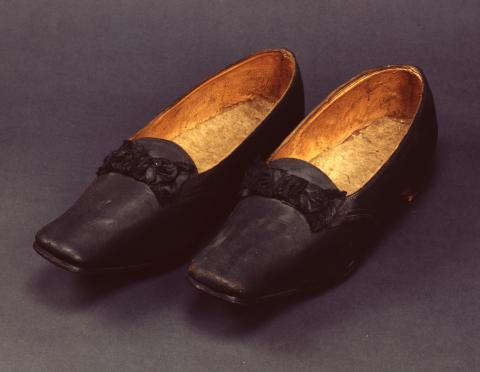
The costume is completed by black leather skarpinia with their long, rounded edges turned up. They have a low heel made of several pieces of thick leather. The heel is attached by iron mails, and the sole by means of wooden mails that can be seen on the edge of the underside. The upper part forms a tongue that is overlapped by the edges of the side pieces, which are covered by a silver bow. The inside of the back is lined with soft leather and the back half of the sole is covered by a thick piece of woollen cloth.
Bibliography:
Rizopoulou-Egoumenidou, E. 1999: ‘Cypriot Costume at the End of the Nineteenth Century’, In Cypriot Costumes in the National Historical Museum. The World of Cyprus at the Dawn of the Twentieth Century. Athens, 102-111.
References/Remarks:
G.S. Frangoudis described this costume as follows: ‘‘The vraka was formerly starched and young men walking about the alleyways took great pride in the swishing sound made by the vraka as they moved, like the starched skarpetes worn by ladies. Nowadays, however, the starched vraka, which is represented by the second male costume in the collection, is disappearing, to the point where the vraka has vanished entirely from the towns, in which Frankish dress has triumphed.’’ Φραγκούδης, Γ.Σ., Ο ριζοσπάστης, Εν Αθήναι, 1901, σελ. 35