
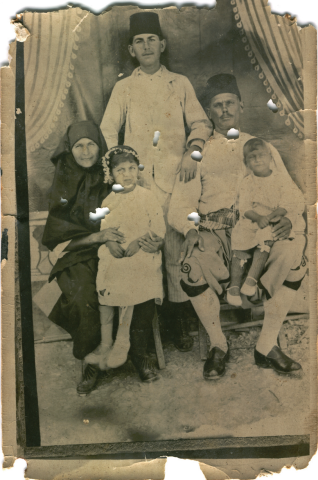
Photograph of Kunturacı Mus¬tafa Yeşiltaş with his family no. 19
Gender information of the object:
Color:
Type:
Primary Material:
Source:
The Aziz Damdelen Collection, Kioneli (Gönneli)
Village of Mora
Code:
81
Translator:
Euphrosyne Rizopoulou-Egoumenidou
Description:
Photograph of Kunturacı Mustafa Yeşiltaş with his family. It is a studio photograph, as shown by the painted background with drawn-back curtains, and was taken in 1922. Mustafa and his wife Emine are sitting with their children on their knees, the girl in her mother’s lap and the young boy on his father’s left knee. In the centre of the photograph, between the pair, is standing Nuri, Emine’s brother. Mustafa, the older man, wears an Ottoman fes (fez), a loom-woven cotton gömlek (shirt), şalvar, (baggy trousers) made of broadcloth (çufa turk. çuha) and decorated with spirals and other curvilinear motifs of twisted black braids sewn onto it, a polychrome silk guşak (sash, turk. kuşak) The silk polychrome sash around his waist was imported from Tripoli (tarablus turk. trablus) around the waist, white çorap (stockings) tied below the knee, and black elastic gusset ‘Cambridge’ shoes. As an accessory he has a köstekli saat (watch with chain). Emine Hanım wears the typical for Muslim women long black dress with çarşaf (veil this is a two- or three-piece); the veil covers the head and part of the forehead, and the front part of the çarşaf has buttons. Her front lace shoes or boots are also black. The young girl, her daughter Pembe, wears a yemeni (headscarf) ornamented with handmade lace with the motif of narcissus (nergiz) all around the edges; also a dress made of white cotton flannel cloth (bazen kumaş), handmade çorap (stockings) with tassels and bow-ties (püsküllü çorap fiyonklu) and white shoes, probably with a strap over instep, or boots. The young boy, Salih Yeşiltaş, wears a dress made of loom-woven striped cloth (alaca), hand-knitted lastikli çorap (elastic stockings) and button bar shoes. Nuri Erbaş wears an Ottoman fes (fez), a gömlek (shirt) made of loom-woven coarse cloth, probably made of cotton and silk (idare, in Gr.C.itares = fine cotton yarn, silk-cotton fabric with warp of fine cotton yarn; see Papademetriou 1991, 125), striped trousers of three quarters length, a white jacket and gonçlu potin (ankle boots).
Bibliography:
Rizopoulou - Egoumenidou, E. and Aziz Damdelen, 2012, Turkish Cypriot dress The Aziz Damdelen Collection, Nicosia, 131. Papademetriou, E. 1991: Cypriot Costumes, Athens, 125
References/Remarks:
Mustafa was a shoemaker, as denoted by his name (kunturacı), in the village of Mora. In 1923 he emigrated with his family to Antalya (Turkey), and, according to the law in Turkey, took the surname Yeşiltaş. Nuri stayed in Cyprus and became a grocer in Nico¬sia. (Mustafa Kunturacı was the older brother of Mehmet Kahkül. In 1923 they emigrated on the same ship to Turkey).
It is worth noting that in the past boys used to wear dresses (entari) until their circumcision, which took place at home, when they were about six years old.