
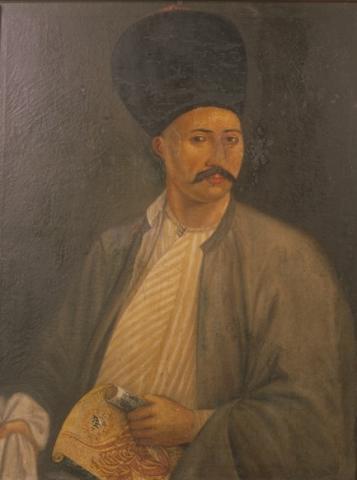
Portrait of Hadjigeorgakis Kornessios
Gender information of the object:
Color:
Type:
Primary Material:
Source:
Department of Antiquities
Code:
47
Translator:
Euphrosyne Rizopoulou-Egoumenidou
Description:
Hadjigeorgakis Kornessios, Dragoman of Cyprus (1779-1809) is wearing anteri (over a shirt which is not visible), tzouppe an outer robe with full sleeves and a short upright collar and kalpaki. The anteri is a long open gown crossed at the front, closed up to the neck with a series of three small buttons. The neckline is round. It is made of white silk fabric with golden stripes. Along the front the stripes run in opposite directions, indicating the design of the anteri. The edges of the long sleeves of the anteri are visible under the tzouppe. It is made of greenish fabric lined with white cloth. His Kalpaki (head-gear) has the shape of a mitre (kettle-shaped). This type of kalpak was made of fine black lambskin stretched upon pasteboard forms. On the top of the kalpak one can see the red stuffing, similar to that of the Boyars. On his right hand the Dragoman is holding a white kerchief and in the left hand a rolled firman (or berat). The head seems to be fully shaved. He also has a long black moustache.
Bibliography:
Rizopoulou - Egoumenidou, E.,1996, Urban dress of Cyprus during the 18th and 19th centuries, Nicosia. Rizopoulou - Egoumenidou, E., 1991, The House of the dragoman, Nicosia. Rizopoulou - Egoumenidou, E. and Damdelen, A., 2012, Aziz Damdelen, Turkish Cypriot dress The Aziz Damdelen Collection, Nicosia. Given, M. and Hadjianastasis, 2010, “Landholding and Landscape in Ottoman Cyprus”, BGMS, 34 (1): 38-60.
Ριζοπούλου-Ηγουμενίδου, Ε., 2020, Κατάστιχον Περιουσίας του Δραγομάνου της Κύπρου Χατζηγεωργάκη Κορνέσιου, Λευκωσία: Ίδρυμα Αναστάσιος Γ. Λεβέντης, 499-503.
References/Remarks:
1. The Portrait of Hadjigeorgakis in formal Ottoman court dress and prominently displaying his firman from the Sultan proclaims his identity as a member of the Ottoman elite. (Given and Hadjianastasis 2010, p 46)
2. This type of costume was complemented with tzaktziria (baggy breeches), usually red, onto which were sewn the mestia or meskia footwear made of Morocco leather in the priv¬ileged yellow colour.
3. Tzaktziria made of red şal (woolen cloth) are mentioned in the list of property of Hadjigeorgakis (1 τζακτζήριν του άρχωντος άλικον σαλίν.)