


Village woman with fustani
Gender information of the object:
Type:
Place:
Source:
National Historical Museum
Code:
92
Translator:
Euphrosyne Rizopoulou-Egoumenidou
Description:
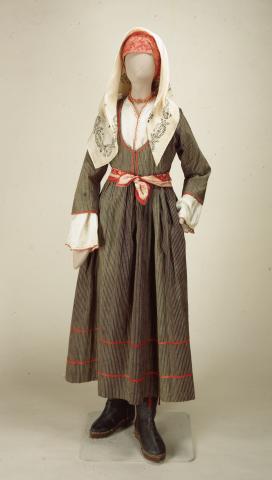
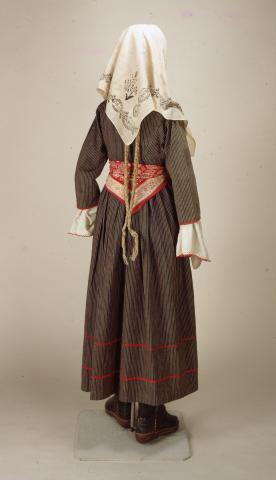
The costume consists of ypokamison (chemise), foustani (dress), two headscarves and a kerchief for the waist, a necklace and podines (boots).
The chemise is short and made of taiston cotton fabric (woven material with crinkled stripes running lengthwise). The back and front are made of a single piece, with no stitching on the shoulders. A straight piece of the full width of the fabric is used for each side, and extends to form the lower part of the sleeve, while another straight piece is used for the upper part. The V-shaped opening, and the hems of the sleeves are adorned with pipilla (lace) made of thick white cotton thread, and have a red finish.
The fustani is made of striped cotton alatzia, with green, white and red stripes in the warp and a blue cotton weft. It is entirely hand-sewn and has a body with a large semi-circular opening, passing beneath the breast, which is covered by the chemise. The long sleeves are attached to the body by sleeve-seams, as in modern garments. The long skirt is made of five pieces of material sewn together, with a thick gathering at the waist. The body and sleeves are lined with fine cotton fabric. The edges of the breast opening, the sleeves and the hem are decorated with a thin band consisting of two wool gaitania, one straight and the other wavy.
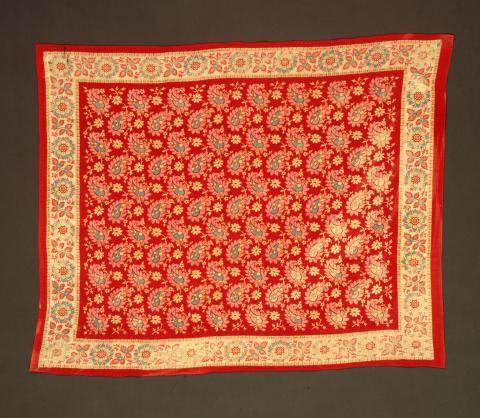
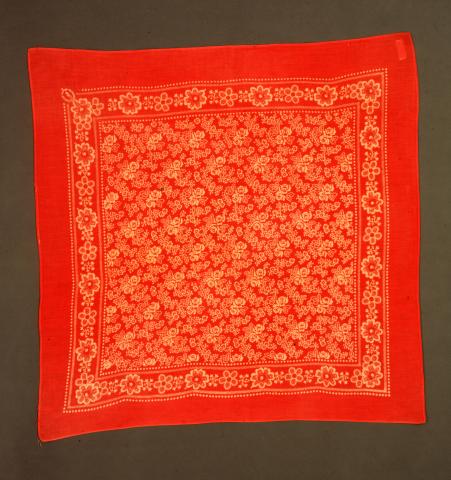
A kerchief of printed cotton fabric is tied around the waist. Around the edge of this is a coloured band of flowers against a white background. The rest of the kerchief is decorated with blue and red lahuri pattern, amongst which are branches with white flowers set against a red back ground.
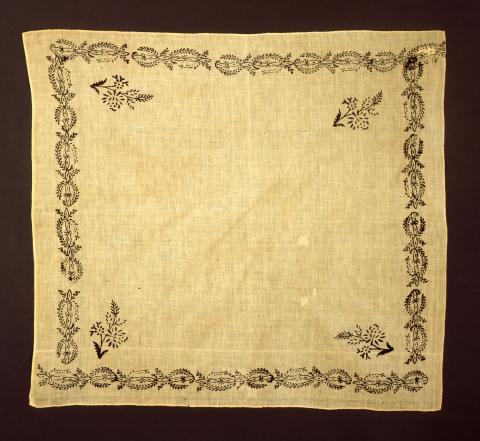
The head is covered by two square kerchiefs, one tied like a cap and the other worn loosely over it. The former is made of red cotton cloth with white floral decoration, and the latter is made of white cotton fabric with black printed decoration consisting of wreaths of flowers and branches.
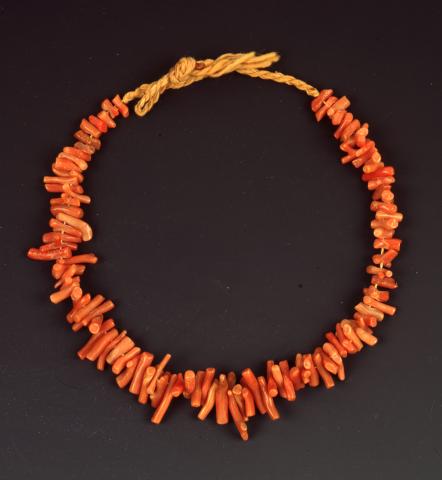
A necklace is worn at the neck consisting of pieces of unworked coral strung on braid of thick cotton thread.
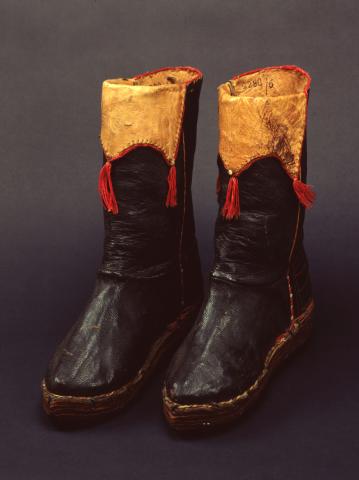
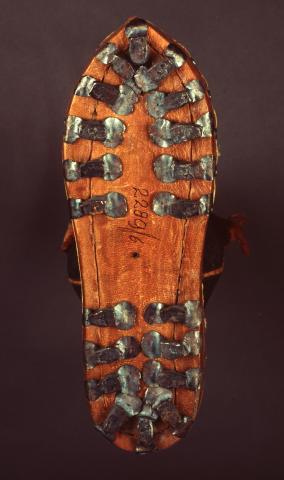
The podines (boots) come up to the middle of the thighs and are made of black leather with thick soles made of several pieces of leather. Each sole has 20 broad-headed rizes (iron nails), the ends of which are bent up at the edge of the sole, and secure a white and red decorative gaitani. The leather at the top of the front is folded back, ending in three points. A red gaitani is sewn to the finish of the boot and extends to these points, where it forms tassels. In the side stitching a white strip of the leather inside can be seen, and somewhat lower down, on the same line, there is a decorative element of red and white cotton thread. The heel is adorned with white stitches.
Bibliography:
Rizopoulou-Egoumenidou, E. 1999: ‘Cypriot Costume at the End of the Nineteenth Century’, In Cypriot Costumes in the National Historical Museum. The World of Cyprus at the Dawn of the Twentieth Century. Athens, 152-159.
References/Remarks:
According to G.S. Frangoudis: ‘‘the sixth female costume is quite commonly found and is generally worn in all the villages. Is consists of a garment made of a single piece of material, leaving open the breasts, which are confined by the chemise.’’ Φραγκούδης, Γ.Σ., Ο ριζοσπάστης, Εν Αθήναι, 1901, σελ. 37