Turk
Gender information of the object:
Color:
Type:
Primary Material:
3D object:
Code:
314
Translator:
Euphrosyne Rizopoulou-Egoumenidou
Description:
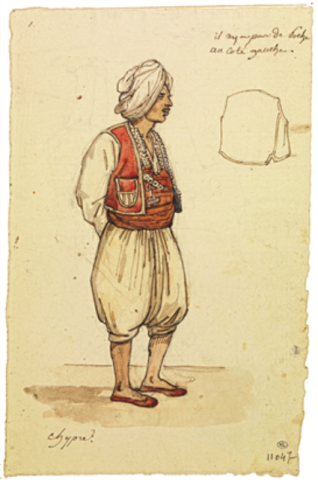
The drawing (R.F.7538) presents a Turk with moustache, who stands reluctantly with his hands behind his back. The nationality is indicated by the voluminous white sarık and the white baggy trousers, which are tied below the knee; short parallel lines probably indicate strings or fringes(?). A wide sash or belt (kuşak or kemer) is wound around the waist; this belt was used as a receptacle to keep several accessories and weapons; the decorated hilt of a knife protrudes from the belt in the middle. Over the shirt the man wears a waistcoat with decorative edging and a pocket on its right side. The waistcoat is red, as are also the wide sash around the waist and the flat shoes, probably made locally of Morocco-type leather. The legs are bare and light brown (sun-tanned) like the face. A drawing of the waistcoat in outline appears on the right side of the page, with a note above it, on the top of the page: ‘il ny a pas de poche au coté gauche’ (there is no pocket on the left side). The word ‘Chypre’ is written below the figure on the bottom left. Taking into consideration the scarcity of visual evidence, this detailed drawing offers a good idea of the appearance of the ‘Turks of Cyprus’, as they were called, at a time from which no actual garments have survived.
Bibliography:
Severis, R. C., Travelling Artists in Cyprus 1700-1960, London: Phillip Wilson Publishers Limited.
References/Remarks:
Antoine- Alphonse Montfort was so taken by the East that ten years later he returned with a friend named Leboux and visited Beirut, Jordan and Syria (1837-8). Their main interest was ethnographic, so much of Montfort's work comprises drawings of costumes and figures. their trip started from Toulon on 4 December 1836; it was on this voyage that Montfort revisited Cyprus. The two friends had to change ships at Larnaca, and Montfort took the opportunity of making two drawings, one Turk and some costume studies. (Severis 2000, page 95 fig 82)