
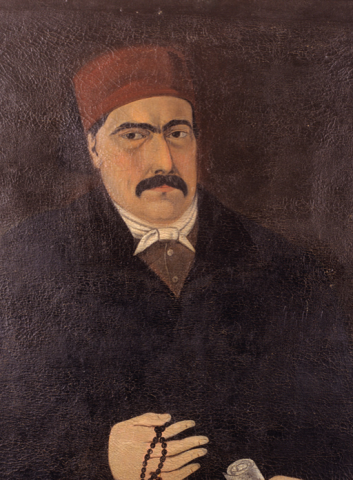
Portrait of Tzelepi Yiangos Georgiades

Gender information of the object: 
Color: 
Author: 
Euphrosyne Rizopoulou-Egoumenidou
Primary Material: 
Source: 
Department of Antiquities
Code: 
45
Translator: 
Euphrosyne Rizopoulou-Egoumenidou
Description: 
The portrait depicts Tzelepi Yiangos Georgiades, the youngest son of the Dragoman Hadjigeorgakis. It was painted by Constantinos Tak­katzis in 1852. He is presented wearing a red  Fesin (fez) and a thick black coat with a V-shaped opening, over a waistcoat closed with buttons up to the neck; a white cravat tied in a bow is shown un­der his chin. He has a moustache and short hair projecting under the fez (Turk. Fesin) at the temples. He wears a ring on each hand, and holds a rosary (string of beads) in the right and a rolled manuscript in the left hand. The name of the painter and the date 1852 are written with black ink on the manuscript. A ring similar to those depicted is still preserved as a family heirloom in the collection of his sister’s Mariora descendants. Tzelepi Yiangos is a typical case of the emerging new local elite, whose appearance reflected the western-style fashion promoted by the reforms in the Ottoman Empire.
Bibliography: 

Rizopoulou - Egoumenidou, E., 1991, The House of the Dragoman, Nicosia.1991, page 42, fig. 30. Rizopoulou - Egoumenidou, E., 1996, Urban dress of Cyprus during the 18th and 19th centuries, Nicosia. Rizopoulou - Egoumenidou, E. and Damdelen, A., 2012, Aziz Damdelen, Turkish Cypriot dress The Aziz Damdelen Collection, Nicosia. Rizopoulou - Egoumenidou, E., 1993, “Historical Background Sources and Documents”, in M. Pihler, A Dragoman’s House – The house of Hadjigeorgakis Kornesios in Nicosia, Copenhagen: The royal Danish Academy of Fine Arts School of Architecture Publishers, page 52, fig. 2.

Ριζοπούλου-Ηγουμενίδου, Ε., 2020, Κατάστιχον Περιουσίας του Δραγομάνου της Κύπρου Χατζηγεωργάκη Κορνέσιου,  Λευκωσία:  Ίδρυμα Αναστάσιος Γ. Λεβέντης, 271-272.

References/Remarks: 
1. Tzelepi Yiangos (as indicated by the title çelebi, Gentleman. Used before the reign of Mehmed II) was an educated person of high reputation. Following his repatriation from Constantinople in the 1830s, he regained part of his paternal property and was involved in public affairs on the island. 2. In Cyprus, as elsewhere, the fez (Turk. Fesin) as the head-cover imposed by Mahmud, was first adopted in the urban centres, and primarily by the upper classes who wore it in com¬bination with west European, Frankish (European) dress. The portrait of Tzelepi Yiangos Georgiades, is a representative example.