
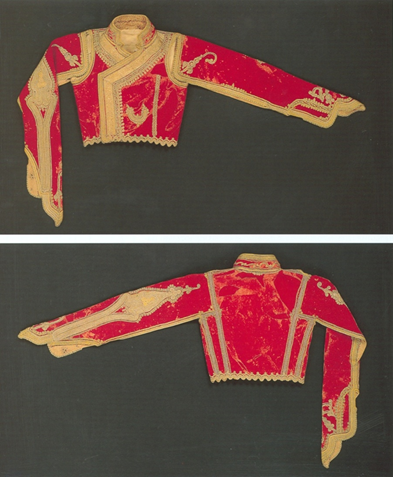
Fermeli braided waistcoast inv. no. 2309
Gender information of the object:
Type:
Primary Material:
Source:
National Historical Museum, Athens
Code:
44
Translator:
Euphrosyne Rizopoulou-Egoumenidou
Description:
Fermeli is men’s short sleeved waistcoat, richly decorated with gold braids; (from the Albanian fermele); it is recorded as fermeni, in Greek Cypriot documents.
The Fermeli is made of red felt. The back is of a single piece of material, and the front is made of two pieces fastened vertically by six buttons braided of naturally coloured silk thread. At the centre of the front there is a semi-circular false pocket formed of gold gaitania (turk. gaytan or kaytan, cotton or silk cord, twisted gold braid). The Fermeli has an upright collar and long sleeves, sewn vertically to the back and hanging free front. The sleeves and edges of the openings are richly trimmed with gaitania, forming a variety of spiral motifs. The opening at the front is further adorned with an attached gold-woven band in which flowers and zig-zag line are woven. The fastening loops are secured in position by an attached vertical gold band woven with gaitania and braids of twisted multi-coloured silk threads. The Fermeli is lined with white cotton material, and the collar and sleeves have a lining of striped cotton material adorned with printed garlands and bouquets of flowers.
Bibliography:
1999, Cypriot costumes in the National Historical Museum. The Word of Cyprus at the Dawn of the 20th Century, Athens.
References/Remarks:
According to the written sources, the Fermeli, a luxurious dress item which was worn in Cyprus at the end of the 18th century. It was forbitten to Christians to wear luxurious dress items like those of the Turks. Luxury in appearance was repeatedly condemned by the Orthodox Church. The Encyclical letter of 1797, threatened with excommunication those Christians who dared to wear dress items characterize of the conqueror’s apparel among others, “the gold embroidered red fermeni, the devils fermeni” (Codex A, p. 110)