female costume
Gender information of the object:
Color:
Type:
Primary Material:
Place:
3D object:
Code:
514
Translator:
Euphrosyne Rizopoulou-Egoumenidou
Petroula Hadjittofi
Description:
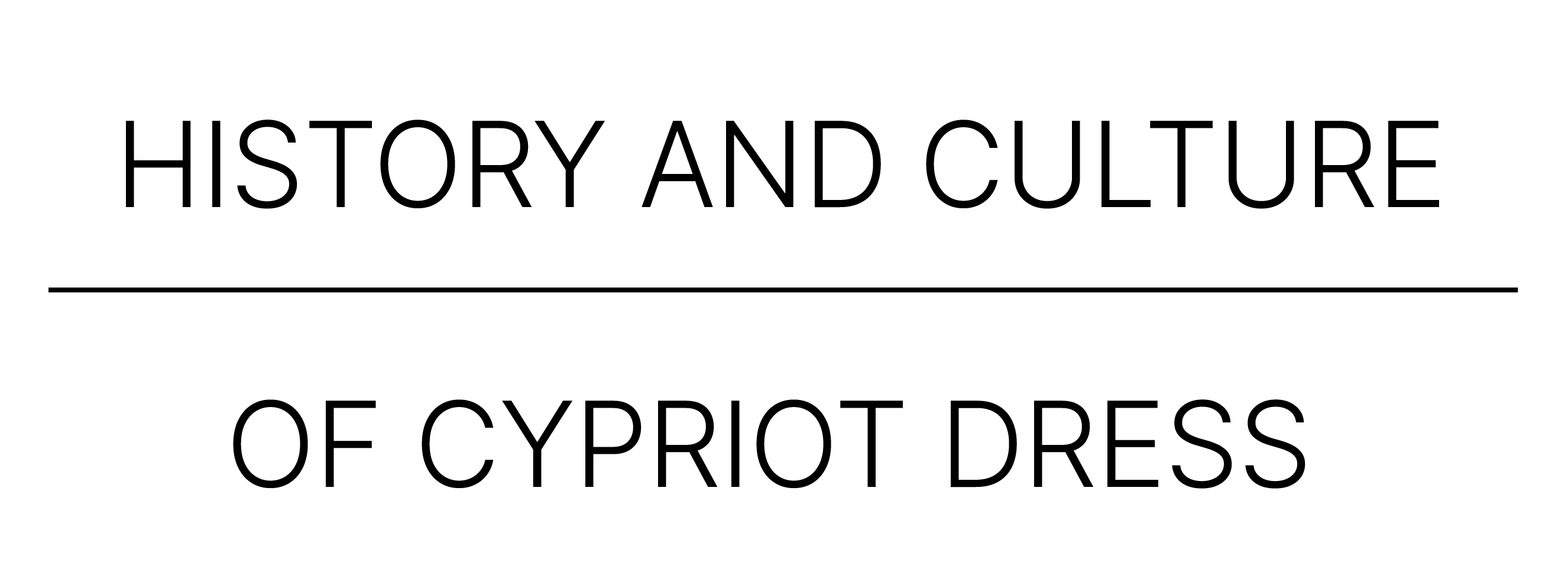
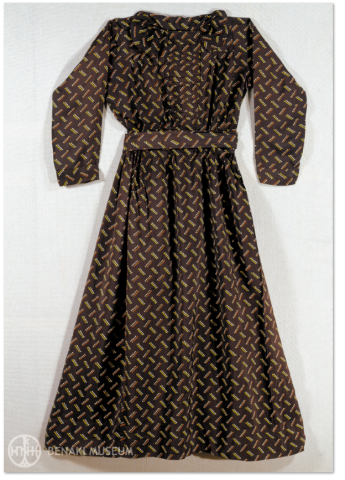
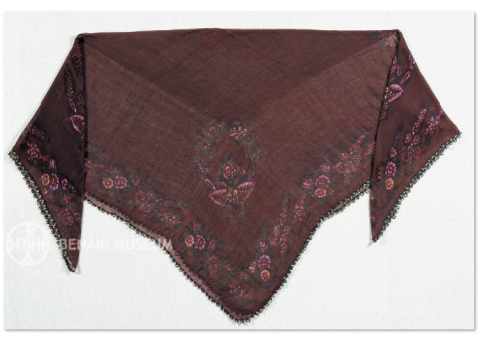
This later female costume (dress Inv. No. 245) comprises a dress (EE 3827), a tsemberi (EE 3828) and a pair of stivalia (EE 3829). Donated by “Demetra”, the Rural Local Union of Lysi, Cyprus, in 1973.
Inv. No. EE 3827: Dress made of European stamped fabric, with delicate pattern of five consecutive tiny triangles, repeated in two parallel rows. The white-, red- and yellow-coloured motifs appear scattered against a brown background. The dress consists of a separate, wide skirt made of three fabric panels, and a fitted top with narrow horizontal pleats forming a vertical decorative band at the chest. A vertical opening, formed along one of its sides, closes with clips. The dress has a round collar of the same fabric, and long sleeves with cuffs. The joint between the skirt and the top is covered by a belt of the same fabric.
The design of the dress follows pre-1950s’ fashion styles and denotes European influence. Such dresses were made by professional seamstresses, while simple traditional costumes were sewn and embroidered at home, by women themselves. Length of dress: 120 cm. Length and width of sleeves: 76x0,5 cm.
Inv. No. EE 3828: Tsemberi (headscarf) of kouroukla (thin cotton fabric), with stamped decoration on a brown background. The all-around print, the kkenarin, consists of a repeating floral pattern, formed with the use of oblong wooden moulds. The corners are also adorned with a milia pattern, a neoclassical-type wreath with leaves and flowers. The outline of the designs, the kara-kalemi, is black, with red and yellow as complementary colours, printed with different moulds. The design, which resembles that of other stamped headscarves in the Benaki Museum Collection, remained in use at the workshop of Kakoullis brothers until 2004.
The tsemberi is trimmed all around with continuous kamares (arches) of green thread, and knots of white thread. Dimensions: 70x70 cm.
Inv. No. EE 3829: Stivalia, pair of female black boots, made by a skarparis (shoemaker) (for their way of manufacture, see Ionas 2001, 471, 477). Their toe box is round, and their heel is low and curved (“Louis”), made of overlaid pieces of sole leather. Their shaft widens upwards, reaching up to the middle of the calf. They are fastened with 13 round leather buttons, arranged in a vertical row at the side of the shaft. Each boot consists of six pieces: two at the front, covering the toes and the upper part of the foot, one at the heel counter, two at the sides of the shaft and a strip bearing the buttonholes. The joints are machine-sewn, decorated with stitches and rows of small holes. Machine-made stitches form straight and zigzag or wavy lines, as well as stylized anthems. Two leather strips, sewn vertically along the entire front and back of the shaft, protrude at its upper end. They are decorated with stitches, forming consecutive rhombuses bordered by lines. Prokkouthkia (small nails) are employed at the heels.
The stivalia are accompanied by a small metal hook with an elongated shaft, curved into a loop at its back end. The hook, 11 cm. long, was used to fasten the boots. Height of boot: 36 cm. Width of top opening: 25 cm.
Bibliography:
Ριζοπούλου-Ηγουμενίδου, Ε. 2010: Η Κυπριακή Εθνογραφική Συλλογή του Μουσείου Μπενάκη, Αθήνα, p. 142