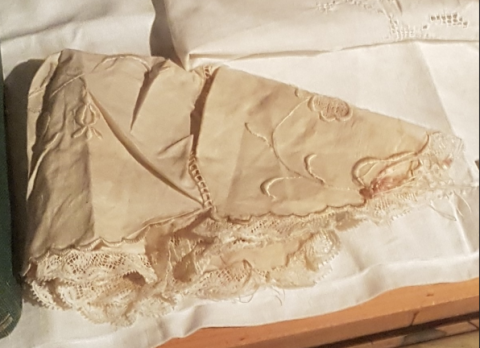
Christening hat belonging to Vartouhi Tavihan (Βαρτουχί Ταβιχαν) from Seleukia. The beige hat with flower embroidery and lace around the perimeter, is one of the pieces they embroidered for sale.
Her family created very fine embroideries by the end of the 19th century. It was the cousin of Mr. Klathig HadjiTarihan, Mrs. Ahahid Parazian, who taught Miss Varrouhi Tavihan how to embroider. During the war, they left Bandirma (Panormos) and took refuge to Kavala, wherefrom they exported their embroidery to Germany. This was the sole income they earned as refugees.
3D object:
3D object
Translator:
Euphrosyne Rizopoulou-Egoumenidou
Noly Moyssi
Charlotte Steffen
Author:
Euphrosyne Rizopoulou-Egoumenidou
Noly Moyssi
Description:
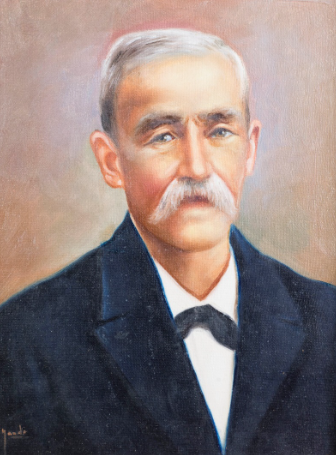
Artin Melikian is depicted in the painting wearing a dark blue, western-style suit with a matching bow tie. He is also wearing a white shirt, with his hair and facial hair styled in a western fashion.
3D object:
3D object
Translator:
Euphrosyne Rizopoulou-Egoumenidou
Author:
Euphrosyne Rizopoulou-Egoumenidou
Description:
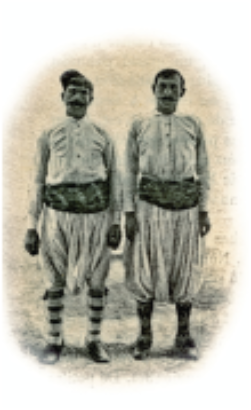
Two Turks from Lefka a village mostly inhabited by Muslims; the two men stand side by side and wear similar traditional clothes, namely, light-coloured shirts, white many-folded trousers tied below the knees, a colourful sash at the waist, stockings and flat shoes. One of them also wears a fez set askew on the head; his striped stockings are tied under the knee. The stockings of the other man are patterned (Deschamps 1898, 182; Lazarides 2005, 166).
3D object:
3D object
Translator:
Euphrosyne Rizopoulou-Egoumenidou
Author:
Euphrosyne Rizopoulou-Egoumenidou
Description:
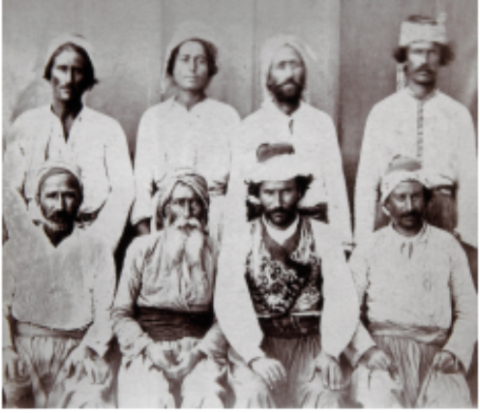
The photograph ‘Some of my Turkish Diggers at Cyprus’ presents eight men, four seated in a row and another four standing behind them. All of them wear the baggy, pleated vráka with a sash around the waist; their vráka is white except for two men, who wear a dark-coloured, probably black vráka tied at the waist with a string. Most of the upper garments, shirts and sleeved jackets, apparently of loom-woven striped cloth, are also of light hues. Only a young man seated in front wears a brilliant waistcoat crossed over the chest and made of a flower-patterned fabric. His head bears a tall fez with a tassel falling to his right side and a white headscarf wound around the lower part of the fez. The head-kerchief of the bearded old man sitting next to him is probably of printed fabric. The headdress of the other men presents a variety of the same type, namely fez or red cap wrapped with a scarf.
3D object:
3D object
Translator:
Euphrosyne Rizopoulou-Egoumenidou
Author:
Euphrosyne Rizopoulou-Egoumenidou
Description:
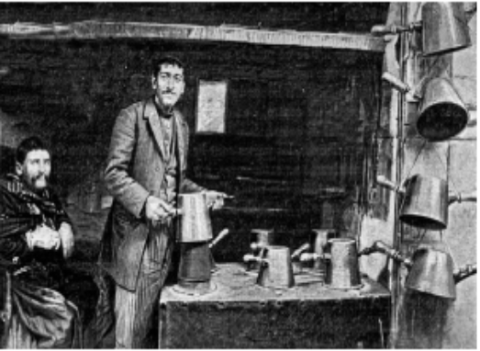
A fez workshop in Nicosia, depicted by Oulevay in the 1890s shows a craftsman, dressed in western-style costume and fez, blocking a fez with a mould; more moulds are placed on the same table and other examples are hanging on the wall (Deschamps 1897, III, fig. 171; Deschamps 1898, 51).
3D object:
3D object
Translator:
Euphrosyne Rizopoulou-Egoumenidou
Author:
Euphrosyne Rizopoulou-Egoumenidou
Description:
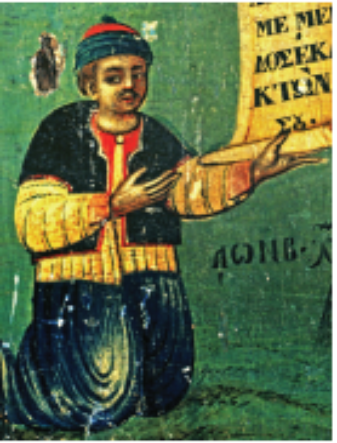
Donor wearing blue baggy trousers in an icon of 1852. The icon depicts the Transfiguration on the upper part, and Saint John Prodromos with the kneeling donor on the lower part. Church of the Transfiguration, Kato Mylos, Limassol district.
The Christian Orthodox donor wears blue wide trousers (vraka) in combination with a striped shirt and over it a red waistcoat and a dark blue jacket.
3D object:
3D object
Translator:
Euphrosyne Rizopoulou-Egoumenidou
Author:
Euphrosyne Rizopoulou-Egoumenidou
Description:
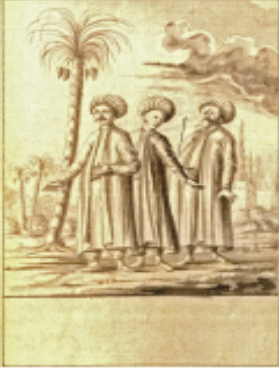
Three Ottoman Turks are presented in a landscape with palm trees. They are peasants carrying goods for selling – one of them holds a steelyard for weighing. They are dressed with the typical upper class costume, namely a long robe (cüppe) over the entari, under which are seen pantaloons reaching down to the ankles, and flat leather shoes. A voluminous turban completes their attire. (sarik)
3D object:
3D object
Translator:
Euphrosyne Rizopoulou-Egoumenidou
Author:
Euphrosyne Rizopoulou-Egoumenidou
Description:
A few years later, in 1881, an amateur painter, Colonel Benjamin Donisthorpe Alsop Donne, painted two watercolours presenting ‘A Greek Peasant on the Limassol Works’ and ‘A Turkish Cypriot Worker’, respectively, as if he wanted to urge us to compare the appearance of the two. Both wear their traditional costume, each part of which is accurately depicted: the Greek (shown from the front) wears a black waistcoat crossed over the chest and with two oblique rows of buttons, over a white shirt, black baggy trousers (vráka), which meet the black top boots under the knee, a crimson broad sash at the waist and a crimson fez with a striped headscarf round it.
3D object:
3D object
Translator:
Euphrosyne Rizopoulou-Egoumenidou
Alexander-Michael Hadjilyra
Charlotte Steffen
Author:
Alexander-Michael Hadjilyra
Charlotte Steffen
Description:
Apisoghom Utidjian (1853-1929) arrived in Cyprus from Constantinople shortly after July 1878 and stayed in the island until his death. He worked as the official state translator and chief interpreter to the colonial British government from 1878 to 1919. He was an educated person with a great professional career. In the photograph he is presented at an advanced age. He is wearing a dark western-style formal suit with a vest over a white pressed shirt with a high collar and a white bow tie. The jacket is decorated with several medals and one can also see the chain of a pocket watch attached to a button hole of the vest.
3D object:
3D object
Translator:
Euphrosyne Rizopoulou-Egoumenidou
Alexander-Michael Hadjilyra
Charlotte Steffen
Author:
Alexander-Michael Hadjilyra
Charlotte Steffen
Description:
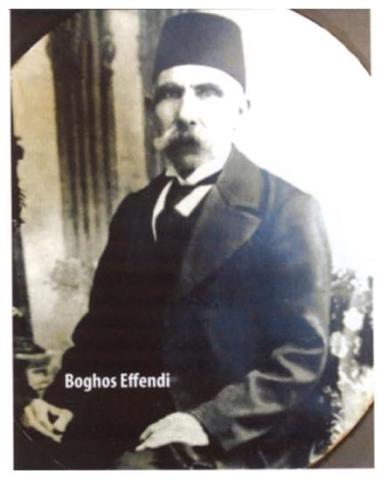
Photograph of Boghos Eramian Effendi (1840-1918), the seventh child of Artin Boghos Eramian and Caterina Luigi Carletti. The photograph was taken in a studio and it shows Boghos in an advanced age. He is dressed in a western-style black suit with an overcoat made of a thick fabric, a vest and a white high-collared shirt. The costume is complemented with a black tie and a tall fez.