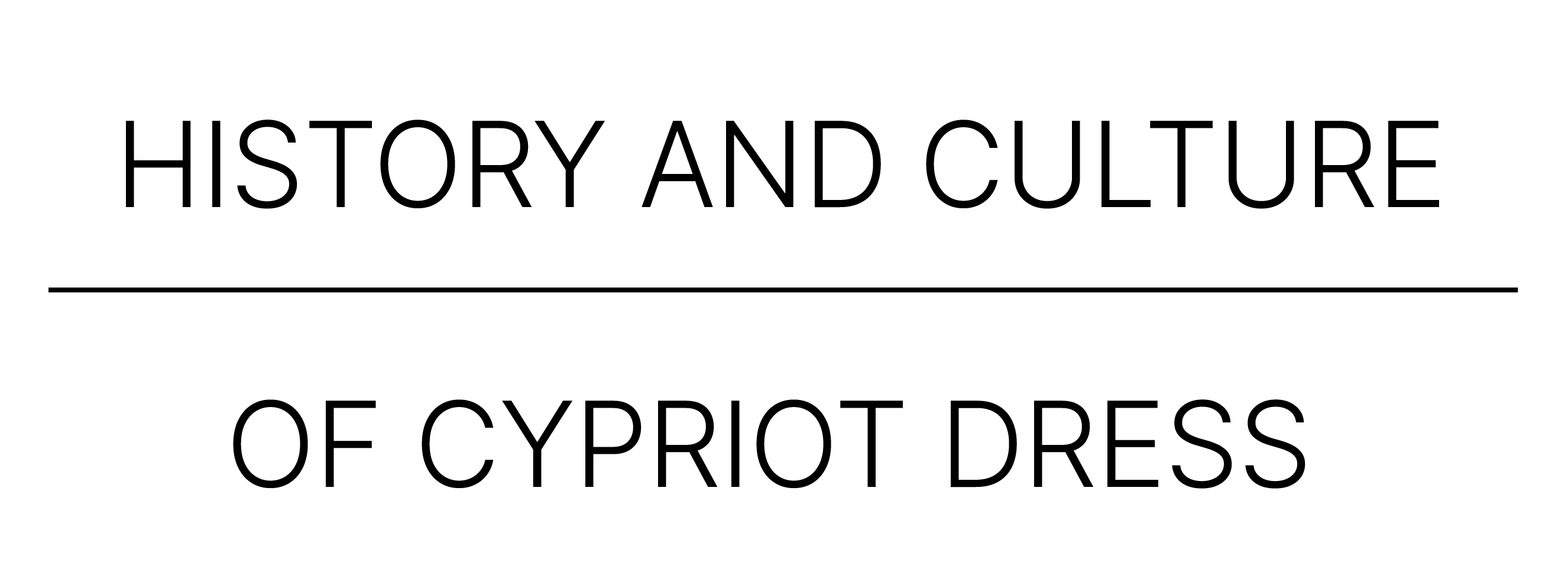
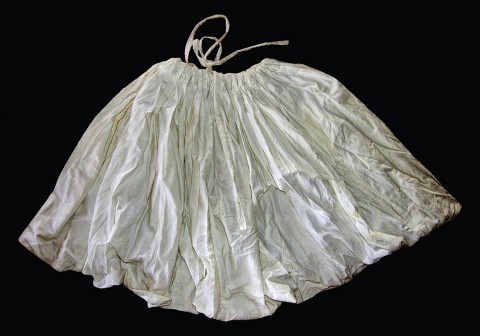
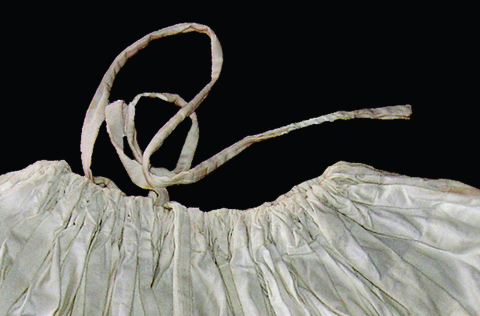
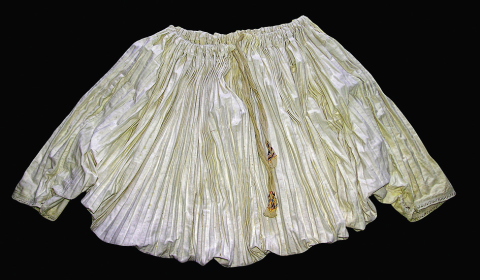
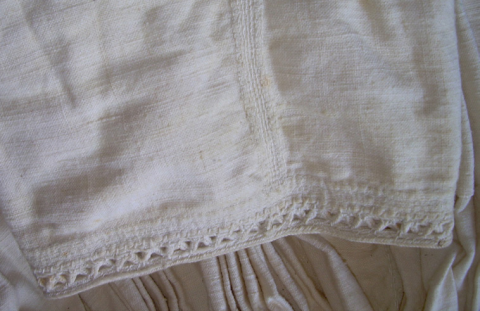
White silk cotton shirt made of taisto fabric, with lengthwise puckered bands created by warp threads of two different tensions. The original shirt was long, and it has been altered. There is a vertical opening at the chest, measuring 22 cm. The long and broad sleeves are sewn lengthways onto the body, which is made of one piece of fabric. The neck opening and its continuation on the chest, as well as the edges of the sleeves, are decorated with off-white pipilla, a fine lace made with a sewing needle, in a pattern of continuous little flowers.
Dimensions: height 70 cm. chest width 65 cm. Sleeves: length 53 cm. width 23 cm.
3D object:
3D object
Translator:
Euphrosyne Rizopoulou-Egoumenidou
Noly Moyssi
Charlotte Steffen
Author:
Euphrosyne Rizopoulou-Egoumenidou
Noly Moyssi
Description:
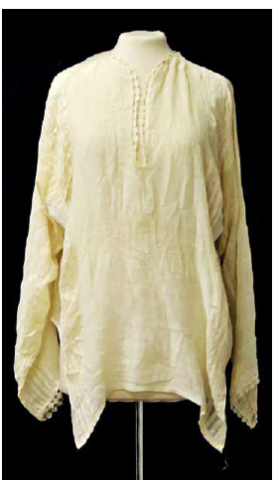
Christening hat belonging to Vartouhi Tavihan (Βαρτουχί Ταβιχαν) from Seleukia. The beige hat with flower embroidery and lace around the perimeter, is one of the pieces they embroidered for sale.
Her family created very fine embroideries by the end of the 19th century. It was the cousin of Mr. Klathig HadjiTarihan, Mrs. Ahahid Parazian, who taught Miss Varrouhi Tavihan how to embroider. During the war, they left Bandirma (Panormos) and took refuge to Kavala, wherefrom they exported their embroidery to Germany. This was the sole income they earned as refugees.
3D object:
3D object
Translator:
Euphrosyne Rizopoulou-Egoumenidou
Noly Moyssi
Charlotte Steffen
Author:
Euphrosyne Rizopoulou-Egoumenidou
Noly Moyssi
Charlotte Steffen
Description:
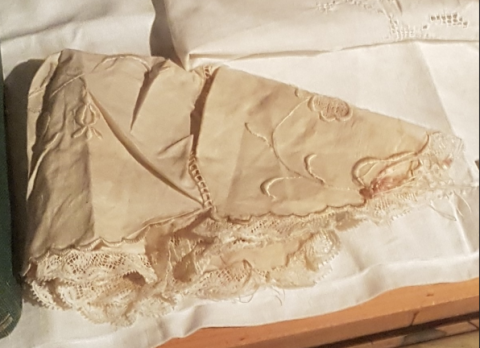
Nightgown and underwear belonging to Haiganoush HadjiTantian (Χαϊγκανούς ΧατζιTαρατιάν) Both pieces were made of woven silk fabric in off-white colour and were decorated with fine embroidery around the neckline and the hem. Originally, they belonged to Haiganoush’s mother-in-law.
3D object:
3D object
Translator:
Euphrosyne Rizopoulou-Egoumenidou
Noly Moyssi
Author:
Noly Moyssi
Description:
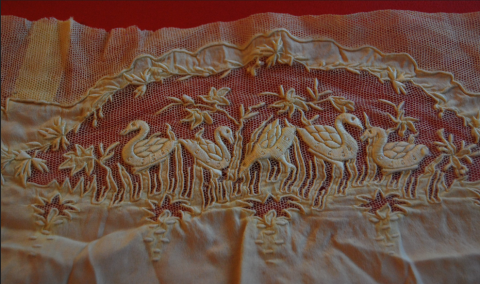
A small piece of Zabelle Melikian's wedding veil. The tulle features embroidered swans in their natural habitat.
Translator:
Euphrosyne Rizopoulou-Egoumenidou
Author:
Euphrosyne Rizopoulou-Egoumenidou
Description:
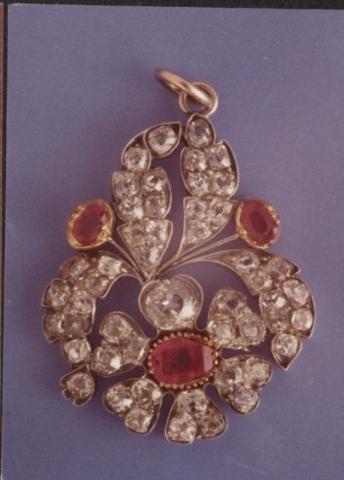
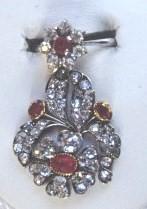
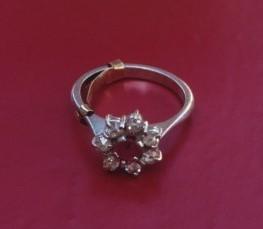
Originally, each medallion formed the lower part of an earring. The lower part of the earing is oval in shape and consists of a six-petal flower and four leaves. The centre of the flower is occupied by a big ruby. There are two more rubies between the leaves, one on either side. In the second medallion one ruby is missing. The surface of the petals and the leaves are set with diamonds, 50 in total. (height: 3cm width: 2,5 cm). Allegedly the upper part of the earring was transformed into a modern ring. This part consists of a big ruby in the centre and seven diamonds around it, forming a flower.
Translator:
Euphrosyne Rizopoulou-Egoumenidou
Author:
Euphrosyne Rizopoulou-Egoumenidou
Description:
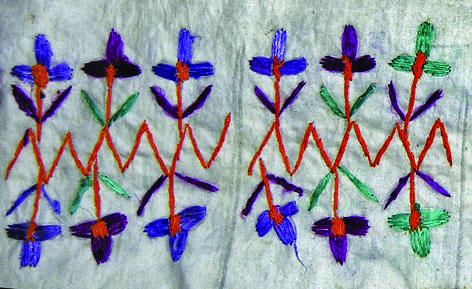
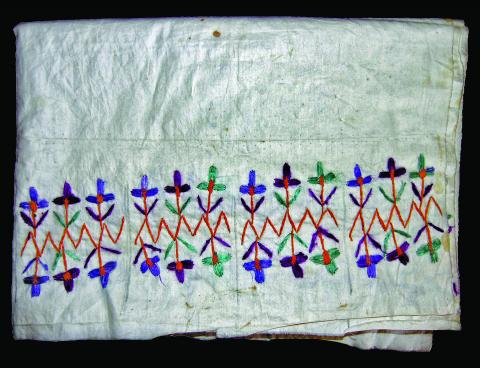
White cotton cloth with loom-woven selvedge on one long side; the other three sides are cut. On both narrow ends the same embroidered pattern, a row of eight groups of flowers, is repeated eight times. Each group is a synthesis of three flowers repeated on either side of a horizontal zigzag line running in the middle. Each flower has three petals and one leaf on either side of its stem, forming a V. The embroidery is made with simple filling stitch (dolgu işi). All stems and the zigzag line are embroidered with orange thread in backstitch (iğne ardı; ardın ardın = backwards) or sap işi stitch (sap = stalk, stem, also to deviate, to turn off in a different direction). The flowers are mauve and lilac, only six of them completely green. The same colours are used for the leaves. Between each group of flowers, on both sides, there are vertical lines made with a pencil to mark the cutting in order to make eight separate girdles (uçkur/uşgur). Width: 76cm, 9.5cm for each girdle. Length: 2.10m.
Translator:
Euphrosyne Rizopoulou-Egoumenidou
Author:
Euphrosyne Rizopoulou-Egoumenidou
Description:
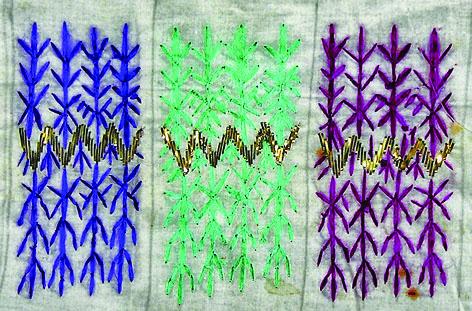
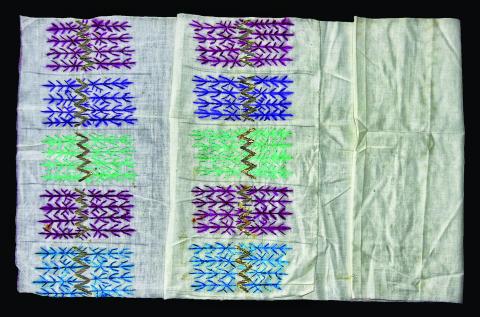
Waist girdle (uçkur/uşgur) made of cotton cloth, with hand embroidery on both narrow ends. The decoration consists of five groups of patterns, each comprising four long stems with branches in different colours; from right to left, the motifs are purple, bluish-mauve, light green, then again purple and bright blue. Through the middle of each group runs a horizontal zigzag line embroidered with thin gold metal wire (tel). The other end is decorated with the same patterns in corresponding colours. The edge of one long side is formed by a loom-woven selvedge (kenar), while the other side is simply cut. Probably, it was intended to make five long and narrow girdles out of this piece. This is indicated by a pencil line, which separates each group, marking the strips which would form separate girdles. Width: 38cm. Length: 1.53m.
Translator:
Euphrosyne Rizopoulou-Egoumenidou
Author:
Euphrosyne Rizopoulou-Egoumenidou
Description:
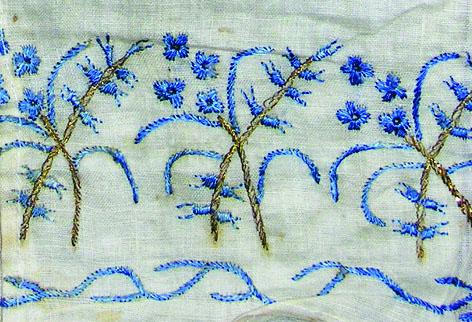
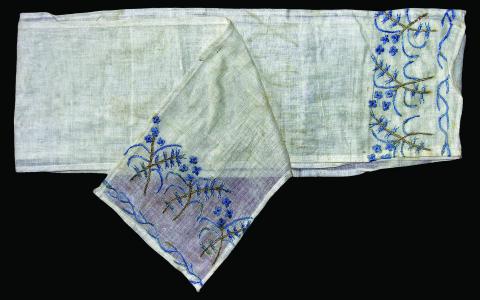
Waist girdle (uçkur/uşgur) made of loosely woven cotton cloth. Both narrow ends are embroidered at the ends with flower patterns – three groups of blue flowers at each end – consisting of two crossed sprigs with different flower motifs. The stems are embroidered with gold metal wire (tel). Under the flowers runs a wavy tendril (filiz) in blue. There is a machine-made seam on all four sides. Width: 16.5cm. Length: 2.00m.
Translator:
Euphrosyne Rizopoulou-Egoumenidou
Author:
Euphrosyne Rizopoulou-Egoumenidou
Description:
Turkish Cypriot men’s breeches (vraka, turk. dizlik) made of white, loom-woven cotton cloth. Two equal pieces form both the front and back of the body part. At the waist they are gathered with pleats and held in place by a plain white girdle (turk. uçkur/uşgur) which runs through a hem 5cm deep. Below the waist, on both sides, is a vertical slit 17cm long. The total width of the breeches (turk. Dizlik) is 2.16m and the total height 70cm. The leg parts, which are folded lengthwise and stitched to the body piece, have the same height and reach down to the knee (turk. diz), according to the meaning of the term dizlik. At the extremities they have openings 20cm wide for the legs. The edges of these openings are reinforced and ornamented with three series of machine stitches. At about the middle of the height of the leg piece, is a decorative horizontal band consisting of a zigzag line bordered by a series of stitches. This dress item is very well preserved.
Translator:
Euphrosyne Rizopoulou-Egoumenidou
Author:
Euphrosyne Rizopoulou-Egoumenidou
Description:
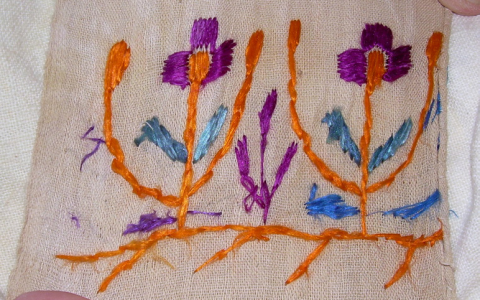
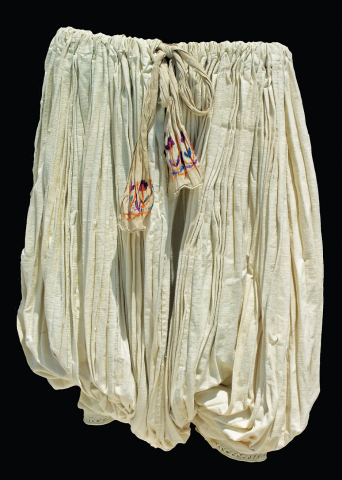
Pleated baggy trousers (vraka, turk. şalvar) made of white cotton cloth. The middle part consists of six pieces stitched together. Each piece is 50cm wide and the whole length is 1.48m. Each side part, for the legs, is made of four pieces sewn together by hand. The upper part of each side is 47cm wide and 15cm long. The lower part is one piece of the same width (47cm) and 20cm long, while the lowest part, which is attached with a thicker join with stitches, consists of two rectangular pieces of the same dimensions (each piece 23.5cm wide, and 42.5cm long), connected lengthwise. This part narrows downwards because of the gathering and ends to the opening for the leg, which is 21cm wide. Next to the main opening, on the inside, there is a small slit, 5cm long. All around the opening are handmade braids (Turk. kaytan/gaytan) of the same cotton material. Another braid forms a wavy line and this is stitched to a double outer braid. At the waist the cloth is turned and stitched to form a casing through which to pass the drawstring/band (Turk. uçkur/uşkur). It is made of a length of dark beige cotton fabric, 10cm wide, whose ends are decorated with silks forming two flowers with leaves, in orange, lilac and blue colours. The embroidery is simple and naïf. Many of the pleats are still sewn together, indicating that the vraka was not used. Tradition has it that the reason for this was that the person to whom it belonged died soon after his wedding. It was not a wedding vraka, but it was brand new, made as part of the groom’s clothing. After his death nobody wanted to use it. The white colour was typical for the baggy trousers of the Turkish Cypriots.