Coloured

Translator: 
Euphrosyne Rizopoulou-Egoumenidou
Author: 
Euphrosyne Rizopoulou-Egoumenidou
Description: 

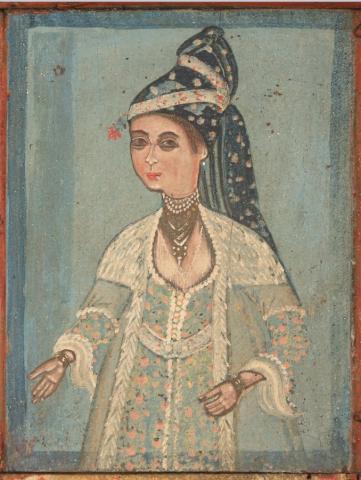
The portrait of a lady is painted on the wooden case of a grandfather clock. She wears a fine-spun white shirt trimmed with lace at the edges, over the shirt she wears an anteri (open gown) made of a fabric with floral pat­terns. It has a big round opening on the chest is closed with a series of buttons down to the waist. At the waist it is secured by an embroidered belt with round buckles. On top of the anteri she wears a tzouppe (long robe) lined with spot­ted ermine fur. The fabric show delicate reddish flowers on a background in shades of green. A high, headdress swathed in flower-patterned scarves, as well as jewellery (earnings, pearl and other necklaces, bracelets), complete the attire. Part of the hair is projecting from the headdress along the temples. A red flower is attached to the scarf decorating the right part of her face. Her eyes are outlined with holla (kohl), and the lips are painted red. 

Translator: 
Euphrosyne Rizopoulou-Egoumenidou
Author: 
Euphrosyne Rizopoulou-Egoumenidou
Description: 

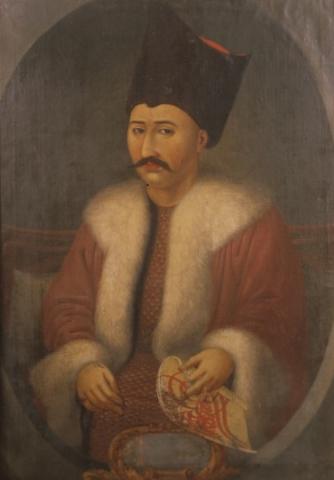
Hadjigeorgakis Kornessios, Dragoman of Cyprus (1779-1809) is wearing anteri (over a shirt which is not visible), a belt around the waist, tzouppe lined with fur (gunna), and kalpaki. The anteri is a long dress closed up to the neck, with a round neckline. It is made of luxurious red fabric, most probably brocade, covered with scale patterns in golden colour.  Tzouppe is a long red robe lined with white fur most probably ermine. The fur forms the inner side of the long overcoat and can be seen around the neck, along the opening in front and at the lower edge at the sleeves. The tzouppe is covered outside with a valuable cloth in red colour, symbol of power. The kalpaki is two-pointed and is consists of a red cap made of telâtin surrounded by sable fur. The red telâtin (Russian leather) is clearly visible on the top of the headdress. In his right hand he is wearing a ring set with a ruby and in his left hand he is holding a firman (or berat).The head seems to be fully shaved. He also has a long black moustache. The dragoman is sitting on a wooden sofa with cushions made of silk blue-grey striped cloth. 

Translator: 
Euphrosyne Rizopoulou-Egoumenidou
Author: 
Euphrosyne Rizopoulou-Egoumenidou
Description: 

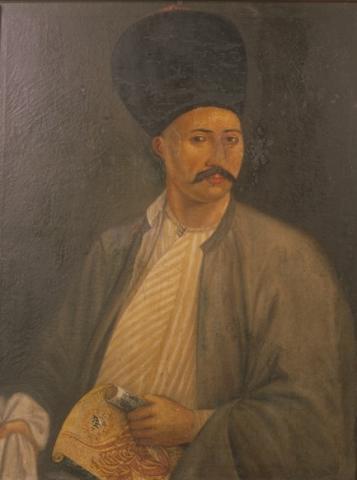
Hadjigeorgakis Kornessios, Dragoman of Cyprus (1779-1809) is wearing anteri (over a shirt which is not visible), tzouppe an outer robe with full sleeves and a short upright collar and kalpaki. The anteri is a long open gown crossed at the front, closed up to the neck with a series of three small buttons. The neckline is round. It is made of white silk fabric with golden stripes. Along the front the stripes run in opposite directions, indicating the design of the anteri. The edges of the long sleeves of the anteri are visible under the tzouppe. It is made of greenish fabric lined with white cloth. His Kalpaki (head-gear) has the shape of a mitre (kettle-shaped).  This type of kalpak was made of fine black lambskin stretched upon pasteboard forms. On the top of the kalpak one can see the red stuffing, similar to that of the Boyars. On his right hand the Dragoman is holding a white kerchief and in the left hand a rolled firman (or berat). The head seems to be fully shaved. He also has a long black moustache.

Translator: 
Euphrosyne Rizopoulou-Egoumenidou
Author: 
Euphrosyne Rizopoulou-Egoumenidou
Description: 

The clothing of the Christian elite is best represented in icons and wall paint­ing decorating churches.

 The Dragoman of Cyprus Christophakis Constantinou, is here seen leading his family group with hands out towards the model of the church, which is collected by St. George himself. In between the buttresses of the model is recorded the date 1745, when the church was erected.

 Christophakis is dressed in garments of a leading member of the society of the time, bearing strong Ottoman influence. As an over coat he wears a tzouppe (long robe), lined with grey fur shown as a broad collar and down the opening in the front, at the cuffs and the side-pocket.  Under the tzouppe is visible the lower part of the red baggy breeches, the tzaktziria, onto which were sewn the mestia or meskia, footwear made of Morocco leather in the priv­ileged yellow colour. The head-gear is a black kalpaki (fur cap). Similarly dressed, in the fashion of their father, are the two youths in the front row.

Behind Christophakis stands a colourfully dressed lady, wearing a red foustani (dress) cut down the front in a U-shape to show her white shirt. Over all she wears a tzouppe (long robe), lined with ermine fur, which is visible all the way down the opening in the front, in patches at the shoulders and the side(s) slit(s) for the hands. The tzouppe is made of a precious fabric (brocade) decorated with flowers on a green background and has long sleeves with turned-out cuffs.  On her head she wears a red fesin (flat-shaped cap, fez) over which is thrown a green scarf with stamped (or embroidered) flowered decoration. In her clasped hands she holds a red handkerchief and a pouch.

An elderly woman standing immediately behind her shows a long robe clasped at the neck and trimmed with ermine down the opening in the front and at the cuffs. On her head she wears a red kerchief under a scarf which covers the back of the head and the neck.

Immediately behind her appears a female child wearing a red fesin (flat-shaped cap, fez) with a turban. Her tzouppe (overcoat), with sleeves to the elbows, has a white collar of ermine which continues down the opening in the front. From the under-garment, made of red-striped white material, only one sleeve is visible.

Next, stands a grown-up woman of about the same age and similarly dressed as the lady behind Christophakis. She wears the same headdress consisting of a richly decorated red fez over which is thrown a scarf with printed flower decoration. Her tzouppe is of the same type, lined again with ermine fur, but the brocade fabric has flowers on a red background instead of green. Similar is also the cut of the white shirt. On the other hand, there seems to be a difference between the upper and the lower part of the garment over the shirt.  It seems that here we have a combination of a zimbounin (waistcoat) and a red skarpetta (pleated skirt), which recalls the  alla Cipriotta (Cypriot style) dress mentioned by Giovanni Mariti (1760-1767).

Immediately behind her kneels a young girl wearing an anteri (gown) made of red-striped material. Over the anteri (gown) she wears a short white tzouppe (overcoat) open down the front and clasped at the neck. It has sleeves to the elbows and is trimmed or lined with fur seen around the neck, down the open front and at the edge of the sleeves. She wears a red fesin (cap, fez) with a scarf around it, the ends of which fall on to her shoulders. It repeats in miniature the headdress of the other two ladies who wear fez and scarf.

Another sister, the last of the group, is depicted behind the girl. She wears the same type of red-striped anteri as the young girl before her. The anteri is closed at the waist with a belt fastened with a pair of round buckles. Her ermine-lined robe (tzouppe), made of fine colourful brocade, is open down the front and not clasped at the neck, so that it allows the U-shaped cut at the chest of the upper-garment to show, revealing a white shirt underneath. On her head she wears a turban-like cap. 

Translator: 
Euphrosyne Rizopoulou-Egoumenidou
Author: 
Euphrosyne Rizopoulou-Egoumenidou
Description: 

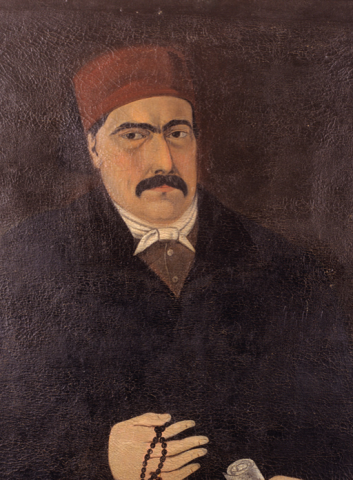
The portrait depicts Tzelepi Yiangos Georgiades, the youngest son of the Dragoman Hadjigeorgakis. It was painted by Constantinos Tak­katzis in 1852. He is presented wearing a red  Fesin (fez) and a thick black coat with a V-shaped opening, over a waistcoat closed with buttons up to the neck; a white cravat tied in a bow is shown un­der his chin. He has a moustache and short hair projecting under the fez (Turk. Fesin) at the temples. He wears a ring on each hand, and holds a rosary (string of beads) in the right and a rolled manuscript in the left hand. The name of the painter and the date 1852 are written with black ink on the manuscript. A ring similar to those depicted is still preserved as a family heirloom in the collection of his sister’s Mariora descendants. Tzelepi Yiangos is a typical case of the emerging new local elite, whose appearance reflected the western-style fashion promoted by the reforms in the Ottoman Empire.

Pages