Pierides Museum - Bank of Cyprus Cultural Foundation

Translator: 
Euphrosyne Rizopoulou-Egoumenidou
Author: 
Euphrosyne Rizopoulou-Egoumenidou
Description: 

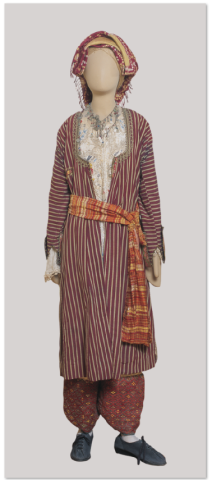
Inv. no. 210: Costume with sayia, typical of the Karpasia region. It consists of a woven shirt embellished with silk pipilla (needle lace) and fine embroidery of light blue flowers at the visible part of the chest. The sayia is worn on top of the shirt. It is made of silk-cotton striped alatzia with alternating white and burgundy stripes, and has gold thread decoration at the edges. The garment is long-sleeved and open at the front. The lower part of the sleeves is lined with a colourful printed fabric, which is visible in the opening of the sleeves and on the small pocket on the right side of the chest. The sayia is long enough to cover the knees, revealing the rich loom embroidery on the lower part of the cotton pantaloons, which are worn as underwear. The sayia closes at the waist with a colourful sash made of striped fabric. The costume is completed with white socks and black laced shoes, as well as with the headscarf no. 218 (for sayies made of a similar striped fabric, see Cypriot Costumes 1999, 133, and Papadimitriou 1995, 112).

Translator: 
Euphrosyne Rizopoulou-Egoumenidou
Author: 
Euphrosyne Rizopoulou-Egoumenidou
Description: 

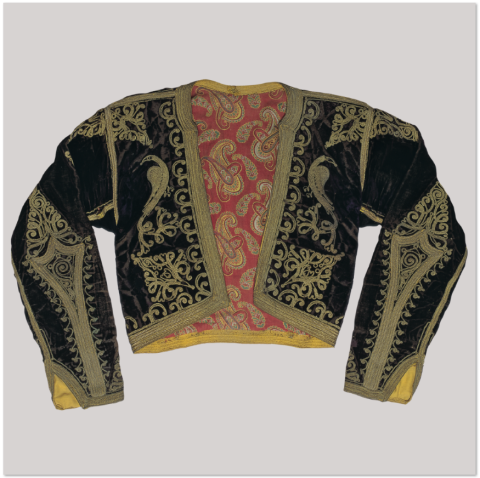
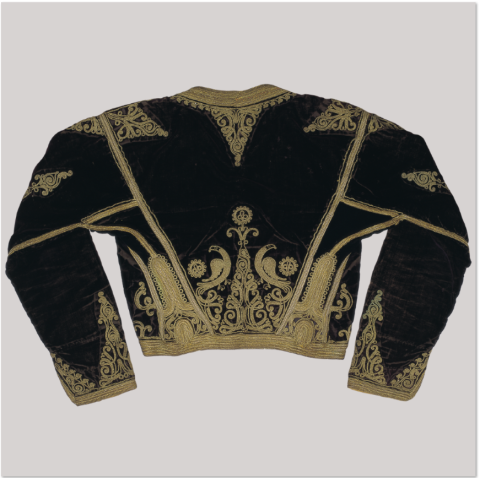
Inv. no. 216: Short women's jacket made of lilac velvet, richly decorated with twisted cord or braid (terzidiki) embroidery. The jacket consists of seven pieces: the back part, almost triangular with a sharp narrowing towards the bottom, two front pieces, and two side pieces under the sleeves, which are joined with a double gold braid. Gold braid generally covers the seams and edges and also forms part of the decoration of the back and the sleeves. The central pattern on the back is a tall, stylised floral motif with spirals, rosettes and small leaves, usually interpreted as the tree of life. It is framed by two peacocks with their heads turned backwards. The same peacocks, a symbol of excellence and beauty, with long tails that extend into spiral motifs, are also embroidered onto the two front pieces. The decoration is characterised by movement, expressed by the prominent curves in the rendering of the birds and the diversity of the spiral motifs which repeat selected elements of the principal floral pattern in the complimentary decoration. The jacket is lined with printed fabric featuring paisley designs in prominent colours. Yellow/gold fabric is used as lining in the sleeves. This jacket differs from the Cypriot sarka, its cut and decoration being similar to that of the peseli, the late 19th-early 20th century women’s festive and bridal waistcoat of Corfu. The embroidery was done by specialised craftsmen, the terzides, who originated principally from the mountainous areas of Greece and provided with their embroidered dress items the Balkan regions. Their embroidery, characterised by consistency of style, was done with chrysogaitania or chartzia, gold thread twisted into fine cords, and secured with stitches onto the fabric. While this jacket is clearly an imported item, it could easily be worn in place of the Cypriot sarka, as a luxurious addition to formal attire (for similar examples see Theotoki 1994, 84-85, and Zora 1994, 125 and 23 for the terzidiki embroidery).

In Cyprus as elsewhere, the lilac colour, as well as the black or blue, were colours used in formal costume.  

This jacket belonged to Mariou Karydi-Pieraki from the Ionian islands, great-grandmother of Zeno Pierides.

Dimensions: Height: 41.25 cm. Shoulder width: 42.5 cm. Lower edge width: 32 cm. Sleeve length: 51 cm and width: 17 cm and 12 cm at the ends.

Translator: 
Euphrosyne Rizopoulou-Egoumenidou
Author: 
Euphrosyne Rizopoulou-Egoumenidou
Description: 

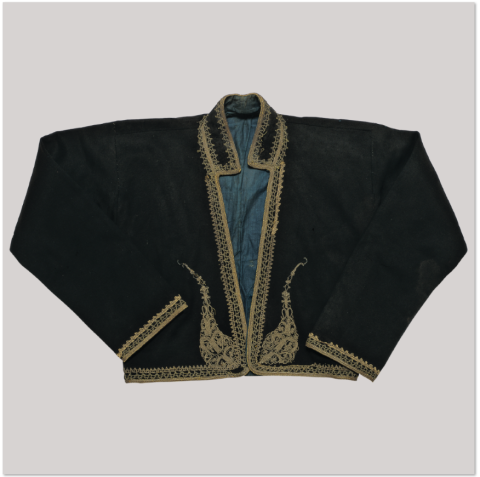
Inv. no. 215: Women’s sarka (waist jacket) made of black felt, with a low upright collar and long sleeves sewn vertically onto the body. The back consists of a single piece. At the front, two separate pieces fasten low, at the middle of the waist, forming a deep V-shaped opening. An additional gusset under each armpit provides ease of movement. The edges of the garment are trimmed with sewn-on gold bands, while a paisley motif decorates the bottom corners of the two front pieces, at the middle of the waist. The seam of the sleeves is accentuated with gold braid. The sarka is lined with blue fabric. This type of jacket is typical of Cyprus and was part of women’s formal costume in urban centres during the 19th century. It was soon adopted in rural areas, where it survived into the 20th century as festive and bridal costume. The sarka no. 215 is comparable to similar samples, such as one in the collection of Ino Stavridou-Hadjipavlou, in Limassol (Rizopoulou-Egoumenidou 1996, 137, fig. 122).

Dimensions: Height 40 cm. Width: 40 cm. Sleeve length: 44.5 cm, width: 15 cm and 13 cm at the sleeve edge. Height of collar: 4.5 cm.

Translator: 
Euphrosyne Rizopoulou-Egoumenidou
Author: 
Euphrosyne Rizopoulou-Egoumenidou
Description: 

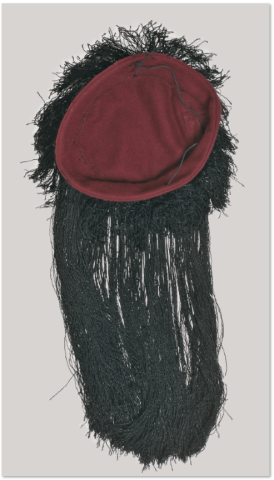
Inv. no. 224: Fez made of red felt, covered externally with a tassel of black, silk threads affixed radially to the top of the cap, forming concentric circles with fringes all around. Α second, thick, dangling tassel falls to the shoulder. The double-tasselled fez was typical of Cyprus. It was part of the urban women’s festive, “Amalia” costume, and its decoration was completed with the fiora, a garland of flowers made of pearls, gold and silk threads. A fez bearing such decoration is preserved in the National Historical Museum of Athens (Cypriot Costumes, 1999, 88, fig. 57).

Dimensions: Internal diameter of the fez: 18 cm. Top (tepeliki): 16.5 cm. Tassel length: 30 cm.

Translator: 
Euphrosyne Rizopoulou-Egoumenidou
Author: 
Euphrosyne Rizopoulou-Egoumenidou
Description: 

Inv. no. 296: Cypriot costume of the “Amalia” type. It consists of the following pieces:

  1. Off-white silk chemise with a V opening at the chest, decorated with handmade pipilla (needle lace), which also adorns the edges of the sleeves.
  2. A skirt made of imported fabric with stripes in vivid red, yellow and green, as well as  delicate designs in lighter colours, all in a vertical arrangement. The skirt is ankle-length with rich folds at the waistline. A blue ribbon with a red band in the middle extends all around, above the hem.

This type of colourful fabric, which was common in Cyprus, in particular after the mid-19th century, was also used to make sarkes (waist jackets with long sleeves). In certain regions (Mesaoria), these jackets, matched with a skirt, were called “misirkotika”, probably a reference to the origin of the fabric in Misir (Egypt) (photographs of “misirkotika” see in Michalopoulou-Charalampous 1993, 199).

  1. Sarka made of black felt with straight, long sleeves sewn vertically onto the shoulders, and a low upright collar. It closes above the waist, forming a large V opening at the bust. The collar, the sleeves and all the edges have a rich decoration of sewn-on gold cords. On both sides of the chest, the decoration extends into a paisley design. Even the seams of the sleeves are accentuated with gold decorative braid.
  2. A red fez with a long thick tassel made of black silk threads. This dangling tassel falls on the chest, while a second tassel is fixed on the top of the fez, forming the tepeliki.

The outfit is completed with jewellery, a clasp, a necklace and a pin (for jewellery, see below). The “Amalia” costume was established in Cyprus before the mid-19th century. It was initially the formal attire worn by women in the urban centres, where it was preserved until the adoption of European dress. Later it was adopted in rural areas, where it was used as a festive or bridal outfit even as late as the first decades of the 20th century.          

Pages