white

Translator: 
Euphrosyne Rizopoulou-Egoumenidou
Noly Moyssi
Author: 
Euphrosyne Rizopoulou-Egoumenidou
Noly Moyssi
Description: 

Female, festive sayia from Karpasia, made of thick cotton cloth. The garment is adorned with white embroidery and threaded beads. It was worn over a chemise.

The back and front parts consist of a single fabric panel. At the front, a vertical slit extends all the way down. A deep opening is also formed at the bust, leaving a large part of the chest uncovered. Just below the chest, the sayia closes with  loops and buttons. 

The long and narrow sleeves, sewn vertically to the shoulders, have two additional triangular pieces joined diagonally below each armpit to facilitate movement. The back part below the neck is  lined with white cotton fabric; the same applies for the part surrounding the chest opening, which is embellished with white embroidery in delicate scrolls or zigzag patterns, enriched with threaded red and green petroues (beads). The same embroidery covers the seams of the sleeves at the shoulders and, in a thinner band, the shistres (side openings) of the sayia. Threaded beads decorate also the openings of the sleeves.

Translator: 
Euphrosyne Rizopoulou-Egoumenidou
Noly Moyssi
Author: 
Euphrosyne Rizopoulou-Egoumenidou
Noly Moyssi
Description: 

Double-breasted zimbouni made of thick white cotton cloth. The garment is adorned with white embroidery and threaded beads.

Translator: 
Euphrosyne Rizopoulou-Egoumenidou
Charlotte Steffen
Iosif Hadjikyriakos
Author: 
Euphrosyne Rizopoulou-Egoumenidou
Petroula Hadjittofi
Iosif Hadjikyriakos
Description: 

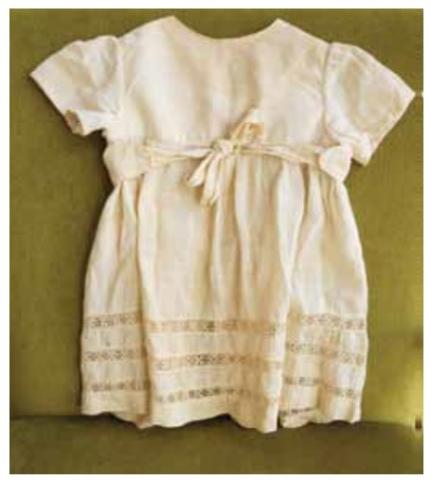
Christening dress made of fine silk taffeta fabric. It has a round neck opening, short sleeves and a belt tied at the waist. The lower part of the dress is adorned with three horizontal bands of cutwork embroidery.

Private collection, Larnaca.

Translator: 
Euphrosyne Rizopoulou-Egoumenidou
Petroula Hadjittofi
Author: 
Euphrosyne Rizopoulou-Egoumenidou
Description: 

C/2203/0161


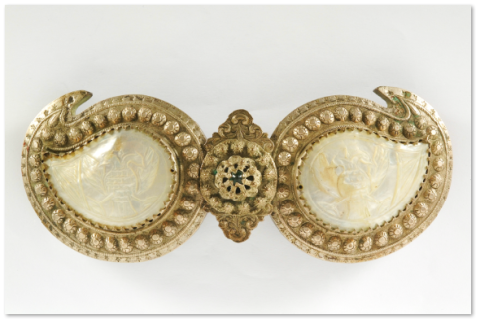
Buckle/clasp of two almond-shaped mother-of-pearl plaques, each set in a silver frame of the same shape. The clasp is of the same type as no. C/2003/0151, with a similar representation of the two-headed eagle in a less sophisticated rendering. The decoration of the silver frame differs, namely in that it consists of a series of repoussé rosettes with chased details, bordering the inset mother-of-pearl panels. On the central clasp element, which covers the fastening, there is a pierced rosette adorned with a green stone and granules. It is surrounded by a row of smaller rosettes, and it is framed above and below by stylised floral designs with chased details. Two bars are soldered on the reverse side of each clasp element.


Total width: 21 cm. Height: 8 cm.

Donation from the A.G. Leventis Foundation.

Translator: 
Euphrosyne Rizopoulou-Egoumenidou
Petroula Hadjittofi
Author: 
Euphrosyne Rizopoulou-Egoumenidou
Description: 

C/2003/0151


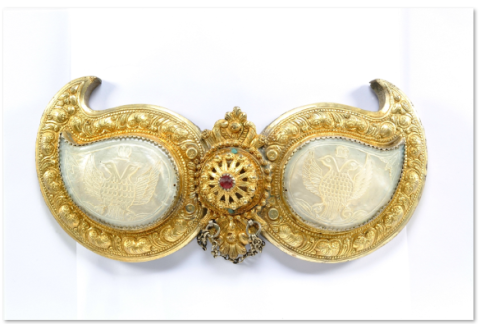
Silver-gilt buckle/clasp of two almond-shaped mother-of-pearl plaques, each set in a silver frame of a corresponding shape, with its edges turned prominently upwards. The broad border of each frame is richly adorned with relief/repoussé and chased floral designs, as is the central part of the clasp, the cast base of which is soldered onto the fastening loop. A pierced domed rosette set with a red stone, is nailed to the centre of the cast base, surrounded by tiny rosettes. Above and below are chased anthemia, while at the bottom part there are also two attached rings with three chains. Both mother-of-pearl plaques are carved with a crowned two-headed eagle. Its wings are outstretched and its body is covered in rows of scale patterns. The pointed edge of both plaques features a floral design. All silver elements are gilded, and the gold colour accentuates the shine of the white mother-of pearl panels. On the reverse side of the two outer elements of the clasp, there are two copper bars for securing it to a belt. The metal frame of the clasp is of exceptional craftmanship, comparable to similar examples from areas outside Cyprus (see Mazarakis-Ainian (eds.) 1993, 200, from Kavakli in eastern Thrace, Korre-Zografou 2000, 376, fig. 15, 380, fig. 36, and 383, fig. 35, clasps in the Collection of K. Notara, Athens, the first from Jerusalem and the other two from Thrace; see also Blagoeva 1997, 74, fig. 27, clasp of the same type, also with a double-headed eagle, from the region of Sophia).


Total width: 24.3 cm. Height: 9.5 cm.

Donation from the A.G. Leventis Foundation.

Translator: 
Euphrosyne Rizopoulou-Egoumenidou
Petroula Hadjittofi
Author: 
Euphrosyne Rizopoulou-Egoumenidou
Description: 

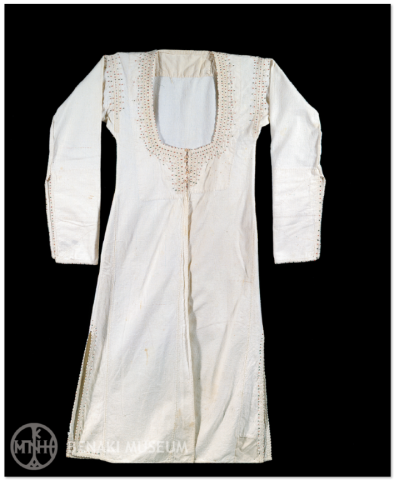
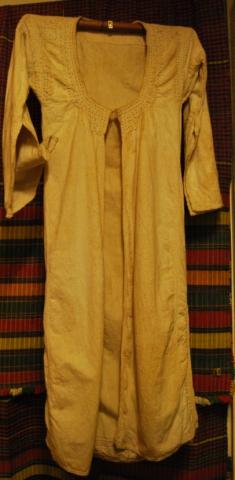
Inv. No. EE 4326: Female, festive sayia from Karpasia, made of thick cotton thread worked on the doulappin (spinning wheel). The garment is adorned with whitework embroidery and threaded beads. It was worn over a chemise.

The back and front parts consist of a single straight fabric panel, seamless at the shoulders. At the front, a vertical slit extends all the way down. A deep opening is also formed at the bust, leaving a large part of the chest uncovered. Just below the chest, the sayia closes with six knitted loops, which corresponded to now missing buttons. A little lower an additional oblique piece of fabric is sewn on each side, widening downwards. Adding these gores served the cross-over fastening of the garment at the front. Two gores have also been added to the sides, where slit openings 34 cm. high allow ease of movement. A small patch of thin cotton cloth has been added at the end of one of these openings.

The long and narrow sleeves, sewn vertically to the shoulders, have two additional triangular pieces joined diagonally below the armpit to facilitate movement. The two sleeves have a bottom opening measuring 22 and 23 cm., respectively, while in their entire length they are lined with white cotton fabric. The back part below the neck is also lined with white cotton fabric; the same applies for the part surrounding the chest opening, which is embellished with whitework embroidery in delicate scrolls or zigzag patterns, enriched with threaded red and green petroues (beads). The same embroidery covers the seams of the sleeves at the shoulders and, in a thinner band, the shistres of the sayia, namely the side openings. Threaded beads are also employed at the opening of the sleeves. Particularly interesting is the embroidery at the back of the hem: three narrow embroidered bands with threaded beads are defined by lourouthkia (thin stripes) of siettarin-coloured (light brown) thread. Two more brown stripes, 0.05 m. wide, border the decoration of the fringe.

In her description of Karpasia embroideries, Angeliki Pieridou also mentions dress decoration: “The same embroideries with beads also adorned women’s clothes, white sayies. They were woven using the thick cotton thread worked on the doulappi, and the embroidery, which was usually arched, was limited to the edges, which were easy to embroider on the loom. The embroidery on the chest, the sleeves and the side openings was needlework with threaded beads for [further] decoration" (Pieridou 1980, 28).

See a similar sayia in: Ohnefalsch-Richter 1994, table 65: 2; Papademetriou 2000, 110 cat. 1.

Length of the sayia: 113cm. Length of sleeves: 58 cm.

It belonged to Angeliki Pieridou and was donated to the Benaki Museum by George and Marina Pieridou in 1981.

Translator: 
Euphrosyne Rizopoulou-Egoumenidou
Petroula Hadjittofi
Author: 
Euphrosyne Rizopoulou-Egoumenidou
Description: 

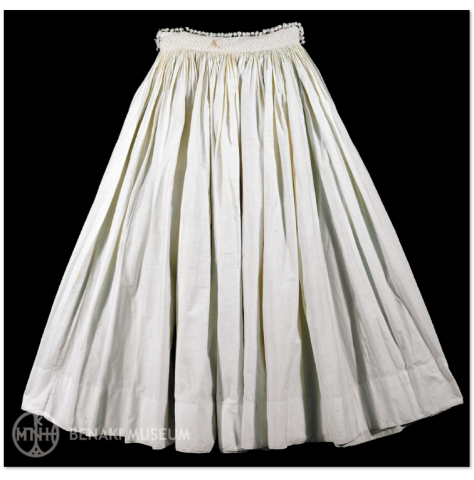
Inv. No. EE 1678: Doublettin (white pleated skirt worn as a mantle) made of thin white cotton fabric (hases). It consists of one piece of cloth measuring 82 cm. in width, and another two pieces, each 263 cm. wide. Its total width is 6.08 m. Its folds are gathered in dense pleats at the top, where they are covered by a cotton cloth, forming an upright thick "collar". The surface of the latter (4 cm. wide) is decorated with drawn-thread white embroidery featuring an arch pattern on the one side, and continuous lozenges containing smaller ones on the other side. Along the two narrow and the top long sides there is a fringe of small tassels with red, green, pink and honey-coloured glass beads (petroues = small stones) at their base.

The doublettin, a characteristic element of Karpasia’s festive dress, has the peculiar decoration met in local embroideries and costumes. This pleated mantle was worn over the sayia. A second pleated garment, the red-coloured routziettin, was also worn over the back as a mantle, but was mainly used as a skirt in bridal and festive costumes, along with the sarka. The red mantle was worn by young women, while older women wore the doublettin. Few specimens are preserved in museums today, yet the way doublettin was worn can be seen in old photographs (photo of the Benaki Museum Archive no. 30210, and Hadjimichali 1954, pl. 85; see also Papademetriou 1991, 17 fig. 4).

Length of doublettin: 99cm. width of collar: 34 cm.

Hadjimichali 1983, 383 fig. 410, 396 fig. 425; Papantoniou 2000, 175 fig. 237

Translator: 
Euphrosyne Rizopoulou-Egoumenidou
Petroula Hadjittofi
Author: 
Euphrosyne Rizopoulou-Egoumenidou
Description: 

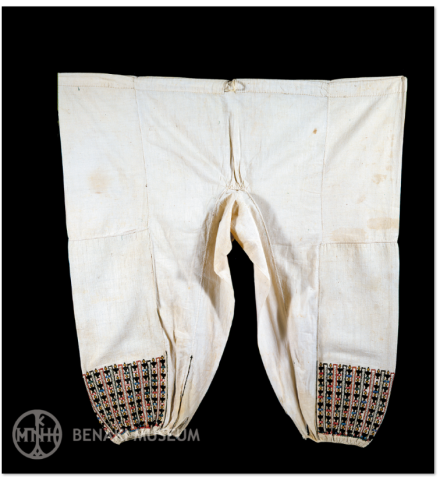
 Inv. No. EE 4083: Vratzin (long and loose pantaloon worn as underwear) made of cotton. The lower ends, the povratzia, are made of thick cotton loom-woven cloth, covered with embroideries. The vratzin consists of seven pieces: one long, curving piece for the crotch, two similar pieces for the front and the back of the upper part of the garment - these also extend lower while becoming narrower -, two similar pieces for the sides, that cover the area of the thighs at the front and the back, and the two embroidered povratzia at the lower ends. At the upper edge the fabric is folded and sewn, so as for the white cotton vrakozonin (belt) to pass through the hem and secure the vratzin by tying around the waist.

The multicoloured embroideries of the povratzia are arranged in 17 vertical bands featuring consecutive stylized robust floral motifs, made by applying single stiches, regular or long-armed cross stiches, stem stiches and other types of stiches for solid filling. The aforementioned vertical bands alternate with 16 narrower bands, which consist of white open-work embroideries with a deep red or brown frame alternately. The colours of the embroideries vary: brown, green, yellow/golden, light blue, red/deep red. A stem stich made of red silk thread extends along and accentuates the joints between the two vertical edges of each embroidered piece and the thinner fabric of the vratzin. Similar stiches are found along other joints at the lower part of the garment and are also used for decorative purposes. At their lower ends, the povratzia are tightened around the ankles by a girdle, while at their inner side there is an opening which appears to have featured a button fastening. The buttons do not survive.

It is worth noting that the povratzia, made by a thicker embroidered cloth, were preserved for a longer time than the rest of the underwear and, when the latter perished, they were sewn onto a new one. Height: 90 cm., Width at the waist: 85 cm. Embroidered surface: 18x36 cm.

Translator: 
Euphrosyne Rizopoulou-Egoumenidou
Author: 
Euphrosyne Rizopoulou-Egoumenidou
Noly Moyssi
Description: 

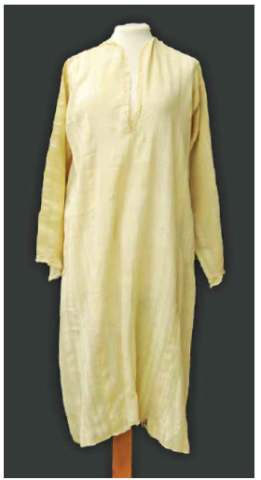
A women's long shirt made of off-white woven silk-cotton taisto fabric, with lengthwise puckered bands of varying width, created by warp threads of two different tensions. The seams are hand-sewn and serve a decorative purpose. The front and back of the shirt are seamless, and there is a vertical opening of 25 cm. on the chest, curving at the neckline on both sides. Ready-made decorative lace, 2 cm. wide, is sewn with hemstitching onto the neckline and chest opening. The edges of the neck and chest openings are decorated with zigzag lines using flat stitch embroidery in the colour of the shirt. The sleeves are sewn vertically to the body until the midpoint of their width, widening with the addition of three gores on each side. The edge of each sleeve is decorated with ready-made lace with linear patterns, 3.5 cm. wide. The lower hem of the shirt has a delicate cord finish, made by twisting the threads of the warp. The shirt shows signs of wear and later interventions.


Dimensions: height 120 cm. Chest width 65 cm. Sleeves: length 47 cm., width 22 cm. Hem circumference 106 cm.

Translator: 
Euphrosyne Rizopoulou-Egoumenidou
Author: 
Euphrosyne Rizopoulou-Egoumenidou
Noly Moyssi
Description: 

A square scarf made of white georgette fabric, decorated all around with delicate needle lace (pipilla), sewn with gold thread and green thread. In the four corners, there is a simple decoration made of tiny golden beads, fastened with green thread. Across the surface, one can see the marks left by folding the handkerchief multiple times, in order to be sewn onto the fez. It is paired with the fez with registration number 2213/11.


Dimensions: height 10 cm., length 10 cm.


It was purchased at the price of 35 drachmas, along with the fez 2213/11, which cost 149 drachmas.

Pages