Coloured

Translator: 
Euphrosyne Rizopoulou-Egoumenidou
Author: 
Euphrosyne Rizopoulou-Egoumenidou
Description: 

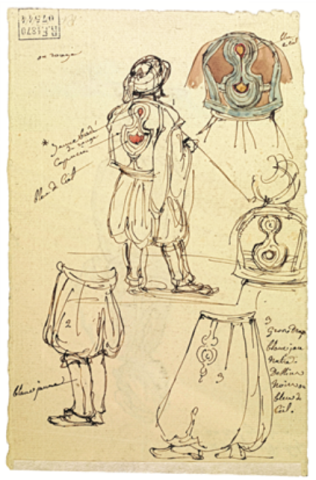
The drawing (R.F.7544) is a costume study with notes on the colours writ­ten by the artist. It includes a fully dressed male figure in the middle (number 1) seen from the back, and another four drawings, two of them depicting the back of the upper part and two (numbers 2 and 3) the lower part of a dressed body. The man in the middle is smoking a long pipe. His costume comprises a sarık wound around a cap or fez, a richly decorated (braided) short waistcoat with shoulder flaps hanging over the sleeves of the shirt, and knee-long baggy trousers with folds. He appears also to have a sash around the waist. The calves seem to be covered with gaiters reaching down to the ankles. Flat shoes complete the costume. The back of the waistcoat is decorated with a figure-of-eight shaped pattern; only the central parts are painted red, and the other different colours are written and pointed out with lines: ‘jaune bordé du rouge’ (yellow bordered with red), ‘Capucin’ (light brown, the colour of the robe of the Capuchins) and ‘bleu de Ciel’ (sky-blue). The back of the waistcoat is shown again twice to the right of the figure, with slight differences (dark-coloured / light-coloured). In the upper draw­ing the figure-of-eight and the borders are painted light blue and the rest red. Only the blue (‘bleu de ciel’) is noted in connection with the pattern of the upper drawing. The drawing number 2, at the bottom left, is similar to the lower part of the dress of the main figure; here is noted the colour of the gaiters: ‘blanc jaune’ (whitish yellow). The last drawing (number 3) presents the lower part of a body in long pantaloons, most probably şalvar, which seem to be tied round the ankles. Along the side they are deco­rated with a curvilinear pattern. This drawing is accompanied with a note: ‘gros Drap blanc jaunatre. Dessins noir ou bleu de Ciel.’ The black or sky-blue colour refers to the curvilinear decorative pattern applied on the thick white-yellowish fabric of the panta­loons. The drawing number 3 might also be related to the drawing of the back of the waistcoat above it, which ends with a sarık seen from the back. The note ‘ou rouge’ on top left of the page does not seem to have any connection to the drawings below. The richly decorated waistcoat with shoulder flaps resembles the waistcoat called férmeli or férmeni (Turk. fermene), which was worn by Greeks, especially the fighters in the Greek War of Independence, but was also known in Cyprus (see above condemnation of this garment by the Church in 1797).

Translator: 
Euphrosyne Rizopoulou-Egoumenidou
Author: 
Euphrosyne Rizopoulou-Egoumenidou
Description: 

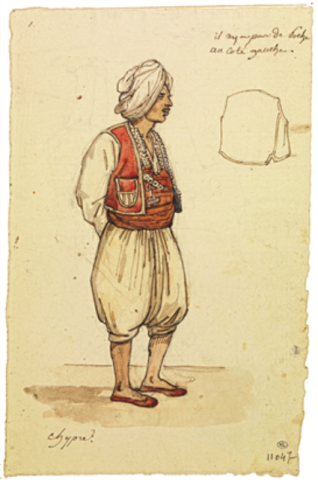
The drawing (R.F.7538) presents a Turk with moustache, who stands reluctantly with his hands behind his back. The nationality is indicated by the voluminous white sarık and the white baggy trousers, which are tied below the knee; short parallel lines probably indicate strings or fringes(?). A wide sash or belt (kuşak or kemer) is wound around the waist; this belt was used as a receptacle to keep several accessories and weap­ons; the decorated hilt of a knife protrudes from the belt in the middle. Over the shirt the man wears a waistcoat with decorative edging and a pocket on its right side. The waist­coat is red, as are also the wide sash around the waist and the flat shoes, probably made locally of Morocco-type leather. The legs are bare and light brown (sun-tanned) like the face. A drawing of the waistcoat in outline appears on the right side of the page, with a note above it, on the top of the page: ‘il ny a pas de poche au coté gauche’ (there is no pocket on the left side). The word ‘Chypre’ is written below the figure on the bottom left. Taking into consideration the scarcity of visual evidence, this detailed drawing offers a good idea of the appearance of the ‘Turks of Cyprus’, as they were called, at a time from which no actual garments have survived.

Translator: 
Euphrosyne Rizopoulou-Egoumenidou
Christina Roditou
Author: 
Christina Roditou
Description: 

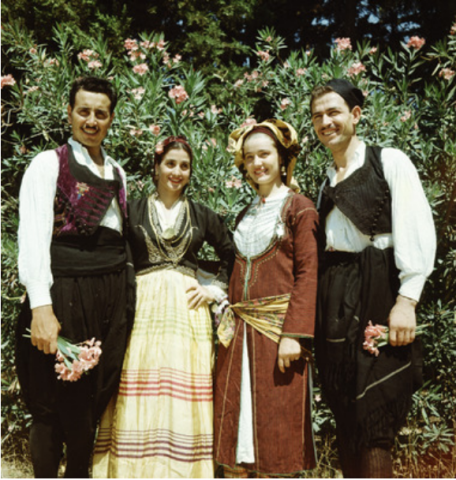
Young men and women dressed in traditional Greek Cypriot costumes. The male costume comprised of a shirt, a vraka (baggy pleated breeches) of black cotton, zostra (a coloured silk sash), yelekkin (sleeveless waistcoat), a black headscarf, and podines (top-boots). The woman on the left is wearing the traditional 'Amalia' type costume that was linked with the name of Amalia, Queen of Greece (1836-1862), and was established in urban centres in Cyprus by the mid 19th century as a variation of the Greek national costume. It is made up of a dress or skirt above a silk chemise and a felt or velvet jacket, the sarka, with gold ornamentation. The waist was girded by a belt with a filigree clasp or a tied sash with embroidered ends. The head was covered with scarves or, in the urban original, with a fez. The Cypriot fez, which was different from the one used in Greece, had two black silk tassels, a short one which was fixed to the crown and covered the whole cap in a radial pattern, and another one falling to the shoulder on the side. The fez was decorated with garlands of flowers made of tiny pearls and braided with silk. The woman on the right was wearing a costume with  sayia, a long-sleeved coat open down the front, worn over pantaloons decorated with woven embroidery. On her waist she wore a colourful headscarf tight as a sash. 

Translator: 
Euphrosyne Rizopoulou-Egoumenidou
Christina Roditou
Author: 
Christina Roditou
Description: 

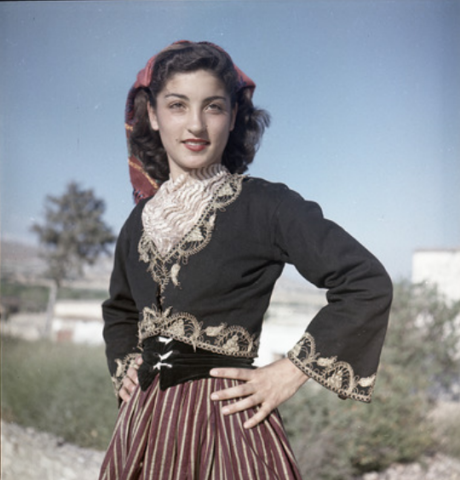
A woman in Paphos dressed in the 'Amalia' type costume. This type was linked with the name of Amalia, Queen of Greece (1836-1862), and was established in urban centres in Cyprus by the mid 19th century as a variation of the Greek national costume. It is made up of a dress or skirt above a silk chemise and a felt or velvet jacket, the sarka, with gold ornamentation. The waist was girded by a belt with a filigree clasp or a tied sash with embroidered ends. The head was covered with scarves or, in the urban original, with a fez.  The Cypriot fez, which was different from the one used in Greece, had two black silk tassels, a short one which was fixed to the crown and covered the whole cap in a radial pattern, and another one falling to the shoulder on the side. The fez was decorated with garlands of flowers made of tiny pearls and braided with silk.

Translator: 
Euphrosyne Rizopoulou-Egoumenidou
Author: 
Euphrosyne Rizopoulou-Egoumenidou
Description: 

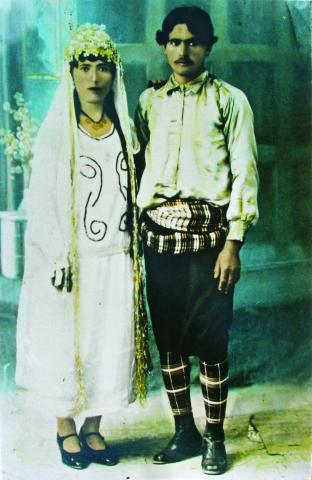
Photograph taken in 1931 in the studio of Fevzi Akarsu, commemorating the wedding of Sadiye Ali (1905-1989) and Ali Hasan Yorgancı (1906-1989) (the same persons as in No. 030). The painted background shows a window and a low table on which stands a vase with flowers, all white.

The bride, Sadiye Ali, wears a white wedding-dress (gelinlik) decorated with hand-embroidered spiral patterns in purple colour on the chest, and a single line around the neck. The dress is long, down to the ankles, and shows a narrow horizontal strip of the same cloth just below the waist. The dark hair forms waves along the front and falls down over the shoulders on the chest (a similar coiffure to that of the bride in No. 027). The head is covered with an impressive crown composed of artificial, handmade flowers, white and yellow. From the crown falls a long veil (duvak) with golden yellow tinsels along its inner sides (tel). Thin, transparent stockings and black button bar shoes complement the wedding attire. Around the neck there is a black ribbon of thick silk tissue (mantin) from which hang a bendo and three red/golden lira (kırmızı (altın) lira), of pure gold. This is a characteristic traditional jewel. The left hand of the bride is resting on the groom’s shoulder. Her fingers are painted with henna, as was customary (the dark-painted fingers of the right hand are seen more clearly).

The groom wears a loom-woven white silk shirt with soft black-striped collar and broad sleeves with cuffs; also black knee-breeches and a wide Tripoli sash (tarabulus kuşak) around the waist; the colours of the sash match those of the hand-knitted stockings, which are decorated with checkered patterns. He also wears black elastic-sided ankle boots. Worth mentioning is the special hair style with hair parting in the middle and falling on either side with ends turning upwards; this style is called horaşa/horoşa by the Turkish Cypriots (probably related to the Greek word horístra, parting). He has thick eyebrows and moustache.

Although accompanied by the traditional tall headdress, the wedding attire of the bride seems to follow the fashion of 1930. On the other hand, the groom is traditionally dressed, as is the case with the couple in No. 027.

Source: Mehmet Yorgancı ailesi.

Village: Kiados (Çatoz), Mesaoria, Famagusta District.
Translator: 
Euphrosyne Rizopoulou-Egoumenidou
Author: 
Euphrosyne Rizopoulou-Egoumenidou
Description: 

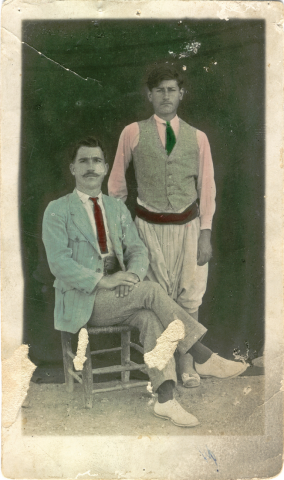
Photograph of two young men, taken in 1924. Derviş Çomunoğlu (1900-1991), who is presented sitting on a village chair, was a teacher by profession. He wears a casual, sport jacket over a white gömlek (shirt) with collar and a tie, cashmere trousers, dark çorap (stockings) and white front lace shoes, usually for summer wear. He has a typical posture, with his hands on the right leg which is crossed over the left, and looks stern. The other man, standing next to Derviş with his right hand resting on the back of the chair, is Ömer Hasan Sinekci, four years younger (1904-1995). He wears a tailor-made modern shirt with tie and a western-style waistcoat with four buttons. Surprisingly, the lower part represents typical traditional attire: white pleated şalvar (baggy breeches) made from a loom-woven cotton fabric, gathered at the waist and supported by a red guşak (sash turk. kuşak). Thick, knitted çorap (stockings) come up to the knees and are combined with light-col­oured sandals decorated with buckles on the front. Both men have short-cut hair and a moustache.

Translator: 
Euphrosyne Rizopoulou-Egoumenidou
Author: 
Euphrosyne Rizopoulou-Egoumenidou
Description: 
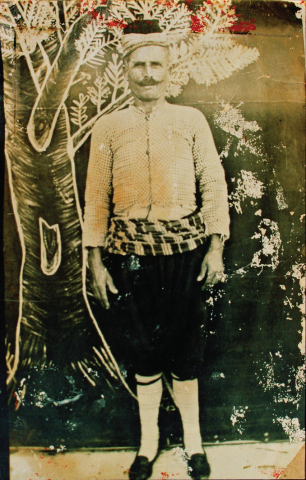
  • Photograph of Ömer Hasan (1866-c.1946). It was taken outdoors, by an anony­mous street photographer, but the man stands in front of an artificial background with a tree crudely painted on it. He wears a red fes (fez) with a white twisted çevre (kerchief) tied around its lower part. His hair is very short and almost completely covered by the fes (fez), his moustache thick with upturned ends. Over a white fanella (shirt), he wears a front-buttoned jacket (hırka = woollen, or wadded and quilted jacket), a tarablus guşak (Tripoli sash, turk. trablus kuşak) with tassels at the edges, kara dizlik (black knee-breeches), knitted cotton çorap (stockings) with horizontal stripes, all white, and black tab front kundura (shoes, turk. kuntura). The stockings are tied under the knees with black strips.
Translator: 
Euphrosyne Rizopoulou-Egoumenidou
Author: 
Euphrosyne Rizopoulou-Egoumenidou
Description: 

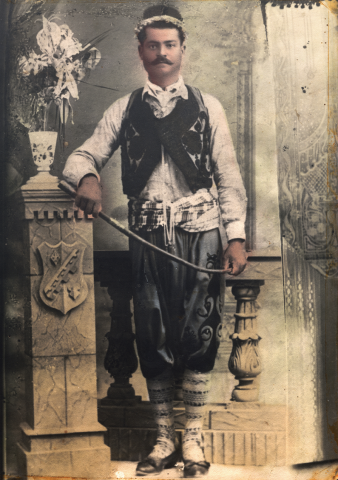
Photograph of Veleddin Hüseyin (1887-1963). The photograph was taken by Glaszner around 1920. The young man is standing with his right arm resting on a pil­lar which has a coat-of-arms in relief on the front. On the pillar there is a goblet-shaped painted glass vase containing a bunch of flowers. The background shows the colonnaded balustrade of a balcony, as often seen in neoclassical houses. Veleddin holds a riding kırbaç (whip) with both hands. He has a moustache and short hair covered on top with a skull­cap, around which is wrapped a white headscarf decorated with lace (oyalı yemeni) in the tulip (lale) pattern. Over his white gömlek (shirt) he wears a waistcoat made of light-coloured blue broadcloth and richly decorated with applied silk braids which form thick bands all around the edges and schematized vegetal patterns on either side of the chest. Similar decoration composed of curvilinear patterns ending in heart-shaped leaves and spirals decorate either side of the pleated çuha şalvar; these baggy breeches are also made of broadcloth and match the waistcoat. This attire is a good example of the traditional fes­tive Turkish Cypriot townsman’s costume. He also wears a Tripoli (tarab­lus, turk. trablus) guşak (sash, turk. kuşak) around the waist, hand-knitted çorap (stockings) with square patterns (lokumlu, in the shape of lokum = Turkish delight) and black yarım kundura (low-heeled shoes, turk. yarim kuntura = half shoes) decorated with a bow. A long double watch chain seems to be hanging from the neck, under the collar of the gömlek (shirt); it falls down below the waist and turns upwards to dis­appear in the guşak (sash, turk. kuşak), where the watch (köstekli saat) must have been kept. 

Translator: 
Euphrosyne Rizopoulou-Egoumenidou
Author: 
Euphrosyne Rizopoulou-Egoumenidou
Description: 

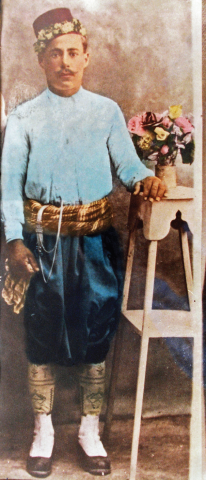
Photograph of a wealthy man, Ömer Hacıali. He was born on 15th May 1888 and died in 1980. The photograph was taken not later than 1917 in Ahmet Şevki’s studio. The man stands resting his left hand on a high corner table on which is a vase with roses of different colours. Ömer has short hair and a moustache. He wears a rigid Ottoman fes (fez, turk. Osmanlı durulla fes) with a yemeni (headscarf) around its lower part, decorated with lace; the pattern consists of narcissus (nergiz) flowers. His attire is traditional, composed of a silk gömlek (shirt), şalvar (heavily pleated breeches) made of blue broadcloth (çufa/ turk. çuha) and a silk multi-coloured guşak (sash, turk. kuşak) around the waist. His köstekli saat (watch) is hidden in the waist guşak (sash, kuşak) but its chain hangs down in front on the right side. The çorap (stockings), which reach up to the knees, are hand-knitted and bear the coffee cup (fincan) pattern on a white background. The front part of the black ankle boots (a shoe-like galosh with instep and leg of a differ­ent material) is covered with a light-coloured part. These boots are described as making a creaking noise (kapalı gıcırdaklı potin). In his right hand he holds a ipek mendil (silk handkerchief). The photograph was hand-coloured at a later stage; the gömlek (shirt) was painted light blue. 

Translator: 
Euphrosyne Rizopoulou-Egoumenidou
Author: 
Euphrosyne Rizopoulou-Egoumenidou
Description: 

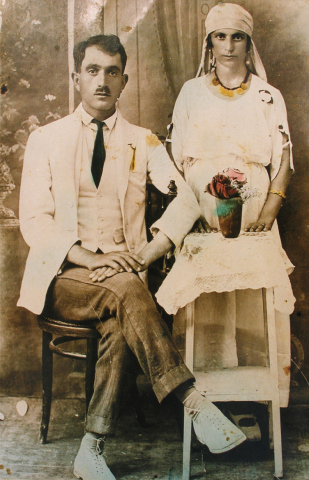
Studio photograph taken in 1914. It depicts a young couple, Ekrem Ovgorozlu, an inspector in the British administration, and his wife Pembe Ovgorozlu. The man is sitting on a chair of Viennese type, with his legs crossed and hands resting on his knee one over the other. His left arm is placed partly around the back of the chair, which appears at his elbow. He has short hair and a short moustache. He is dressed in western style; his cos­tume is composed of a white gömlek (shirt) with collar, around which is tied a black tie. Over the shirt he wears a white cashmere waistcoat and a jacket of the same material. His trousers are of brown striped cloth and end with a wide double turned hem. He also wears knitted çorap (stockings) and front lace ankle boots (the side seam is the more formal style, continuous from sole to sole – ‘closed tab’). The lady is standing next to her husband with her hands on a high corner table in front of her. She wears a ‘modern’ long white dress with sleeves down to the elbows. The sleeves have vertical openings with two horizontal strips. There is a round opening around the neck and a belt at the waist. Thin black çorap (stockings) are combined with white kundura (shoes, turk. kuntura) with a narrow strap at the front. Her head above the eyebrows is covered with the traditional çarşaf which is made of white silk and hangs down the back. Her appearance is complemented with jewellery. The earrings consist of two round elements, one on the ear and the other hanging. Around her neck she wears a traditional necklace made of gold Ottoman coins (turk. Mahmudiye) tied onto a black ribbon, and on her left wrist twisted bracelets. The white tablecloth has a handmade band all around the edges; the repeated pat­tern consists of the white flowers of the tree Sambucus nigra. On the table stands a vase of flowers.  

Pages