Male

Translator: 
Euphrosyne Rizopoulou-Egoumenidou
Author: 
Euphrosyne Rizopoulou-Egoumenidou
Description: 

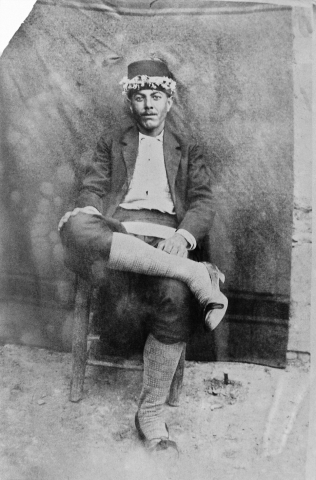
The photograph shows a young man sitting on a village chair with his right leg rest­ing on the left. A blanket hangs in the background. The young man is Ayalı Mehmet Bey; he was born in 1895 and died in 1913. He has short hair and a short moustache. His head is covered with an Ottoman fes (fez, turk. Osmanlı durulla fes) surrounded by a headscarf, which is decorated with lace in narcissus (turk. nergis) pattern. He wears a light-coloured gömlek (shirt)  made of ordinary fabric; it has long sleeves ending in cuffs, a short collar and an opening at the centre front closed with buttons. Over the gömlek (shirt) he wears a western-style jacket. Loom-woven şalvar (pleated baggy trousers) come down to the knees; the long white woolen, square-patterned çorap (stockings) come over the trousers and stop below the knees. Around the waist there is a wide guşak (sash, turk. kuşak). He wears slip-on kundura (shoes, turk. kuntura) with medium high heels; on the front, they are decorated with a dark broad band.

Translator: 
Euphrosyne Rizopoulou-Egoumenidou
Author: 
Euphrosyne Rizopoulou-Egoumenidou
Description: 

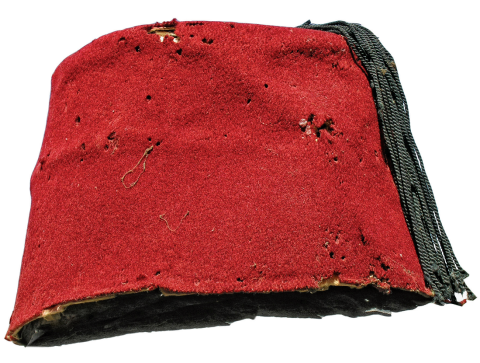
Fez (fesin, turk. fes) made of dark red felt. The felt is stuck onto cardboard, which forms the inside lining and keeps the fez in shape. From the centre of the top protrudes a piece of felt, on which is stitched a tassel made of twisted black thread. The fez is old and worn. Diameter of top: 14cm. Opening: 18cm. Height: 12cm. Length of tassel: 16.5cm.

Translator: 
Euphrosyne Rizopoulou-Egoumenidou
Author: 
Euphrosyne Rizopoulou-Egoumenidou
Description: 

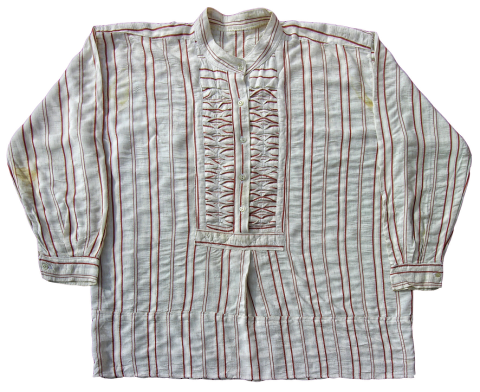
Man’s chemise (poukamiso, turk. gömlek) made of silk-cotton crepe textile, white with light brown stripes, woven on the loom with wefts of different tensions, thus creating puckered stripes along the warp (taiston). The front is made of a piece 80cm long and 72cm wide, with the stripes set vertically. On the chest is an additional rectangular piece (46x20cm) with a vertical opening 39cm long, fastened by five buttons (one of them on the col­lar). Here the stripes are arranged horizontally and the cloth is gathered together with stitching forming a honeycomb pattern within a frame. The strip of cloth that borders the lower part of this piece has decorative zigzag stitches. An additional piece stitched to the lower edge makes the front part 17cm longer. On the shoulders is another piece of cloth, 13.5cm wide and 56cm long from arm to arm, with the stripes set horizontally. The back is one piece with the stripes arranged vertically, and is stitched to the shoulder piece and to the sides of the front piece under the arms. The back is also elon­gated with an extra piece of the same cloth, 8cm long, attached to the lower end. The edges are treated with machine stitching. Around the neck is formed an upright collar 3.5cm wide. The long sleeves (57cm) are sewn vertically to the body and to the shoulder piece. Starting with a width of 25cm at the shoulder, the sleeves narrow downwards to 13.5cm and end in cuffs 6cm wide, fastened by one white button. The stripes of the cuffs are horizontal. The chemise is of fine manufacture and well preserved. 

Translator: 
Euphrosyne Rizopoulou-Egoumenidou
Author: 
Euphrosyne Rizopoulou-Egoumenidou
Description: 

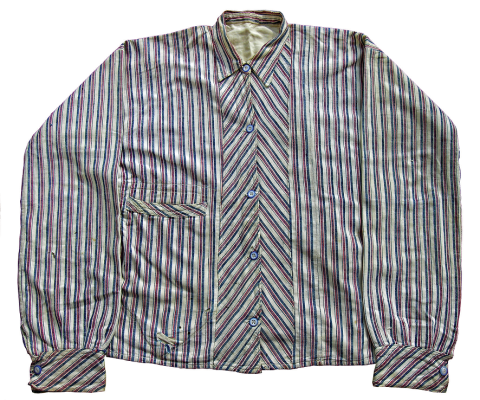
Man’s chemise (poukamiso, turk. gömlek) made of striped cotton cloth (alatzia, turk. alaca), with blue and red stripes on off-white background. The front part consists of two pieces of about 18cm width each. The length in front is 60cm. The piece of cloth forming the front continues as a single piece at the back for 39cm, then it is stitched to another piece 15cm wide. At the neck there is a two-piece collar. The front has a vertical opening fastened by five buttons of white and blue colour. Along the opening on either side there is an extra piece of cloth, each 7cm wide, the stripes of which are set obliquely. These extra pieces make the total width of the front 50cm (18x2+7x2cm). Additional square pieces, made of two triangular pieces of the same cloth stitched together diagonally (19cm), are inset at each underarm to give ease of movement. At the lower edge there is a slit on each side, 5cm long. The chemise is lined with white cotton fabric. On the right side it has a pocket (26cm high, 17cm wide) made of an extra piece of alaca with the stripes set horizontally. The opening of the pocket is 13.5cm wide. The long sleeves, which are sewn vertically to the body, end in cuffs, 7cm deep, fastened by one button.The cuffs are of the same alaca but with the stripes set obliquely. At the joint with the cuffs, the width of the sleeves is 12.5cm. At the opening of the sleeves, an oblique stripe is attached, 2cm wide. The seams of the chemise are made with the sewing machine. There is a hole at the lower part of the pocket and the lining near the edge of the back has been repaired with an additional piece of fabric. A rather similar striped silk and cotton chemise was brought to Athens for the Cy­priot Exhibition in 1901, as part of a traditional Turkish Cypriot costume, which also in­cluded the same richly adorned waistcoat (yeleko, turk. yelek) and pleated breeches (vraka, turk. dizlik) both made of blue broad ­cloth (turk. cuha salvar). 

Translator: 
Euphrosyne Rizopoulou-Egoumenidou
Author: 
Euphrosyne Rizopoulou-Egoumenidou
Description: 

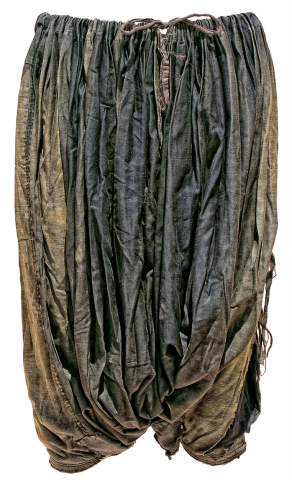
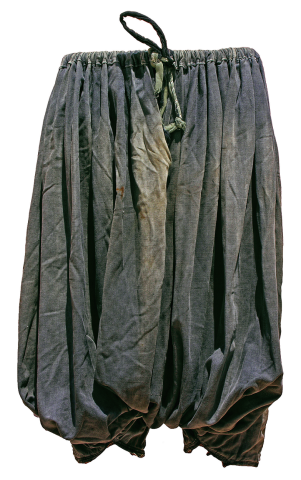
Turkish Cypriot men’s breeches (vraka, turk dizlik) made of ready-fabricated black cloth. The body part consists of two pieces which also continue to form the back. To either side of these are stitched the leg pieces which are folded lengthwise and end with an opening 16cm wide. These openings have four series of stitches at the edge. The seams are made with a sewing machine. All parts have the same length, 68cm, reaching down to the knee. At the waist a black girdle runs through a hem 3cm deep, and in the middle of the front, below the waist, is a vertical opening 19cm long. The total width of the dizlik is 2.00m. It is worn, repaired with patches, and the colour is faded.

Translator: 
Euphrosyne Rizopoulou-Egoumenidou
Author: 
Euphrosyne Rizopoulou-Egoumenidou
Description: 

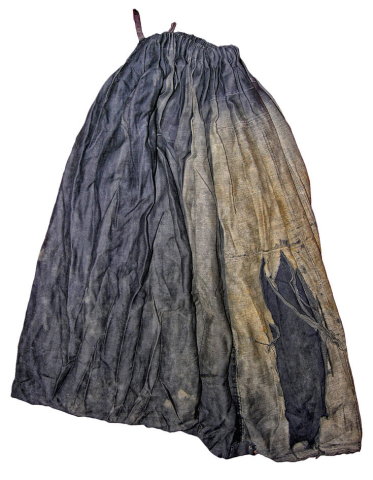
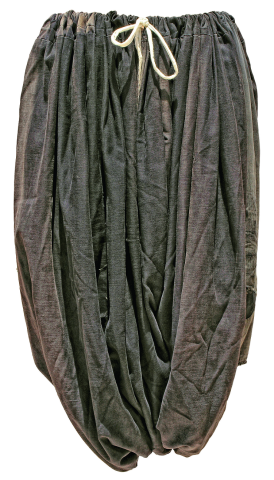
Man’s baggy trousers (vraka, turk. dizlik) made of thick black cloth woven on the loom. The seams are machine-made. The body part consists of two pieces (86x86cm), which also form the back. At the waist the cloth is folded to a hem 4cm deep, through which runs an off-white girdle (turk. uçkur/uşgur). Below the waist in the middle of the front there is a vertical slit 24cm long, and another one of the same length on the back side. The body part is heavily pleated and baggy, extending to a length of 86cm, while the side parts are knee-length, 62cm long. They each consist of a single piece 40cm wide, which is folded lengthwise and ends with an opening of 20cm for the legs. The total width of the trousers is 2.12m. They are worn and repaired with patches. The garment comes from Kormakitis, a Maronite village. The fact that the middle baggy part is longer than the leg parts distinguishes it from the Turkish Cypriot dizlik, which has all its parts equally short, reaching to the kneeAvgousti, A.
(2020).  biblio test.
(Andreou, marios., Ed.).New Journal. 3(10), 

Translator: 
Euphrosyne Rizopoulou-Egoumenidou
Author: 
Euphrosyne Rizopoulou-Egoumenidou
Description: 

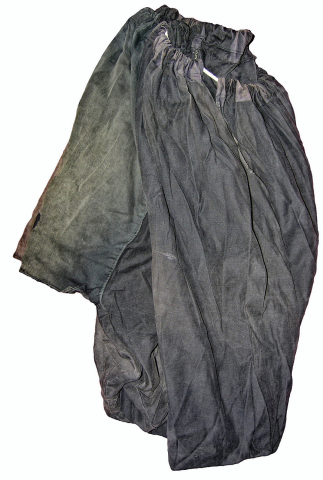
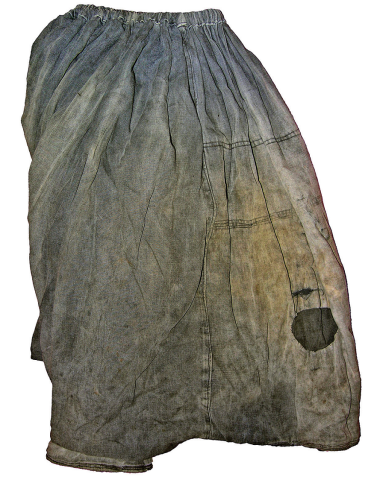
Turkish Cypriot men’s breeches (turk. dizlik) of factory-made black cloth. The body part, 72cm long, is composed of two pieces stitched together (lengthwise) in the middle of the front side and continuing at the back with the same seam. Each part of the legs, 70cm long and with a total width of 30cm, is folded and stitched lengthwise. At the extremi­ties the cloth is sewn together for 15cm, leaving an opening of 15cm. At the waist it is supported by a black strip of cloth (turk. uçkur/uşkur), which runs through a hem 2.5cm deep. In the middle under the girdle is a vertical opening 20cm long. The breeches have been repaired with patchwork, and the black colour is faded.

Translator: 
Euphrosyne Rizopoulou-Egoumenidou
Author: 
Euphrosyne Rizopoulou-Egoumenidou
Description: 

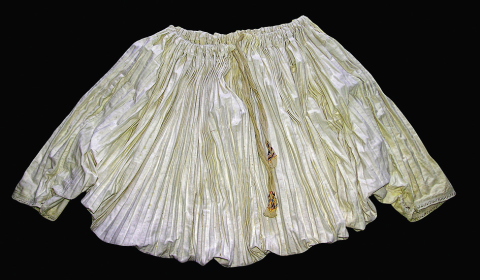
Turkish Cypriot men’s breeches (vraka, turk. dizlik) made of white, loom-woven cotton cloth. Two equal pieces form both the front and back of the body part. At the waist they are gathered with pleats and held in place by a plain white girdle (turk. uçkur/uşgur) which runs through a hem 5cm deep. Below the waist, on both sides, is a vertical slit 17cm long. The total width of the breeches (turk. Dizlik) is 2.16m and the total height 70cm. The leg parts, which are folded lengthwise and stitched to the body piece, have the same height and reach down to the knee (turk. diz), according to the meaning of the term dizlik. At the extremities they have openings 20cm wide for the legs. The edges of these openings are reinforced and orna­mented with three series of machine stitches. At about the middle of the height of the leg piece, is a decorative horizontal band consisting of a zigzag line bordered by a series of stitches. This dress item is very well preserved.

Translator: 
Euphrosyne Rizopoulou-Egoumenidou
Author: 
Euphrosyne Rizopoulou-Egoumenidou
Description: 

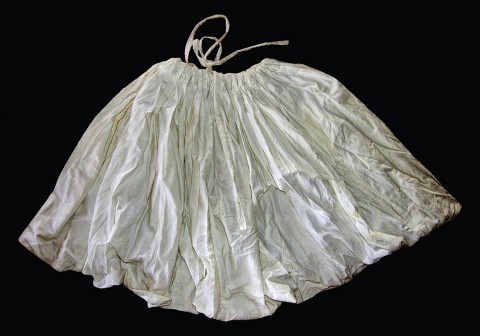
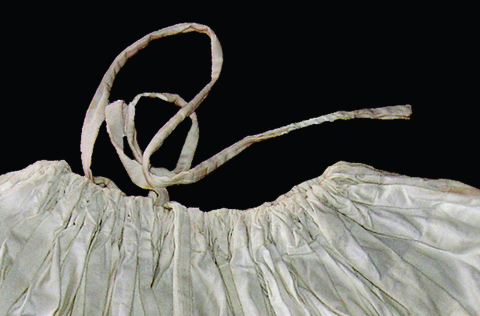
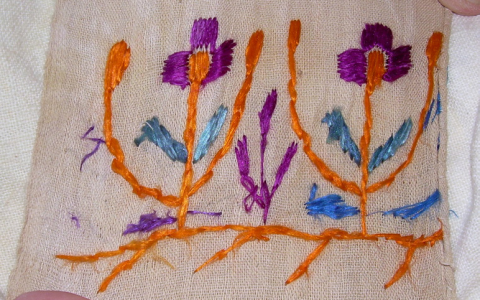
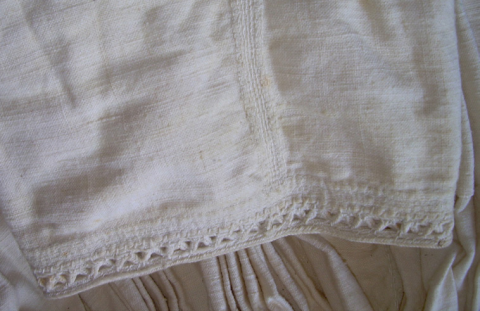
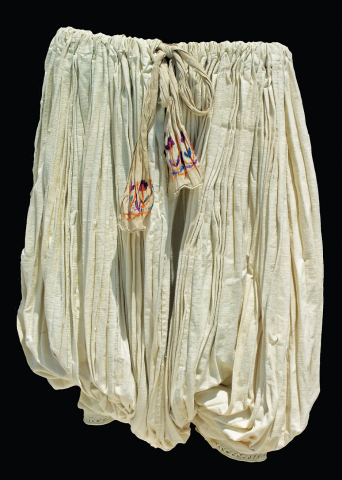
Pleated baggy trousers (vraka, turk. şalvar) made of white cotton cloth. The middle part consists of six pieces stitched together. Each piece is 50cm wide and the whole length is 1.48m. Each side part, for the legs, is made of four pieces sewn together by hand. The upper part of each side is 47cm wide and 15cm long. The lower part is one piece of the same width (47cm) and 20cm long, while the lowest part, which is attached with a thicker join with stitches, consists of two rectangular pieces of the same dimensions (each piece 23.5cm wide, and 42.5cm long), connected lengthwise. This part narrows downwards be­cause of the gathering and ends to the opening for the leg, which is 21cm wide. Next to the main opening, on the inside, there is a small slit, 5cm long. All around the opening are handmade braids (Turk. kaytan/gaytan) of the same cotton material. Another braid forms a wavy line and this is stitched to a double outer braid. At the waist the cloth is turned and stitched to form a casing through which to pass the drawstring/band (Turk. uçkur/uşkur). It is made of a length of dark beige cotton fabric, 10cm wide, whose ends are decorated with silks forming two flowers with leaves, in or­ange, lilac and blue colours. The embroidery is simple and naïf. Many of the pleats are still sewn together, indicating that the vraka was not used. Tradition has it that the reason for this was that the person to whom it belonged died soon after his wedding. It was not a wedding vraka, but it was brand new, made as part of the groom’s clothing. After his death nobody wanted to use it. The white colour was typical for the baggy trousers of the Turkish Cypriots.

Translator: 
Euphrosyne Rizopoulou-Egoumenidou
Author: 
Euphrosyne Rizopoulou-Egoumenidou
Description: 

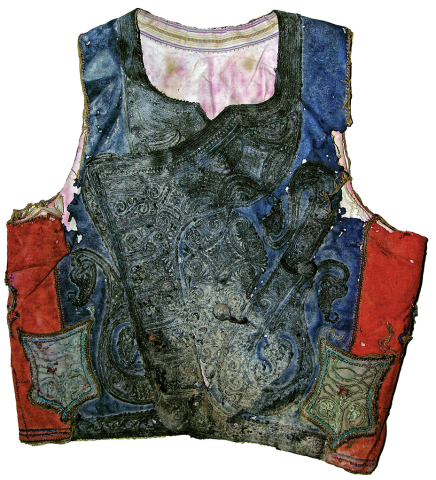
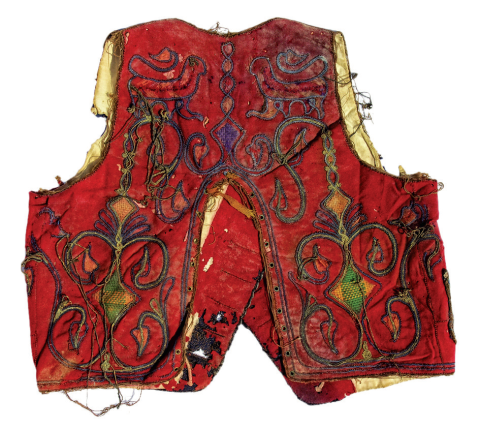
Waistcoat (Turk. kavuşturma yelek) made of blue and red broadcloth. The front consists of two pieces of blue broadcloth of the same size (7cm wide on the shoulder, 28cm at the broadest part and 16cm at the lower edge) and can be cross-fastened on either side by means of eight plaited buttons made of black twisted silk thread. There are eight button-holes but only two buttons have been preserved, connected inside with a cord in oblique arrangement. The back is also made of two pieces of red broadcloth; in the middle there is a vertical opening 22cm long, with 9 pairs of holes and one more at the top, for fas­tening with laces. The height of the back pieces from the shoulder to the bottom end is 40cm. The width of each piece is 7cm on the shoulder, 20cm at the broadest part, the top of the vertical slit, and 17.5cm at the lower end. Under the opening for the arms there are two side pieces of red velvet cloth, 8.5cm on the upper part and 4cm at the lower end. They are stitched to the front and back piece and the seam is covered with a braid (gaitania turk. kay­tan/gaytan) bordered by twisted threads, orange, black and purple, in the join with the front piece, and simply with twisted threads on the join with the back piece. On either side of the chest there is a vase-shaped outer pocket made of green velvet. The pockets are decorated with the pattern of a stylized tree with a bird on top, formed with twisted gold wire (turk. tel) sewn to them. The birds’ legs are embroidered with purple thread. The waistcoat is lined with white cotton material. A stripe of red broadcloth is used as reinforcement on either side of the front opening. Around the neck and chest open­ing there is a striped piping (turk. fitil) 2cm wide. The front part bears thick applied decoration, one S-shaped motif ending in a blossom or leaf, filled with scrolls or spirals and alternat­ing wickerwork patterns. The chest is adorned with sophisticated patterns, curving floral motifs, wickerwork patterns, lozenges, scrolls etc. Similar decoration is found all around the opening. The back is also richly adorned: on either side of the opening (vertical slit) there is an abstract flower motif with two lozenges, one smaller on the upper part with curving branches on either side ending in leaves or blossoms. The lower lozenge is filled with wickerwork in orange and green, the smaller in orange. The motif continues with a chain motif. On top of the opening there is a central lozenge and chain motif with two con­fronted lions, one on either side. The motifs are made of twisted threads and metal (gold) wire. The lions are filled with embroidery. Their bodies are made of two compartments separated by a twisted metal wire sewn to them. The eye of one lion is preserved and is made of a twisted gold wire forming a spiral. The lions’ tails end in a leaf-shaped pattern filled with embroidery. Similar decorative patterns, especially the motif of the confronted lions on either side of a schematized tree or plant, also appear on waistcoats which form part of tradi­tional costumes of the Greek Cypriots.The confronted lions are common in Greek folk art and have a very long tradition in art in general.
Pages