Black and white

Translator: 
Euphrosyne Rizopoulou-Egoumenidou
Noly Moyssi
Author: 
Euphrosyne Rizopoulou-Egoumenidou
Noly Moyssi
Description: 

The Abbé Giovanni Mariti arrived in Cyprus from Leghorn in February 2, 1760, and stayed in the island for seven years, till his return to Florence, October 6, 1767. Mariti was for some years an official of the Imperial and Tuscan Consulates. In 1769, he published at Lucca the Viaggi per l’ isola di Cipro, a book which stands as the best account of the condition of Cyprus in the third quarter of the 18th century. Mariti relied almost entirely on his own observations and notes during his stay in the island. His references to the appearance of the people of Cyprus, though not numerous, are valuable.

Comparing the appearance of the females of both nations, the Abbé Giovanni Mariti, who stayed in Cyprus seven years (1760-1767), records that “the Christian ladies when they go abroad make a great parade of their costumes, while the Turks are covered from head to foot with a white cotton sheet.” (Mariti (1769) 1971, 6)

Mariti also noticed various means applied by women to enhance their beauty; thus, he offers a detailed description of the plant henna, and the use of its leaves: “…The leaves, dry or fresh, when boiled in water produce a fine orange dye, with which the TURKISH WOMEN and a few Greeks stain their nails and the palms of their hands, with the idea that it refreshes the body. They dye their hair with it, as an adornment. And so tenacious is the dye, that it is not easy except by a long lapse of time to efface it.” (Mariti (1769) 1971, 12).

Translator: 
Euphrosyne Rizopoulou-Egoumenidou
Author: 
Euphrosyne Rizopoulou-Egoumenidou
Description: 

Giovanni Mariti

The Abbé Giovanni Mariti arrived in Cyprus from Leghorn in February 2, 1760, and stayed in the island for seven years, till his return to Florence, October 6, 1767. Mariti was for some years an official of the Imperial and Tuscan Consulates. In 1769, he published at Lucca the Viaggi per l’ isola di Cipro, a book which stands as the best account of the condition of Cyprus in the third quarter of the 18th century. Mariti relied almost entirely on his own observations and notes during his stay in the island. His references to the appearance of the people of Cyprus, though not numerous, are valuable. He offers a most vivid and detailed description of women’s dress:


- “The Cypriots are generally well formed, tall and good looking, sober and temperate. The women have mostly good eyes, but ugly features, and few are seen of any special beauty: they are tall, spirited, little industrious, and luxurious…. The men dress alla Turca, like those of Constantinople, and so too the women of any position, except as to the adornment of the head, which is high and striking, a fashion of very ancient date, which they say has been preserved here more faithfully than in the other Greek islands. Their general costume, alla Cipriotta, is more scanty than the other alla Turca; it consists of a kind of tight vest, and a skirt of red cotton cloth, the outer garment, which they call benisce (Turkish, binish) is of cloth, velvet or other silk stuff. This is a long mantle, which starts from the shoulders, and passing over the arms, almost reaches the ground. It is not closed in front, but leaves the body exposed down to the feet. The under garments are of silk, made in the country, and like white veils. They have drawers reaching to the feet, and their boots, called mesti (Turkish, mest), are a kind of low boots of yellow leather, which reach to the instep, under which they wear slippers. They wear no stays, but a little corset of dimity, which stops below the bosom, the rest being covered only by that plain, fine chemise, and another small piece of stuff which they wear for greater modesty. They adorn their necks and arms with pearls, jewels and gold chains. Their head dress, of which I have spoken above, consists of a collection of various handkerchiefs of muslin, prettily shaped, so that they form a kind of casque of a palm’s height, with a pendant behind to the end of which they attach another handkerchief folded in a triangle, and allowed to hang on their shoulders. When they go out of doors modesty requires that they should take a corner and pull it in front to cover the chin, mouth and nose. The greater part of the hair remains under the ornaments mentioned above, except on the forehead where it is divided into two locks, which are led along the temples to the ears, and the ends are allowed to hang loose behind over the shoulders. Those who have abundance of hair make as many as eight or ten plaits. Cypriot women like sweet odours about their heads, and to this end adorn them grotesquely with flowers. The Christian ladies when they go abroad make a great parade of their costumes, while the Turks are covered from head to foot with a white cotton sheet.” (Mariti (1769) 1971, 4-6)

Mariti also noticed various means applied by women to enhance their beauty; thus, he offers a detailed description of the plant henna, and the use of its leaves: “…The leaves, dry or fresh, when boiled in water produce a fine orange dye, with which the TURKISH WOMEN and a few Greeks stain their nails and the palms of their hands, with the idea that it refreshes the body. They dye their hair with it, as an adornment. And so tenacious is the dye, that it is not easy except by a long lapse of time to efface it.” (Mariti (1769) 1971, 12).

Mariti also refers shortly to the appearance of the Dragomans:

“Dragomans dress like Turks, but wear on their heads a qalpaq, or tall cap of marten or other skin, instead of the turban.” (Mariti (1769) 1971, 136).

Translator: 
Euphrosyne Rizopoulou-Egoumenidou
Author: 
Euphrosyne Rizopoulou-Egoumenidou
Description: 

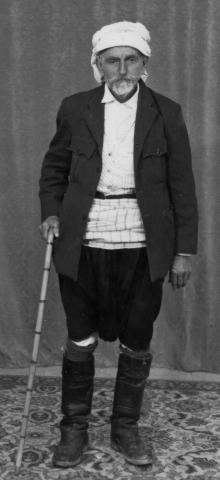
Studio photograph taken by Photo Atlas around 1960. It shows an old man standing with a walking stick in his right hand. He has a moustache and beard. He wears a military-style jacket over a white woven shirt, buttoned at the centre front, dark, probably black, baggy knee-breeches, a striped light-coloured sash (kuşak) around his waist, and leather peasant boots made by a cobbler (GC tsagkaropodínes/TCy çangar çizmesi). Under the boots on the upper part, one can see part of the white underwear and dark stockings. The boots are tied with strings under the knees. On his head he wears a white kulak çapıdı (a scarf to protect head and ears).

Translator: 
Euphrosyne Rizopoulou-Egoumenidou
Author: 
Euphrosyne Rizopoulou-Egoumenidou
Description: 

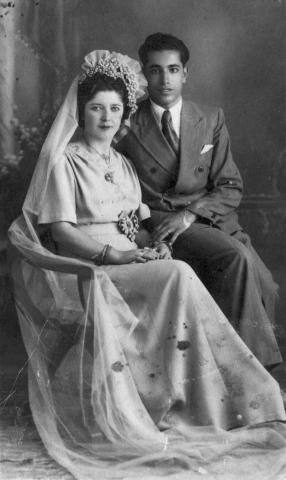
Photograph of a marriage registration, taken in an unknown studio in the late 1950s or early 1960s. The bride is sitting in an armchair and the groom on the arm of the chair.

The groom wears a modern suit of presumably light brown colour, white shirt and tie. A white handkerchief appears in the breast pocket of his jacket. He wears the wedding ring in his left hand, with which he touches the bride’s arm.

The bride wears a long stylish beige dress with a very long veil, which extends onto the floor. The crown (gelin başlığı) is made of artificial flowers, no diamonds (diamonds were exclusively worn at the wedding ceremony). The crown is placed high on the head, leaving the front part of the thick wavy hair exposed. Her lips and finger-nails are painted red. The bride holds one flower in her hands, and there is also a large flower decorating the belt, which is made of the same fabric with that of her dress. Another flower is attached in the middle of the chest. The dress has a V-neck, elbow-long sleeves and pleats on the front of the shoulders, opening onto the chest. She wears earrings, a necklace and bracelets, two on each arm, one of them of the type called burma (twisted); the others are called hasır (mat pattern).

Registration took place before the wedding ceremony, sometimes even years before. Traditionally, after registration the pair continued to live separately; only after the wedding ceremony could they settle in their new home. The bride’s name was Sadıka and the groom’s Muhsin.

Translator: 
Euphrosyne Rizopoulou-Egoumenidou
Author: 
Euphrosyne Rizopoulou-Egoumenidou
Description: 

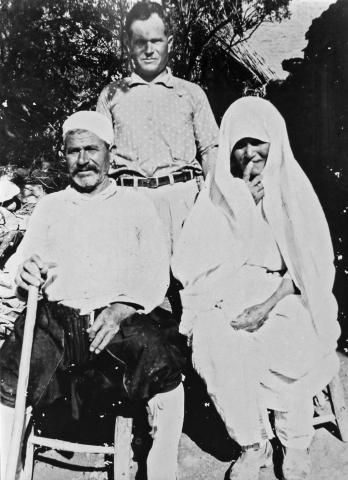
Photograph of an old couple sitting side by side on village chairs, with a young man standing behind between the two. It was taken in 1960, in the garden of a house in Kioneli (Gönyeli). The old couple are Arabacı Veli, a cart-driver as denoted by his name, and his wife Fatma Arabacı.

The old man wears a plain white shirt with a collar, woven on the loom with cotton thread, black baggy trousers (kara dizlik) and white stockings, which reach up to the knee to meet the breeches, and are tied with strings and tassels. His footwear is rawhide sandals (çarık), not seen here. The head is covered with a white skullcap (takke). In his right hand he holds a walking stick.

Fatma is completely wrapped in her çarşaf, which is made of loom-woven white striped cotton cloth (alaca). Underneath she wears long pantaloons (uzun don), also woven on the loom. Her veil comes down to the eyebrows, and one can see only the fingers of her right hand, on which she has a ring; with the index finger she touches her lips. The other hand lies on her lap. She also wears shoes with low heels.

The young man standing behind the couple, is Desdeban Mehmet, a person appointed by the British to watch the fields from thieves, animals etc. He has a western-style appearance; he wears a shirt with white dots and long khaki trousers held at the waist with a buckled leather belt.

Source: Ayşe Çoban.

Village: Kioneli (Gönyeli), Nicosia District.

Translator: 
Euphrosyne Rizopoulou-Egoumenidou
Author: 
Euphrosyne Rizopoulou-Egoumenidou
Description: 

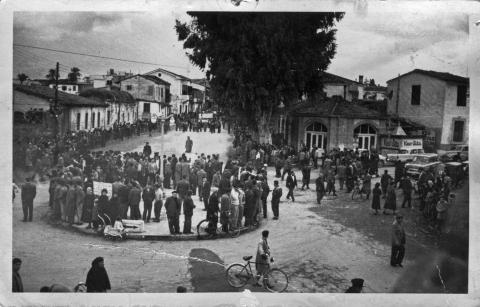
Amateur or press photograph of a meeting in the square in front of the Keryneia Gate (not seen), in Nicosia. The photograph was taken from the gate with a view of the city within the walls. There is a roundabout in the foreground, and on the left side one can see Mevlevi Tekke with its domes. To the right there is a coffee shop and a kiosk with the advertisement of Keo Vita soft drink and KEO KONYAK on the wall further back. Some people are on bicycles, while cars are parked on the extreme right. People are gathered mainly on the roundabout and in front of the Mevlevi Tekke. Probably it is a political meeting or demonstration. More people with banners are crowded in the background in front of the house of Dr Fazıl Küçük, leader of the Turkish community. The Turkish flag is hanging on the kiosk of the house. The photograph must have been taken after 1955, most probably about 1958.

Translator: 
Euphrosyne Rizopoulou-Egoumenidou
Author: 
Euphrosyne Rizopoulou-Egoumenidou
Description: 

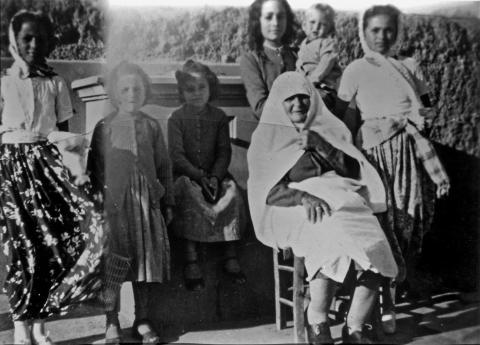
Outdoor photograph taken in the late 1950s in Kioneli (Gönyeli). The most important person, sitting on a chair, is the old lady Küçük Emete Sürmeli, who died at the age of 102. She wears a white, loom-woven çarşaf, the typical Muslim women’s outdoor garment in the form of a bed sheet, over a hand-knitted cardigan (fanella). With her left hand she holds her veil closed on the chest, while the right hand, on which she wears her engagement ring, is resting on her lap. The attire is complemented with white stockings and black front lace shoes with soles made of solid wood.

The old lady is surrounded by five young girls, one of them holding an infant. Behind them is a fountain which was built in Kioneli (Gönyeli) in 1952. The two girls at the extreme right and left of the photograph wear white headscarves tied under the chin, short-sleeved blouses and long pleated skirts with flower patterns; also striped sashes around the waist. The two girls in the centre – one standing, the other seated – wear simple dresses and knitted jackets closed with buttons. The girl (standing), second from the left, has white stockings and black bar shoes. Of the girl standing behind the old woman, we can see only her buttoned jacket over a white shirt. Her long hair falls in tresses over her shoulders. The little girl she holds in her arms seems to wear a dress over a sleeved shirt. The dresses of the young girls reflect the fashion which was common among ordinary people during the 1950s.

Translator: 
Euphrosyne Rizopoulou-Egoumenidou
Author: 
Euphrosyne Rizopoulou-Egoumenidou
Description: 

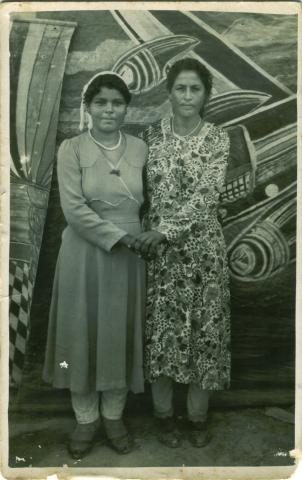
Street photograph showing two village girls, Meyrem Okay (born in 1936) and Ayşe Mustafa (born in 1933). The photograph was taken in 1955. They stand side by side in front of a background showing an aeroplane painted in modern style, and hold each other’s hand (right with left hand respectively) in front of them. Both wear modern, tailor-made sleeved dresses, one with flower patterns and the other monochrome. The dress of Ayşe looks more sophisticated; it has a V-neck and the skirt is pleated. Under the dress they wear pantaloons, which reach down to the ankles and are decorated with lace at the edges. Such pantaloons, but more baggy, and wider, are typical of the traditional dress of Karpasia, the easternmost part of the island. Therefore Turkish Cypriots called them Karpaz donu. In fact, the girls come from the village of Galinoporni (Kaleburnu), in Karpasia. The narrow, ankle-long pantaloons are in contrast to their modern dresses. They also wear traditional headscarves (yemeni) which leave exposed the front part of their black hair; Ayşe’s scarf is decorated with lace made with a hairpin (firkete), while that of Meyrem is ornamented with tassels (pompons). Both wear dark stockings and black shoes; their necklaces consist of a single row of beads.

The appearance of the two village girls is typical of a transitional phase, between traditional and modern, western-style dress; these examples reflect the culture of the previous generation in Karpasia; such traditions were not carried on by the new generation, that of the 1960s.

Translator: 
Euphrosyne Rizopoulou-Egoumenidou
Author: 
Euphrosyne Rizopoulou-Egoumenidou
Description: 

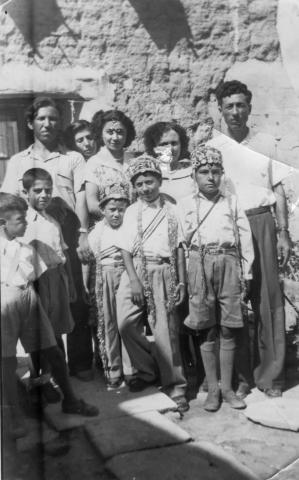
Photograph of relatives in front of a mudbrick house on the occasion of the day of circumcision (sünnet) of three boys, on the 7.9.1952. It was customary for circumcision to take place before boys went to school, about the age of six. In case there were more boys in the family, with a difference of a few years in age, the sünnet took place at the same time for all, for two or more brothers or relatives, taking into consideration that the oldest should not have passed his 8th year. Such seems to have been the case with the boys in the photograph. The boys are wearing white shirts and trousers, two of them long, the third short. Their appearance is modern, as also applies to all the other people on the photograph. The boys who had the sünnet were distinguished by a band made of shining material, worn diagonally across the chest, and the special headdress. On the bands the word maşallah, which means God´s blessing, is usually written. The headdress in those years was a fez covered with gold coins. Metallic silver tinsels (Greek téllia, Turk. tel) are shown hanging from both sides of this special headdress (başlık).

Translator: 
Euphrosyne Rizopoulou-Egoumenidou
Author: 
Euphrosyne Rizopoulou-Egoumenidou
Description: 

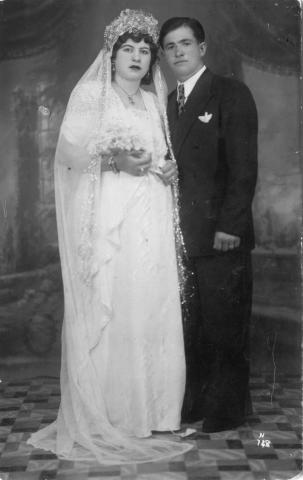
Wedding photograph taken in the studio of Fevzi Akarsu in 1951. The bride wears a white modern long wedding dress with a transparent veil falling down to the floor. The veil is attached to the impressive crown (gelin başlığı) on her head, which is made of diamonds and imitations of flowers. It was customary to borrow diamonds from relatives and friends and to return them after the wedding. On both sides of the crown hang gold or silver tinsels (similar to those used for Christmas and New Year decoration). The bride also wears earrings, a medallion, a bracelet and rings on both hands, one of them the wedding ring. She is holding a bunch of artificial flowers.

The groom wears a European suit with double-breasted jacket, a handkerchief in the breast pocket and a tie (Turk. kravat). He wears a wedding ring, on his left hand, instead of the right, in order to show it on the photograph. The bride is called Emine and the groom Ömer.

Pages