Yeroskipou Folk Art Museum

Translator: 
Euphrosyne Rizopoulou-Egoumenidou
Noly Moyssi
Author: 
Euphrosyne Rizopoulou-Egoumenidou
Noly Moyssi
Description: 

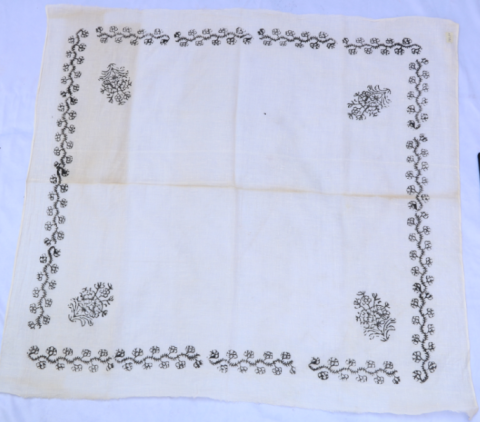
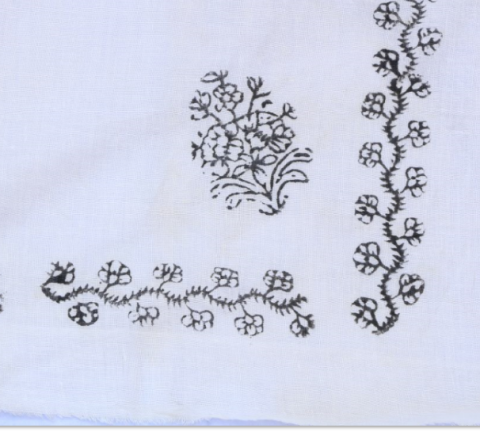
Headscarf (tsemberi) made of fine cotton cloth (kouroukla), with black (karakalemi) printed floral decoration consisting of continuous, narrow wreaths of printed patterns around the borders (kenarin) and branches with flowers in the corners. 

Translator: 
Euphrosyne Rizopoulou-Egoumenidou
Noly Moyssi
Author: 
Euphrosyne Rizopoulou-Egoumenidou
Noly Moyssi
Description: 

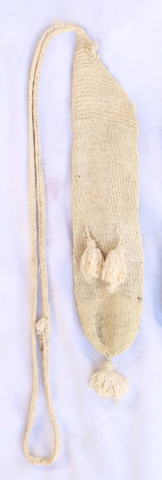
Purse made of cotton thread in its natural off-white colour. It is hand-knitted with decorative patterns in nine horizontal rows. The four of them have perforated patterns. The lower part is plain, densely knitted. The lower part has two decorative additional tassels and also one at the bottom of the purse. All of them are made from the same material and of the same colour with the purse. The openning is closed with a string.

Translator: 
Petroula Hadjittofi
Author: 
Euphrosyne Rizopoulou-Egoumenidou
Petroula Hadjittofi
Description: 

ΜΓ 385

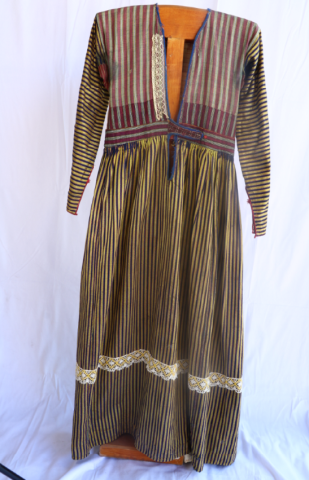
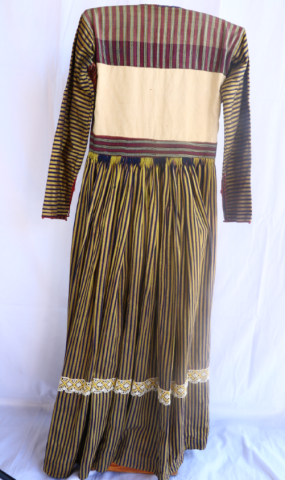
Formal foustanin of striped silk(?) imported fabric with gold, blue and fine red-white stripes. Because of its weave, the gold colour is not visible internally. Cotton alatzia with broad burgundy stripes, alternating with intricate bands of black-delimited white and green stripes, is used on the breast, the waistband and part of the back. That specific part of the dress is particularly worn from long use, showing altered colours, especially under the armpits. Beige cotton fabric has been added to the lower part of the back.


The dress has a simple neckline and a vertical opening at the front, 44 cm tall, which reaches below the waist at a height of 11-12 cm. Fine ready-made(?) banded lace is sewn onto the right side of the opening. Similar lace was probably originally featured on the left side of the breast too. At the front, either side of the breast consists of two panels of cotton alatzia, hand-sewn with red thread. The lower panel, 5.5 cm in height, as well as the waistband, 3.5-4 cm tall, are made of the same alatzia but preserve their original vibrant colours. The upper panels extend to the back in a single fabric piece, 5.5 cm in height. Its lower part, which is joined to the cotton fabric that forms the lower part of the back up to the waistband (height: 17.5 cm, width: 37.5 cm), also features more vibrant colours.


The stripes of the alatzia are horizontal on the waistband. Either side of the front opening extends to a tongue-shaped end made of an added band of a different fabric (10 cm long on the left and 7 cm long on the right). Each extension features a hook, paired to an eye on the waistband, one internally and the other externally. A blue trimming band, densely stitched with orange thread, runs along the entire length of the opening and the extensions of the waistband.


The skirt is wide, densely gathered in the upper part, where it is joined to the waistband. It comprises four pieces of fabric, 60 cm wide each, with the stripes in horizontal arrangement. The blue selvedge is discernible at the handmade joints. At 30 cm over the hem, 4.5 cm-wide lace with consecutive yellow-gold lozenges, is stitched by hand (basting) with white thread along the upper side, whereas the lower side is unstitched. A reinforcing band of white cotton fabric, 3.5-5 cm wide, is hand-stitched with orange cotton thread.


The sleeves are made of the same silk fabric as the skirt, with the stripes in horizontal arrangement. Sewn vertically to the body, they consist of a single fabric piece with an inseam. Two gussets of striped cotton alatzia, red with fine yellow stripes, have been added to each armpit to repair wear. A 14 cm- tall opening is featured at the lower end of each sleeve. A decorative sewn-in braid runs around the edge of the sleeve. Small loops are created in two places on the braid whereas a small tassel is featured at the middle of the opening’s one side.


The bodice of the dress is lined with various types of fabrics: white-beige cotton fabric with red criss-cross stripes for the body; plain white cotton on the sleeves, up to the opening, and for the lower part alatzia with blue, yellow, green and burgundy stripes (height of lining at the opening: 23 cm).


In the Registry of the Museum the dress has been entered as a wedding dress. The poorly preserved upper part of the dress suggests that, albeit originally formal, the garment had been overused.


Height: 125 cm (bodice: 33 cm, skirt: 92 cm).

Width: 36 cm at the waist.

Length of sleeves: 51.5 cm.

Width of sleeves: 13 cm.

Date of entry to the Collection: 8.7.1983

Provenance: Theletra, Pafos – Purchased from Despoinou Nikola.

Translator: 
Petroula Hadjittofi
Author: 
Euphrosyne Rizopoulou-Egoumenidou
Petroula Hadjittofi
Description: 

ΜΓ184


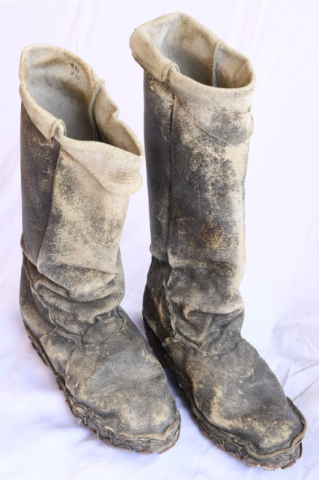
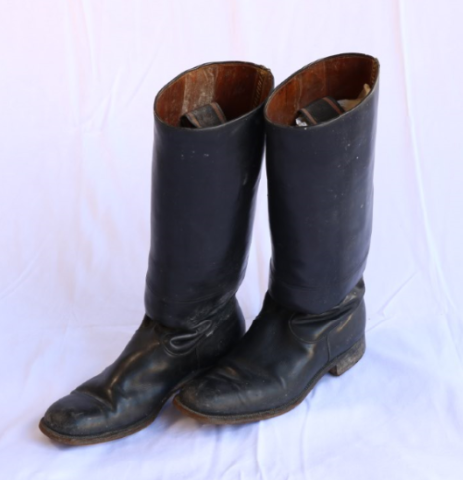
Pair of man’s hobnailed peasant boots made of thick leather, outer side dyed black.


The boots are knee-high and heavy, without distinction of left and right foot.

Each boot consists of three pieces in the lower part, one at front, one on the side externally and one at the rear that covers the heel of the foot and extends sideways. Above the promouttin (nose), namely the front section, there is a tongue made of a separate piece of leather. The shaft consists of two sections joined vertically on the sides. All the different pieces have been sewn together with thick string. On either side of the joints holding together the two shaft sections, there is machine stitching. At the top of the boots, the leather is turned outwards (height: 3 cm), forming a tongue at front (height: 6 cm). On one boot, in the upper part, there is sewing with string, evidently for mending torn leather.


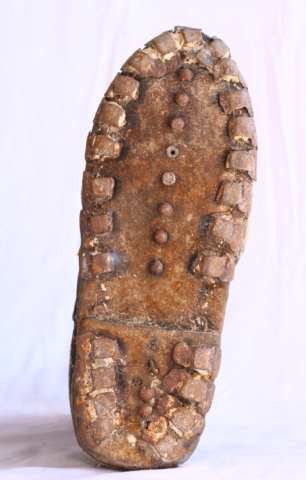
The soles consist of superposed sole leathers, more numerous at the rear where low heels are formed. Large, flat-headed iron nails called rizes (=roots), have been inserted into the soles all around, while a row of round-headed hobnails extends to the centre. A total of 24 rizes and 6 hobnails survive in one boot, with 25 rizes and 9 hobnails in the other. Along the joint of the leather to the sole, small metallic nails (spondilia) have been inserted. The wide heads of the rizes are turned upwards, covering the rim of the sole.


A decorative element, namely an interlaced curvilinear pattern made with fine machine stitches, is discerned all around the bottom section of one boot. Curvilinear machine stitching is discerned in the front section of the other boot.

The boots are worn from use. Even the black dye, that used to cover the entire outer surface, has faded.


As opposed to cordwainer’s boots (skarparisimes podines, see ΜΓ 55, ΧΑΜ) the less elaborate but more resilient hobnailed peasant boots were made by tsagkari(d)es, namely specialised bootmakers, without distinction of left and right foot, for use by farmers and shepherds. Normally, the leather used for hobnailed peasant boots came from the hide of a two-year-old male goat (dietis).


Boot height: 44-45 cm.

Sole length: 27.5 cm.

Date of entry to the Collection: 2.9.1979

Provenance: Theletra, Pafos – Purchase by Nikolaos Stylianou.

Translator: 
Petroula Hadjittofi
Author: 
Euphrosyne Rizopoulou-Egoumenidou
Petroula Hadjittofi
Description: 

ΜΓ 349

Wide cream silk chemise with long sleeves. The fine fabric of the garment features alternating broad and fine, light brown stripes, vertically arranged across all the main pieces.

The central front part is made of a single fabric panel, 44 cm wide, which extends to the back. A long vertical curved opening reaches from the neck to the middle, at a height of 52 cm. Another two fabric panels make up the sides of the garment (one on each side) and also the sleeves, which feature a seam along the outer side of the arm. A triangular fabric segment, 15 cm long, has been added on each shoulder, extending to the upper arm. The separate fabric sections of the chemise have a selvedge of black and beige stripes, which forms a decorative band across the two vertical joints front and back, as well as on the triangular segments on the shoulders and sleeves.

The edge of the sleeves is decorated with fine lace, beige and black. A similar lace trims the neckline and the breast opening, down to a height of 41 cm. The bottom part of the front opening (height: 11 cm) has a finish of very fine lace with consecutive arches. A low hem runs along the bottom of the chemise.

Height: 84 cm.

Width: 85 cm.

Sleeve length: 52-53 cm.

Sleeve width: 20 cm.

Date of entry to the Collection: 18.9.1981

Provenance: Unknown.

Translator: 
Petroula Hadjittofi
Author: 
Euphrosyne Rizopoulou-Egoumenidou
Petroula Hadjittofi
Description: 

ΜΓ 302

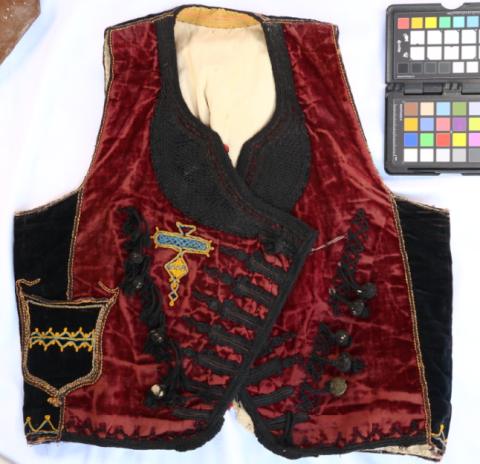
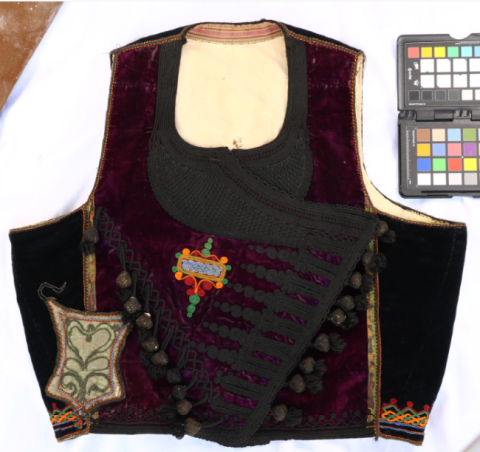
A man’s double-breasted vest made of maroon and black velvet.

The front consists of a panel of maroon velvet on either side of the breast. Each of the two front panels is joined on the side to an oblong piece of black velvet. The back, also of black velvet, appears as a single piece, with a slit lengthwise at the centre, from the waist until high up on the back (opening height: 28.5 cm).

The vest closes on either side, with two oblique rows of eight buttons fixed to a black braided cord, sewn-on inside. The buttons have a beige fabric core and a lining of black cord. The long loops to which the buttons are fixed are joined at the base by an oblique band of fine, black double cord forming a double row of lozenges (net pattern). Rows of cords, combined with braids, also frame the oblong buttonholes. The arched tops of five buttonholes are crowned by a decorative pattern in spiral formations. The oblong opening of the buttonholes allowed the buttons to move, offering ease of movement. Such comfort was necessary, given that the vests were worn as festive garments and for dancing.

Along the neck opening extend rows of braids and black cords that follow the contour and continue until the bottom edge of the front panels of the vest. In the lower part of the neck opening, between the rows of cords, a fine band includes consecutive spirals, exposing the red velvet of the base. Further down, there develops a dense mat pattern with a curvilinear end in the lower part, which is defined by parallel rows of cords and spiral motifs. On the contour of the neckline couched decoration, numerous stitches of light-coloured thread are discernible, fixing the decoration to the fabric.

On the right side of the breast, beneath the decoration of the neck opening, there is a geometrical design, formed of yellow and light-blue twisted cords. The central pattern is rectangular, filled with blue braid, over which a triangular design is formed, empty on the inside. Lower, a lozenge with mat filling extends to the lower part with smaller spirals and a tiny lozenge between them. Further down on the same side, a vase-shaped pocket is trimmed with rows of twisted cords of brown-yellow and light-blue, as well as a brown/black braid. The ends of the brown-yellow cords are projected hook-shaped in the upper extremities, whereas in the lower part they open up to form a tassel. At the centre of the pocket, there extends a horizontal decorative design of two parallel cords, one yellow and one light-blue, that form two zig-zag lines with small loops on the corners, above and below a horizontal line. The pocket is placed above the seam of the vest on the side. The armholes and the side seams are accentuated by brown/black braid and one or two twisted cords of brown-yellow.

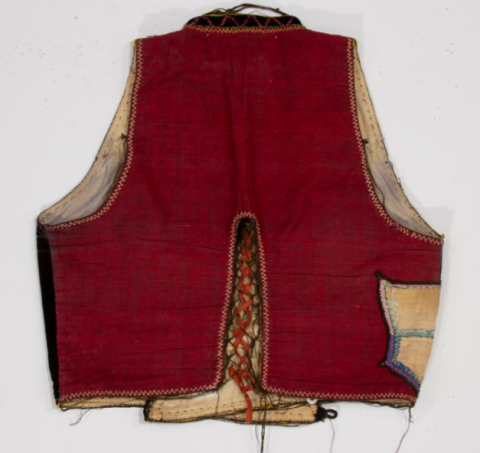
On the back of the vest, a ribbon of red fabric criss-crosses through fourteen holes with metallic eyelets, facing each other on either side of the vertical opening. The opening is trimmed with brown braid and a twisted brown-yellow cord, whereas on the inside of the metallic eyelets, a double cord, light blue and twisted brown-yellow, repeats the shape of the opening. Innermost zig-zag lines formed with light blue and yellow cord, with small loops on the tops, continue along the edges of the back and extend to the side. On the front, on the red velvet, a zig-zag line of black cord continues to the lower edges above rows of cords. The curve of the contour at the base of the neck opening is decorated externally with a sewn-on row of dense loops, also of black cord. Over the opening of the back, there is a symmetrical decorative design with a lozenge at the centre and oval shapes above and below. At the base of the design, on either side above the top of the opening, there are two leaf-shaped patterns. The border of the design is formed with yellow and light blue cord, whereas the inside of the patterns is covered by rows of coloured twisted threads in green, yellow and red. On the inside of the lozenge, twisted cords in red form a mat pattern, through which a double cord in light blue runs horizontally.

The inside of the vest is covered by beige cotton lining, hand-sewn. Along the perimeter of the neck opening, there extends a reinforcing band of fabric with pink and green stripes, hand-sewn with black thread. Further down, the bias-cut opening of the breast is reinforced internally on both sides with a piece of black velvet.

Height: 42 cm.

Width: 24 cm on the shoulders, 40 cm at the armpits, 34 cm at the waist.

Date of entry to the Collection 13.9.1980

Provenance: Polemi, Pafos – Purchased from Ι. Theodosiou.


Translator: 
Petroula Hadjittofi
Author: 
Euphrosyne Rizopoulou-Egoumenidou
Petroula Hadjittofi
Description: 

[ΜΓ 55]

Pair of man’s knee-high leather boots.


The lower part consists of two pieces. The front piece (promouttin) has a rounded toe box and extends to a tongue at the instep. It is joined at the sides to the back piece, covering the heel of the foot. A third piece forms the shaft, reaching below the knee. The different pieces have been joined with rows of machine stitches. Βrown leather lining, discerned on the inside, is also sewn with machine stitches. At the back of the shaft there is a backstay, namely an additional sewn-on vertical strip, joined to the protruding tongue of the back piece that covers the heel of the foot. On the inside of the backstay, the joint of the single piece that forms the shaft is discernible, made with a handmade seam of parallel thick-thread stitches. This joint is framed by double machine stitching, intended to secure the added backstay. At the upper part of the boots, around the edge, there is a small hem, sewn with machine stitches. Below the middle of the shaft there are two parallel horizonal decorative bands, also of machine stitches. Near the upper part of the boots two opposite-facing pull straps are made of wide black textile bands, with single brown stripes along their edges.


The sole, normally made of ox hide, is thick, comprising two layers of leather and slightly protruding all around. Machine stitches are visible along the welt. The low heel, 1.9 cm tall, is built with three superposed layers of leather and rests on a separate cap, secured with a double row of small nails (spondilia).


This is a pair of well-made Frankish boots (Frankopodines) crafted by a cordwainer (skarparis). Cordwainer boots were normally worn in the urban centres and the countryside on official and festive occasions.


Boot height: 41 cm.

Sole length: 29 cm.

Date of entry to the Collection: 14.9.1949

Provenance: Ktima, Pafos.

Translator: 
Petroula Hadjittofi
Author: 
Euphrosyne Rizopoulou-Egoumenidou
Petroula Hadjittofi
Description: 

ΜΓ 45

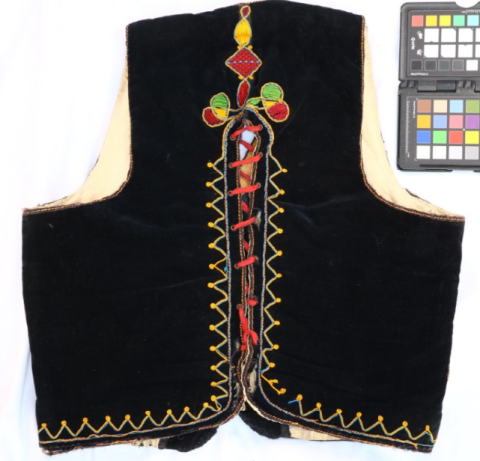
A man’s double-breasted vest made of black and maroon velvet.

The front of the vest consists of two panels of maroon velvet on either side of the breast, one of which, high on the shoulder, is small. Beneath each armpit, a triangular panel of black velvet has been added, whereas the back is formed as a single piece, also of black velvet.

The vest closes on either side, with two oblique rows of eight spherical buttons, fixed from the inside to a thick braided cord, also placed obliquely. The handmade buttons, of black cord around an off-white fabric core, suspend from the ends of long braided loops to allow ease of movement. The loops of the buttons project through a double row of lozenges made with couched black cords. Buttonholes with an oblong opening correspond to the buttons, also for ease of movement. They are defined by rows of cords and terminate at a row of spirals where there is available room.

The deep and wide oval opening at the breast is trimmed with rows of black cords or also braids, which extend to the horizontal bottom edge of the vest. In the lower part of the opening, black cords also form a mat design in repetitive curved lines, as well as spirals in different combinations. Further down, the right side of the breast has a decorative element made of colourful cords. The central rectangular pattern is outlined by rows of cords in yellow and orange, and is filled with blue cords forming a dense braid. Above and below, spirals of cords in green, red and orange are formed. The selvedge of the two front panels of the velvet fabric, in yellow, brown, green and orange, appears at the vertical joints with the black velvet side panels.

On the right side of the vest, part of the selvedge and the velvet fabrics on either side is covered by a sewn-on vase-shaped pocket of worn green velvet. The outline of the pocket is trimmed with rows of green and multicoloured cords with hook-shaped opposite-facing ends at the uppermost edges. In the lower part of the pocket, the open ends of the cords form a tassel. The surface of the pocket, within a frame of double cord, blue and multicoloured, is decorated with a schematized floral pattern, composed in the upper part by a heart with a double border and in the lower part by pairs of opposite-facing leaves. Four spirals are formed in the upper part of the heart. The pattern is made of silver-coloured metal-wrapped cord.

The armholes are framed by multicoloured and black cords that also run along the shoulders and the back of the neck. The bias-cut opening of the vest, from the breast to the lower side, is defined externally by kamaroues, small arches of thick black cord. Lower, the curve of the opposite-facing corners at the base of the opening of the vest has, externally, a sewn-on row of dense taller arches, also of black cord. The bottom edge of the front panels is decorated lengthwise, above the rows of black cords, with consecutive lozenges, also of black cord, terminating at spirals on their tops.

On the back side of the vest, a vertical opening extends from the waist up high on the back (height: 21.5 cm). Along the perimeter of the opening, thirteen holes with circular metallic eyelets are formed, through which a ribbon would pass, meant to be fastened in the lower part. The opening is trimmed with two rows of double cords, blue and multicouloured. Further inside, it is flanked by three interlaced rows of lozenges, formed by double cords of green and orange. Along the inner side of the pattern there extends a red cord, forming spirals at the tops of the inner row of lozenges. This decoration extends along the bottom edge of the vest. In the upper part of the vertical opening, a schematized floral pattern is composed of a lozenge at the centre, two superposed oval patterns in the upper part, and in the lower part, symmetrical leaf-shaped elements on either side of the oval shape. The outlines are formed by orange, blue and multicouloured cords, whereas the oval and leaf-shaped elements are filled with rows of green and red cords. Blue cords form a mat pattern that covers the inside of the lozenge. The entire couched decoration of the vest is fixed at various points with widely distanced handmade stitches in colours that parallel those of the patterns.

On the inside, the vest is lined with white-beige cotton fabric. Near the opening of one arm, the selvedge of the lining is discernible with coloured stripes in yellow, green and blue. Along the neck opening, there extends a reinforcing band of fabric with burgundy, red, blue, yellow and multicoloured stripes, hand-sewn with black thread. Lower, the bias-cut opening of the breast is reinforced on the inside on both sides with a piece of black velvet. The imprint of a blank-ink-stamp may be discerned on the lining. It includes an unintelligible inscription in three rows within an oval frame. Tentatively, the word YFASMATON [of fabrics] may be discerned in the upper row, and LEFKOSIA [Nicosia] in the lower row.

Height: 43 cm.

Width: 25 cm on the shoulders, 45 cm at the armpits, 37.5 cm at the waist.

Date of entry to the Collection: 13.12.1948

Provenance: Kelokedara, Pafos – Purchase.

Translator: 
Petroula Hadjittofi
Author: 
Euphrosyne Rizopoulou-Egoumenidou
Petroula Hadjittofi
Description: 

ΜΓ 41

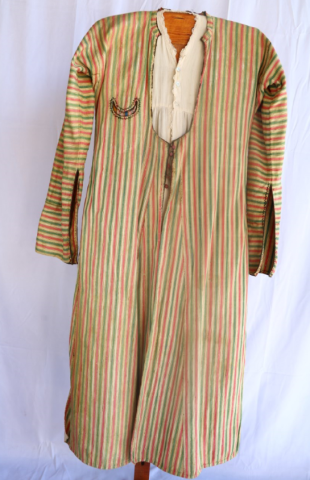
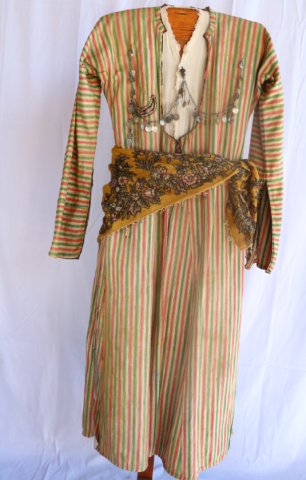
Saya of silk or silk-cotton fabric with alternating red and green stripes, flanked by finer stripes in other colours.


The long-sleeved garment features a deep oval neckline that extends into a vertical opening. The upper part of this opening closes with five handmade spherical buttons of an off-white fabric core, lined with maroon thread. The buttons were originally paired with loops, yet only two posterior loops of black cord survive.


The entire back side and both front panels of the saya consist of a single fabric panel with seams along the sides. Two side openings in the lower part of the garment (height: 37 cm) are framed by two narrow gores each. These gores, which match the height of the vertical front opening, widen towards the hem to enhance movement (maximum width: 6-7 cm). The side openings are trimmed along their upper part with white braid. Two elongated trapezoid gores extend additionally on either side of the vertical front opening, again widening towards the hem (maximum width: 18 cm).


The upright collar (height: 2 cm) is lined with the fabric of the saya. Black braid edges the collar, the neckline and, further down, the upper part of the vertical opening. The saya reaches to the mid-calf, featuring a simple hem finish.


The long sleeves comprise a single fabric panel with an inseam, an additional fabric piece at the lower end, measuring 14 cm in height, as well as two triangular gussets joined lengthwise at the armpit. In their lower part, an oblong vertical opening extends from the inseam, measuring 25 cm in height. Black braid adorns the sleeve edge, while zig-zag stitching in the same colour extends further inside. The sleeve lining is made of the saya fabric, yet its stripes are arranged in the opposite direction than those on the sleeve.


The saya is lined with beige cotton fabric. On the right side, a large pocket (height: 32 cm, width: 16 cm) features an opening trimmed with white braid. Higher up on the breast, a small pocket is lined in the upper part with a colourful imported fabric, combining stripes and floral motifs. The lining is discernible on the 6 cm long sickle-shaped pocket opening, which is bordered by fine black braid and zig-zag stitching in the same colour.


Height: 117 cm.

Length of sleeves: 57.5 cm.

Width of sleeves: 15 cm.

Date of entry to the Collection: 10.11.1948

Provenance: Lasa, Pafos – Purchase.


Translator: 
Petroula Hadjittofi
Author: 
Euphrosyne Rizopoulou-Egoumenidou
Petroula Hadjittofi
Description: 

ΜΓ 39

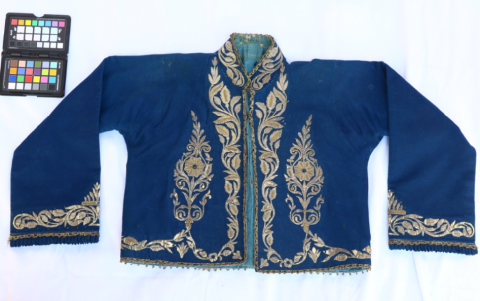
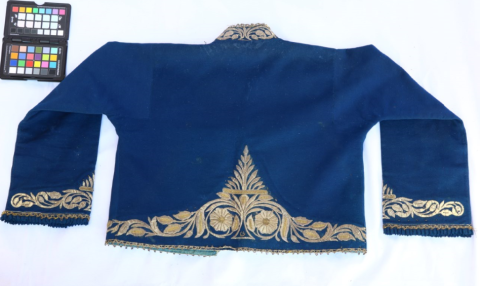
A woman’s sarka of blue felt, decorated with goldwork.


It consists of two front panels, one on each side of the breast, joined to the single back piece through shoulder and side seams.


The sleeves are cut from a single piece of fabric with an inseam that extends to the sides of the garment, reaching down to the hem. They are set in at right angles and their lower end comprises an additional piece of felt, 2 cm tall, featuring an indented edge. This additional section is gathered in folds, held in place by continuous basting stitches. Its upper side is delimited by a band of lace-like goldwork and, further up, by a fine cord of silver(?) thread. The 1 cm-tall goldwork band features continuous inverted arches below a straight braiding. Similar embellishments are found on other locally constructed sarkes.


The garment’s upright collar, measuring 4 cm in height, consists of a separate fabric piece sewn onto the round neckline with a handmade seam. All other garment seams are also made by hand. The collar closes at the base of the neck with a hook-and-eye fastener. A second hook-and-eye, further below, closes the vertical opening extending down the front. The collar border, the front opening and the hem of the garment are trimmed with an appliqué goldwork band, matching that on the sleeves. A fine cord of twisted silver thread(?) further adorns these areas externally.


Elaborate embroidery graces the collar, sleeve ends, entire hem and both sides of the vertical opening. Floral motifs of silver(?) thread and tir-tir (spiral wire) thread in bright gold colour stand out against the blue felt. The embroidery employs satin stitch over padding of cardboard paper, creating a relief  effect. On the collar, a winding branch with leaves and fruit of silver thread stems from a triangle at the centre of the nape and extends symmetrically toward the front opening. The same design is repeated on both sleeves with an added palmette motif crowning its centre. This motif features upright leaves emerging from an elongated horizontal element, filled with an interlace of tir-tir threads within a simple border. Tiny gold-coloured sequins are sewn-on sparsely, using tir-tir thread that passes through a central hole. More sequins survive on the right sleeve, scattered around and in-between the embroidered design.


A similar, yet larger and more enriched palmette motif is depicted at the centre of the back (height: 18 cm). A triple row of tir-tir interlace fills the elongated horizontal element at its centre. Further down, the palmette’s base is flanked by two spirals of leaved branches (one on each side), ending in a multi-petal rosette. At the centre of the flower, an interlace borders four clusters of four or five tir-tir rows arranged in opposite directions. A circular interlace motif of tir-tir emerges upon the blue felt at the triangular base of the palmette. This was once embellished with scattered sequins, most of which do not survive. Two opposite-facing leaved branches extend from the palmette to the front opening, continuing up to the base of the collar on either side of the garment. Each side of the breast is further adorned with an upright schematized branch, emerging from the decoration down at the hem. Each branch boasts leaves and a big central rosette, the petals of which are filled with continuous tir-tir rows. The rosette’s uncovered centre is defined by a tir-tir interlace and adorned with a sequin in the middle. The largest branch leaves of the embroidered decoration are filled with parallel rows or interlaces of tir-tir. Small five-leaved palmettes fill the space below the upright branches, while three-leaved motifs adorn the outer bottom corners of the front opening.


The sarka features a light blue/indigo lining sewn with blue or beige thread. Thick fabric reinforces internally all embroidered areas, including the collar. Although subtle, the reinforcement becomes discernible where the blue cotton lining has worn.


This sarka, namely one of the oldest garments in the Collection, bears a characteristic type of decoration that is rarely met in Cyprus. The neoclassical motifs and embroidery techniques employed evoke the goldwork adornment on luxurious overcoats, which were once part of dress ensembles associated with Hellenic urban centres. The sarka is comparable to overcoats dating back to Queen Amalia’s era, from the mid-19th c. onwards. Given that similar elements –  such as the ready-made lace-like goldwork bands, as well as the light blue/indigo lining – appear on other sarkes within the Collection and in other Cypriot museums, it is considered possible that the sarka was crafted in Cyprus.


Height: 41 cm (including the goldwork band at the bottom).

Width: 50 cm (underarms) 46 cm (at the waist), 36 cm (on the shoulders).

Sleeve length: 47 cm.

Sleeve width: 16 cm.

Date of entry to the Collection: 10.11.1948

Provenance: Goudi, Pafos – Purchase.


Pages