Male

Translator: 
Petroula Hadjittofi
Author: 
Euphrosyne Rizopoulou-Egoumenidou
Petroula Hadjittofi
Description: 

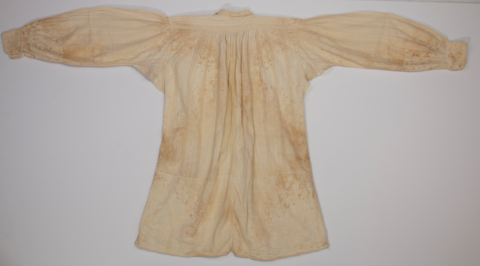
ΜΓ 745

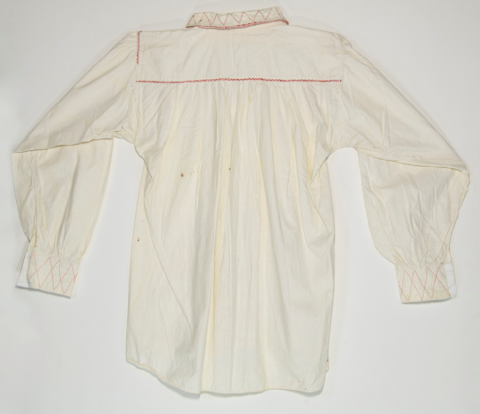
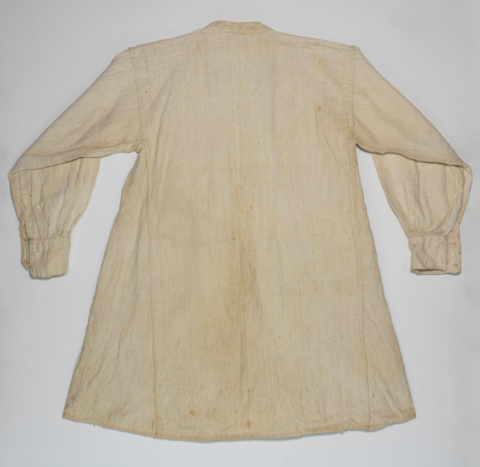
A man’s shirt of white cotton fabric.

Its largest part, not including the upper section back and front, consists of two fabric panels with machine-sewn vertical joints at the sides, beneath the armpits. A low machine-stitched hem extends along the bottom of the shirt. Τhe upper part of the garment, front and back, consists of two additional oblong pieces of double fabric (length: 37.5 cm for the breast piece and 41 cm for the back; height: 18 cm for the breast piece and 12 cm for the back), joined with a machine-made seam along the right shoulder. The seam is overlaid by handmade decorative feather stitch of white thread. On the left shoulder, the open joint closes with three buttons, one of which is placed at the collar stand, over the neckline.

The collar stand consists of a 2 cm tall band, secured with machine stitching along its edges. The collar fall ends in pointed tips at the front (maximum height: 6 cm). When the collar is closed, the tops of its points are 3 cm apart. A second button on the collar stand, sewn on the left of the centre front, is paired to a loop of red thread at the underside of the collar’s left pointed tip. The collar fall is made of double fabric and covered on the inside by consecutive lozenges, 5x3 cm, of red machine-made stitches. Near its outer edges, the collar is also decorated with a handmade stitch of white thread, similar to that on the right shoulder. The outer sides of the collar are trimmed with ready-made machine-stitched white edging, decorated lengthwise with embroidered red motifs, namely lozenges alternating with four-lobe elements. The wavy outer side of the edging is accentuated with red thread.

The breast is covered by a composite floral motif, consisting of a vertical stem with three pairs of opposite-facing leaves and a four-petal flower, crowned with a three-lobe blossom. At the base of the stem there is a multi-petal flower with an upside-down palmette at the bottom. The flower consists of a disk-like centre encircled by eight pointed petals. It may represent a sunflower. From the flower emerge two opposite-facing branches with stems, leaves, rosettes with spear-like petals, and multi-petal flowers similar to the central one. Each branch ends in a pomegranate. Two opposite-facing birds flank the central stem. Embroidered branches of red and white thread border the floral composition on the left and right. All embroidered motifs consist of dense interlaced stitches, creating solid surfaces. 

Beneath the breast, tucks cover a four-sided surface, 25.5 cm long and 20 cm high. At the centre and near the edges, a wider double tuck, 3 cm wide, is framed by smaller ones, 0.5 cm wide. All the small tucks are stitched along one of their long sides, whereas on the wide tucks two vertical seams, that form opposite-facing tucks, flank the decorated centre. The decoration consists of curvilinear embroidered motifs made of blanket stitch (continuous wavy line from which tiny vertical straight lines emerge) in red colour. At the central tuck, the wavy motif is interlaced with a similar one of white thread. Three opposite-facing oblique strands of a different stitch, namely feather stitch (the upper and lower strands made of red thread, the central one of white), join the three vertical wavy bands. Beneath the part with the stitched tucks, free pleats extend down to the hem of the chemise.

At the back of the garment, free pleats are formed beneath the horizontal seam of the upper segment. The machine-made joint is accentuated lengthwise by handmade feather stitch of red thread.

The sleeves consist of a single piece of fabric with a machine-made inseam. Along the inner side of each sleeve, an elongated triangular gusset tapers from the armpit towards the wrist (length: 35 cm, maximum width: 10.5 cm). At the extension of the pointed tip of the gusset, the machine-made inseam of the sleeves is followed by a 12 cm long slit at the wrist.

Each sleeve ends in a cuff, 7 cm high, of double fabric (the inner fabric of a different, whiter type). The cuff is covered externally by assymetrical lozenges of red machine-made stitches. The sleeve fabric gathers both above the cuff, and higher, at the top of the shoulders. The vertical joint of the sleeves to the body, again machine-made, is decorated lengthwise with handmade feather stitch of red then white thread. The colours of the stitches alternate in different parts of each sleeve. The vertical sleeve stitches, in combination with horizontal stitches of the same type across the lower end of the breast piece (in white) and the back piece (in red) form a continuous rectangular frame.

The shirt is particularly elaborate with rich embroidery which is rare on traditional shirts. It originates from Asomatos, Kyreneia, and was used as a groom’s shirt in the early 20th century. It used to be a set with vest ΜΓ 744, which bears the date 1915.

Height: 66 cm at the front, 74 cm at the back.

Width: 40 cm on the shoulders, 76 cm at the base.

Sleeve length: 55 cm.

Sleeve width: 28 cm in the upper part, 11 cm around the cuffs.

Date of entry to the Collection: 26.10.1992

Provenance: Asomatos, Kyreneia – Purchased from Karolos Orphanos. It belonged to Vrahimis A.
Translator: 
Petroula Hadjittofi
Author: 
Euphrosyne Rizopoulou-Egoumenidou
Petroula Hadjittofi
Description: 

ΜΓ 435

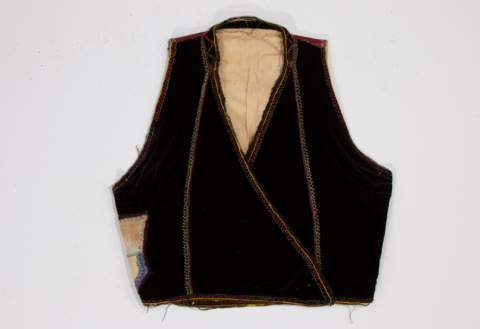
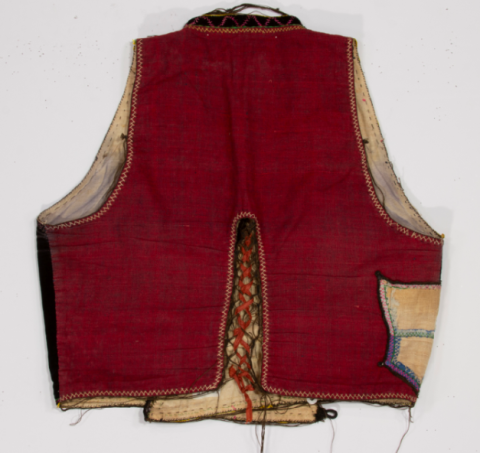
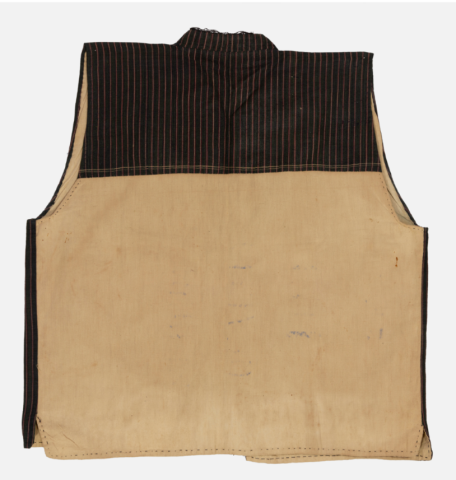
A man’s double-breasted vest made of black velvet on the front, red cotton at the back, and lined with thick, beige loom-woven cotton fabric.

Each front part, of black velvet, consists of two fabric panels: the two outer panels that cross to close are of a triangular shape (height: 34.5 cm, hypotenuse 39.5 cm, base: 20 cm), while the other panels complete the front parts as they reach beneath the armpit. The back of the vest consists of a single piece of red cotton fabric.

A low upright collar (maximum height: 2 cm) is made of double velvet. The triangular opening at the breast and the collar are defined by black braid that has frayed and, externally, by a black cord which, with sewing, forms consecutive kamaroues (low arches) and loops at intervals. Decorative bands from a simple handmade herringbone cross-stitch extend around the neck, along the bias-cut front opening, on the bottom edge of the vest, on the armholes and along the seams joining the front panels. Cross-stitches and straight lines from consecutive stitches that define them lengthwise are made of colourful threads in fuchsia, green, yellow and white. Along the collar, a fuchsia stitch forms a zig-zag line.

On the right side, beneath the armpit, a vase-shaped pocket is formed, of silk light-blueish fabric in the upper part and blue fabric below. Both fabrics survive partially, only on their edges, exposing the beige cotton lining. The pocket is defined all-round by a double black cord forming spirals at the corners. Further inside, there extends a row of herringbone cross-stitch in fuchsia, defined internally by continuous green stitch. A second row of white cross-stitch also follows the shape of the outline in the lower part of the pocket. A horizontal band of green cross-stitch extends along the joint of the two different fabrics of the pocket.

On the right side of the vest, internally, two buttons in diagonal arrangement correspond to two buttonholes on the left side. Another two, much smaller buttons on the left side, externally, do not correspond to buttonholes.

On the back of the vest, a vertical opening, 18 cm long, closes with a brick-red ribbon crossing through loops of black braid, that runs along the bottom edge of the vest and extends to the vertical opening. Off-white herringbone cross-stitch  extends to the back side of the armholes, to the bottom edge of the vest and to the vertical opening of the back.

Height: 39 cm.

Width: 23.5 cm on the shoulders, 38 cm at the waist (folded).

Date of entry to the Collection: 25.10.1985

Provenance: Lefkonoiko – Donation by the family of Yiannakos Hadjisavvas.

Translator: 
Petroula Hadjittofi
Author: 
Euphrosyne Rizopoulou-Egoumenidou
Petroula Hadjittofi
Description: 

ΜΓ 431

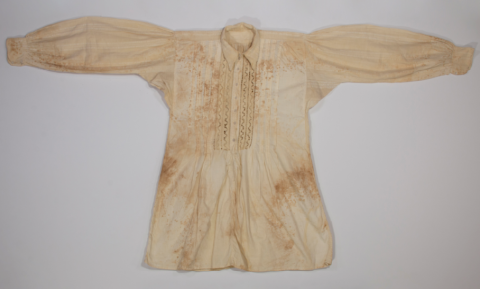
A man’s off-white shirt. Its front consists of fine cotton, while silk cotton taiston (with puckered bands created lengthwise by warp threads of two different tensions) made of ttira and koukkoulli yarns, is used for the long sleeves, the collar, the back and the yoke.

The front is composed of two cotton panels, 40 cm wide at the bottom, with seams beneath the armpits and at the extension of the vertical opening, which reaches at a height of 36 cm from the base of the collar downwards. Plackets of added or folded over strips of fabric, 1.8-2 cm wide, are machine-stitched on both sides of the opening. Placed on them are seven ready-made white buttons and corresponding handmade buttonholes. An eighth buttonhole is found on the neckline. On both sides of the opening, next to the placket, there extends a 5.5 cm wide panel of needlework (cutwork embroidery, filled with silk thread stitches), featuring opposite-facing wavy lines as the main decorative motif. Τhe needlework is lined with fine transparent fabric, plain yellowish silk on one side and silk-cotton taiston on the other. The needlework section, across both sides of the vertical opening, is flanked by parallel vertical tucks, three pairs and a single one on either side. Under the tucks and the breast opening the fabric gathers in free pleats. 

The pointed collar (maximum height: 7.5 cm) consists of machine-sewn double fabric. Its inside is made of two halves, with a handmade joint at the centre of the back side, widthways. The stand of the collar, 1.5-2 cm in height, is sewn with machine stitching(?) in the upper part and handmade in the lower. The hand-sewn yoke, extending across the shoulders behind the collar, consists of a single strip of taiston fabric (length: 46 cm, height: 8 cm) with the ruffled bands in horizontal arrangement. It is lined with plain cotton fabric.

The back of the chemise consists of four panels, two on either side. The upper panels (height: 52 cm, width: 34 cm) are of a greater height and gather under the yoke forming a row of pleats. The latter are secured with a handmade stitch that runs horizontally across them in the upper part, double in places. The two lower panels (height: 27 cm, width: 34 cm at the top and 36 cm at the bottom) are made of a different type of taiston fabric. The hem of the chemise is hand-sewn.

The sleeves consist of two parts, 15 cm and 22 cm wide, joined lengthwise with seams on the inner and the outer back sides of the arm. Small pleats are formed at the joint of the sleeves to the yoke. The armpits consist of a small square piece of a different taiston fabric (measuring 12x13.5 cm on one sleeve and with 13 cm sides on the other), sewn in a diagonal position with handmade stitches. At the edge of each sleeve a 7-7.5 cm high cuff, lined with white cotton fabric, features two buttons similar to those at the front opening of the shirt. Pleats, formed above the cuffs, are secured across with a double stitch.

This shirt stands out for its varied making and decoration as it combines different fabrics, sewing techniques (by hand and machine-made) and elaborate decorative means (cutwork embroidery filled with stitches, as well as pleats and tucks). In the Registry of the Museum it is described as a “formal chemise”.

Height of chemise: 84 cm.

Width: 46 cm on the shoulders, 79 cm at the base.

Sleeve length: 60 cm.

Sleeve width: 22 cm in the upper part, 10 cm around the cuffs.

Date of entry to the Collection: 25.10.1985

Provenance: Lefkoniko – Donation by the family of Yiannakos Hadjisavvas.

Translator: 
Petroula Hadjittofi
Author: 
Euphrosyne Rizopoulou-Egoumenidou
Petroula Hadjittofi
Description: 

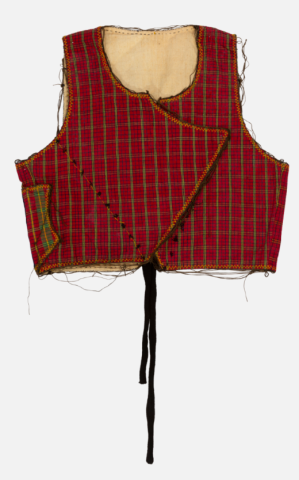
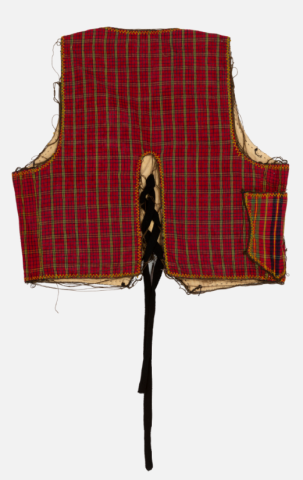
ΜΓ 392

Double-breasted vest of plaid cotton alatzia fabric in vibrant and bright colours, red, green and blue.

The vest consists of two pieces of fabric on the front and a single piece at the back. It closes on either side with two rows of seven surviving purple knit buttons, one row in each part of the breast. The handmade buttons, that terminate at tassels from the same yarn, are fixed to the inside of the vest to a thick bundle of green threads, sewn at intervals to ten different places (nine survive on the right side) with black braid, an extension of the black loops of the buttons. Corresponding to the buttons are oblong buttonholes with a black braid along the opening and, along the perimeter, a ready-made black edging made of one straight and one wavy band. At their inner end, the buttonholes are decorated with tassels of woollen yarn in green, white, pink, red, purple and maroon. An edging of the same type as that on the buttonholes is used as decorative element in different places on the vest, in one or more superposed rows. A double edging covers the side seams and the seams on the shoulders lengthwise.

On the right side of the vest a shield-shaped pocket (height: 9 cm, maximum width: 10 cm) is placed so that the centre of its horizontal opening coincides with the side seam. The pocket is framed by a braid and a single edging in the upper horizontal side, and by a double edging on the sides and at the base. It is lined with the same thick off-white loom-woven cotton fabric that covers the entire vest on the inside.

A black cord on the outside and a single, double or triple edging on the inside run along the openings of the vest. There is a single border on the armholes, a triple one on the triangular neckline and a double one on the remaining edges. At the back of the vest, the double edging and the braid extend to frame a vertical opening, of a height of 20 cm, in the lower part of the back. The opening closes with a ready-made purple knit ribbon, threaded through six pairs of opposite-facing loops formed by the braid that runs along the opening.

The vest, which originates from Lythrangomi, is entered into the Registry of the Museum of Yeroskipou as “Karpasitiko”.

Height: 40 cm.

Width: 25 cm on the shoulders, 35 cm at the waist (folded).

Date of entry to the Collection: 29.10.1983

Provenance: Lythrangomi, Karpasia – Purchase from Sophocles Sophocleous.

Translator: 
Petroula Hadjittofi
Author: 
Euphrosyne Rizopoulou-Egoumenidou
Petroula Hadjittofi
Description: 

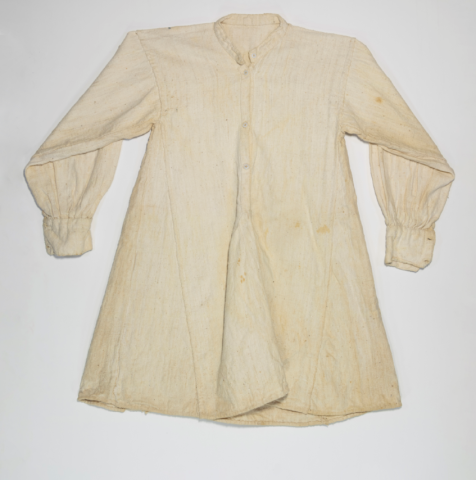
ΜΓ 314

Long-sleeved chemise of thick, loom-woven off-white cotton fabric.

The garment flares downwards (évasé line). Its front and back sides consist of a single central fabric panel, 45 cm wide. On the left and right, an added gore widens from the armpit downwards (width: 3-4 cm in the upper part and 37-38 cm in the lower part). On the right side, the gore consists of two equally sized smaller ones. The chemise ends in a bulky, low hem at the bottom.

A low upright collar of a separate double fabric band, 2.5 cm high, crowns the round neckline. It is hand-sewn across the edges whereas a sparse basting stitch extends across its middle. The collar closes with a button. The vertical opening on the breast carries on until almost halfway down, at a height of 31 cm. Both sides of the opening have a reinforced placket finish of fabric bands 2.5 cm wide. On the left there are three ready-made white buttons, paired to handmade buttonholes on the right. Beneath the opening, the fabric is gathered by a curved stitch, forming open pleats. 

The long sleeves consist of a single fabric piece with an inseam. They terminate at cuffs of double fabric, 8 cm in height, that close with two ready-made white buttons like those on the vertical opening of the chemise. Over the cuff, the sleeve fabric gathers in pleats.

The chemise is entirely hand-sewn.

Height of the chemise: 82 cm on the front side and 84 cm on the back side.

Width: 46 cm on the shoulders, 82 cm at the base.

Sleeve length: 50 cm.

Sleeve width: 20 cm in the upper part, 10 cm at the cuffs.

Date of entry to the Collection: 13.9.1980

Provenance: Polemi, Pafos – Purchased from Ioannis Theodotou.

Translator: 
Petroula Hadjittofi
Author: 
Euphrosyne Rizopoulou-Egoumenidou
Petroula Hadjittofi
Description: 

ΜΓ 304

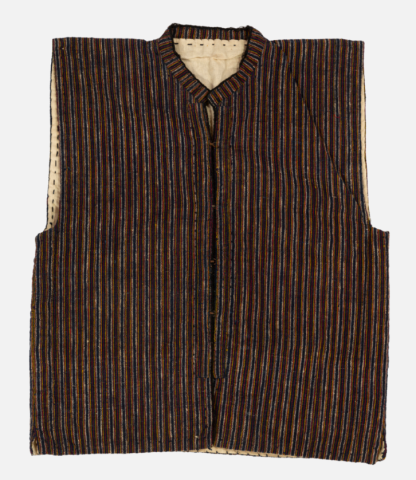
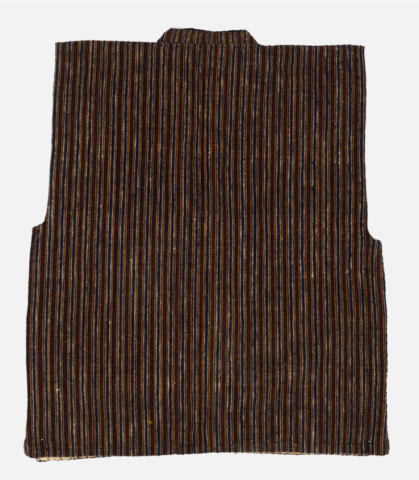
Vest of thick woven cotton alatzia fabric with alternating stripes of white, blue, red, orange and yellow.

A low upright collar of a height of 2 cm is formed around the circular neckline from a double fabric of the same alatzia. Its outer edge is decorated with black braid which extends to the entire vertical opening on the front of the vest. The vest is made of a single piece of fabric on the back, extending to both front panels (height: 50 cm, width: 21-22 cm in the lower part), to which it is also joined with side seams beneath the armpits. In the lower part of the vest, side slits are formed, of a height of 3-3.5 cm.

A reinforcing band, 2 cm wide, from the same alatzia extends to both sides of the vertical opening, reaching a height of 33 cm from the neck base. In this section, the opening closes with metallic elements, four hooks-and-eyes. On the inside, the vest has an off-white cotton lining. An added rectangular piece of thick off-white cotton fabric forms a lateral inside pocket with an opening of 8 cm at the middle of the vertical opening on the left side (height: 19.5 cm, width: 13 cm), allowing the hand to fit horizontally.

The vest is entirely hand-sewn. It has the same design and a common provenance with vest number ΜΓ 303, although its making is more thorough. In this case, the material sufficed for the entire garment and did not require added fabrics.

Height: 51 cm.

Width: 38 cm on the shoulders, 44 cm on the armpits and the waist.

Date of entry/registration in the MFAY: 13.9.1980

Provenance: Polemi, Pafos – Purchase from Ι. Theodosiou.

Translator: 
Petroula Hadjittofi
Author: 
Euphrosyne Rizopoulou-Egoumenidou
Petroula Hadjittofi
Description: 

ΜΓ 89

A man’s double-breasted vest of cotton alatzia with stripes of different thickness in burgundy, blue, yellow and white. The lining that covers the entire vest on the inside is made of beige cotton fabric.

Each of the two front parts of the garment consists of two fabric panels: the outer panel, that crosses when the vest is closed, is triangular (height: 45-47.5 cm, hypotenuse: 44 cm, base: 17 cm); the inner panel is rectangular, with the curved cut of the armhole in its upper part. The rectangular side panels of the front continue as a single panel at the back, forming the upper part of the back at a height of 27 cm. Lower down, the back is completed with a densely-woven cotton fabric (height: 26.5 cm, width: 42 cm). On either side of the vest, there is a 7 cm long opening. 

An upright reinforced collar, 1.5 cm in height, is decorated with machine stitching of white thread forming consecutive lozenges. The collar is trimmed externally by black cord that reaches a little above the lower edge of the opening (9 cm above the edge). At the triangular opening of the breast, it is externally reinforced by a cord with tiny button-shaped elements. Decorative bands of machine-made stitches, with a zig-zag line between two parallels, extend along the outer end of the rectangular panels and the diagonal side of the triangular panels, at the opening of the vest.

A pocket on the right side is lined internally in the section of the horizontal opening, with a piece of alatzia fabric at a height of 4 cm (pocket height: 16 cm, pocket width: 13 cm, length of external opening: 6 cm). The horizontal opening is decorated with blue-red braid and trimmed with a band featuring a zig-zag line between parallel lines, all made of off-white machine stitches. At the centre of the upper side of the opening, a tri-branched schematized vegetal ornament is also formed with machine stitches.

Red and blue braid also surrounds the armholes. The centre of the back of each opening is decorated with a tassel of frayed braid.

On the bottom edge of the vest, the hem is handmade with blue and white thread, whereas along the armholes and around the opening of the neck, machine stitches may be discerned.

Height: 56 cm.

Width: 31.5 cm on the shoulders, 47 cm at the waist (folded).

Date of entry to the Collection: 1978

Provenance: Theletra, Pafos – Purchase.

Translator: 
Petroula Hadjittofi
Author: 
Euphrosyne Rizopoulou-Egoumenidou
Petroula Hadjittofi
Description: 

ΜΓ 37

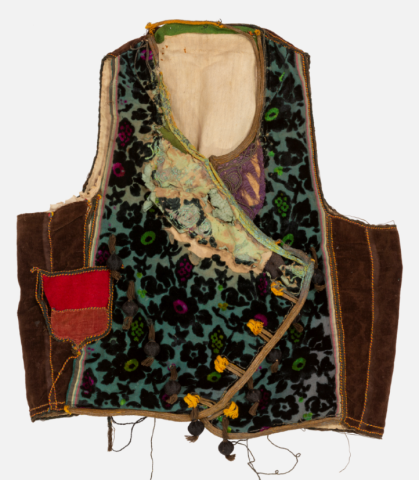
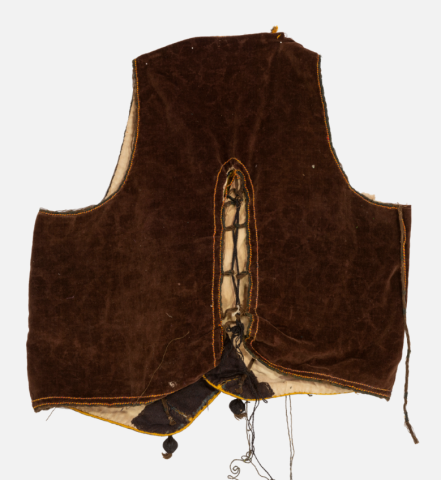
A man’s double-breasted velvet vest, lined with beige cotton fabric.

The back consists of a piece of brown velvet fabric. Another two oblong trapezoid pieces of brown velvet are found on the sides, one each, beneath the armholes, whereas on the front, the two panels that form the sides of the breast are made of green velvet with weaved-in relief floral patterns in black, bright green and fuchsia. The floral patterns alternate in size and cover the entire surface in combination with leaves. At the centre of the flowers, green and fuchsia are used interchangeably. On the armholes and on the sides of the garment, the selvedge of the green velvet fabric is discernible with colourful vertical stripes. It appears that in this case the selvedge is used as decorative band.

The garment closes on either side. Four buttonholes on each side of the bias-cut opening are defined by gold-coloured braid with metallic threads in the upper part, and a base of golden-yellow yarn. The inner edges of the buttonholes are decorated with small tassels of the same yarn. The spherical hanging buttons, of black silk(?) thread  around an off-white fabric core are fixed to a bundle of black threads, sewn to the inside of the garment in five places.

A vase-shaped pocket on the right of the vest, on the side, consists of red felt in the upper part and brown velvet in the lower part, without inner lining. The pocket is trimmed with black braid and, on either side, with two twisted cords of yellow, red and black threads. In the upper corners of the pockets, the cords form small projections, and a small tassel at the pointed bottom end. A cord of the same type extends horizontally, at the centre of the pocket, defining the two different types of fabric.

On the front, the vest is decorated with gold-coloured braids, double or triple, of the same type as those on the buttonholes. A triple braid decorates the bias-cut opening in the upper part of the breast, where a fine cord extends lengthwise externally and, folded over, forms tiny loops. In the same section of the breast opening, purple fabric is used over a second beige fabric and, further below, a sewn-in padding of light green cardboard above the inner lining of the vest. On the purple fabric, an interlace pattern along the circumference and, further inside, consecutive spirals are formed by a cord fixed with numerous stitches. The cord is made of yarn, coated with metallic thread.  Through the couched embroidery patterns, the purple fabric may be discerned as base. This fabric and its couched decoration survive on the left side of the opening but only partially. Traces of the non-surviving spirals are discernible in the lower part of the purple fabric.

The armholes, the seams on the shoulders and the back of the neck opening, as well as the joints of the two side panels with the front panels are accentuated with black braid and a single or double cord, of the same type as that of the pocket. A braid externally and two rows of cords further inside also decorate the bottom edge of the side panels and of the back panel, and extend along a vertical opening, of a height of 23.5 cm, at the centre of the back. The opening closes with a bundle of four black threads, which criss-crosses through small loops formed by the black braid at the edge of the opening.

On the inner side of the garment, the lining consists of different panels of off-white cotton fabric. The bias-cut opening is lined with additional black woollen fabric. Around the neck, the vest is reinforced with a bright green ribbon, 2 cm wide, that advances into the upper part of the bias-cut opening.

Height: 41.5 cm.

Width: 28 cm on the shoulders, 40 cm at the waist.

Date of entry to the Collection: 12.11.1948

Provenance: Kelokedara, Pafos– Purchase.

Translator: 
Petroula Hadjittofi
Author: 
Euphrosyne Rizopoulou-Egoumenidou
Petroula Hadjittofi
Description: 

ΜΓ 11

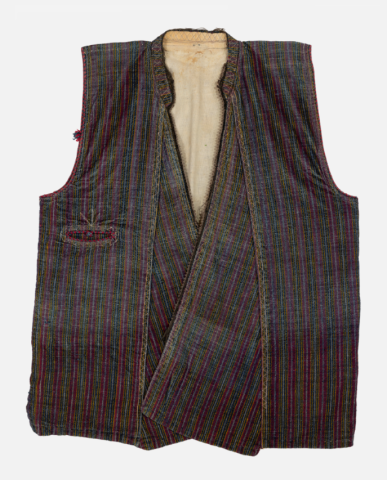
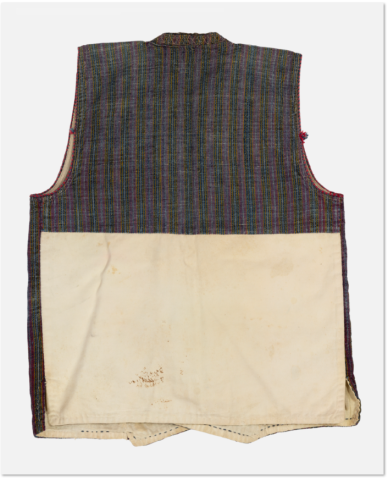
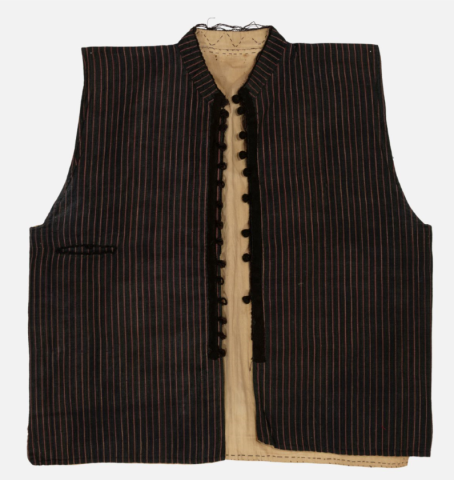
Vest of woven cotton alatzia fabric with fine stripes in a combination of red and white on a dark blue/black ground. On the inside, the vest is entirely lined with off-white cotton fabric. Fabric of a similar type is used externally too, in the lower part of the back.

The vest has a circular neckline with a low upright collar, measuring 2.5 cm in height, from added fabric. The edge of the collar is trimmed with a couched black braid. A vertical opening extends from the neckline to the waist. The two front panels of the vest, of striped alatzia, extend to the back to cover the upper part, at a height of 15.5-17 cm. The rest of the back consists of off-white cotton fabric (height: 35 cm, width: 47.5 cm), joined to the front panels with vertical seams beneath the armpits. In the lower part of the side seams, an opening of a height of 4 cm is formed. All visible seams are handmade with black thread. Along the collar, on the inside of the vest, a stitch in the shape of a zig-zag line is discernible.

On either side of the vertical opening, a black tress/band of 33-33.5 cm is sewn to the upper part. On the right side of the breast, the tress has fifteen loops of fine black cord, frayed at several points. The loops are sewn at more or less equal intervals to the outer end of the tress. Black woven buttons, of which nine remain, correspond to the loops on the opposite side of the opening.

On the right part of the breast, a pocket has a 7 cm long horizontal opening, trimmed with black cord, with a small tassel at the middle of the upper side. On the inside of the vest, the rectangular shape of the pocket may be discerned (length: 14 cm, width: 10 cm). The pocket is made of blue-white plaid woven textile.

Height: 50 cm.

Date of entry to the Collection: 26.10.1948

Provenance: Pegeia, Pafos – Donation.

Translator: 
Euphrosyne Rizopoulou-Egoumenidou
Noly Moyssi
Author: 
Euphrosyne Rizopoulou-Egoumenidou
Noly Moyssi
Description: 

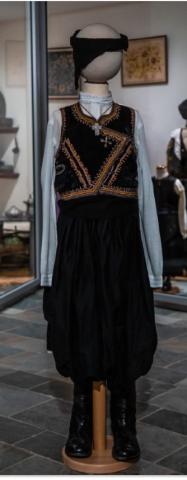
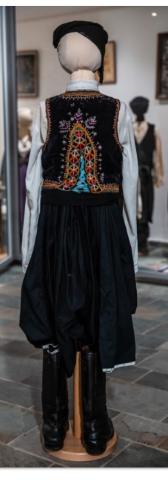
Men’s Costume. The parts of the costume are as follows: a white shirt, a black men’s vest (yelekkin), baggy trousers (vraka), a silver cross and a black headscarf.

Men’s double-breasted vest (yelekkin). The front and the back are made of black velvet. The front consists of two pieces of fabric that cross over the chest on both sides. The vest is decorated with an outline of coloured cords, red and yellow. The back is made of a single piece of black velvet, which extends below the armpits and is joined with coloured seams to the front pieces. In the centre of the back, there is a vertical opening that would have been closed with some kind of ribbon passing through the remaining eyelets for a better fit on the body. The opening is bordered with sewn-on cord in red and yellow, forming a decorative floral pattern.

The Silver cross is decorated with floral patterns in repoussé technique.

Pages