Female and Male

Translator: 
Euphrosyne Rizopoulou-Egoumenidou
Noly Moyssi
Author: 
Euphrosyne Rizopoulou-Egoumenidou
Noly Moyssi
Description: 

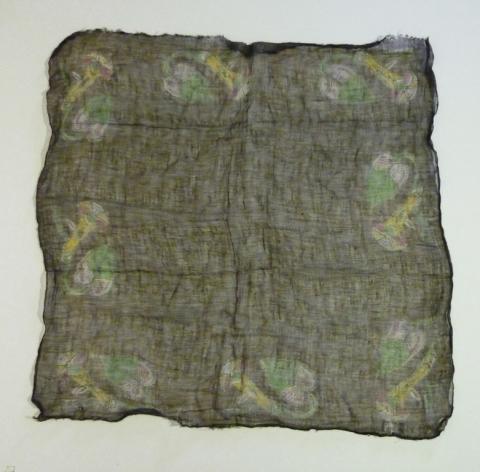
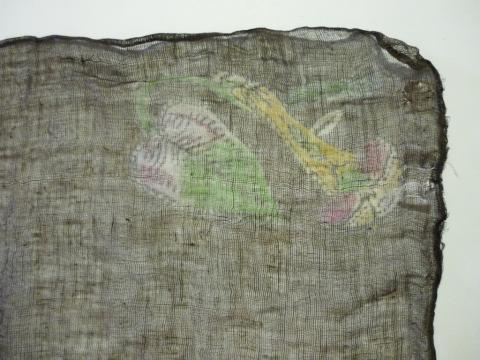
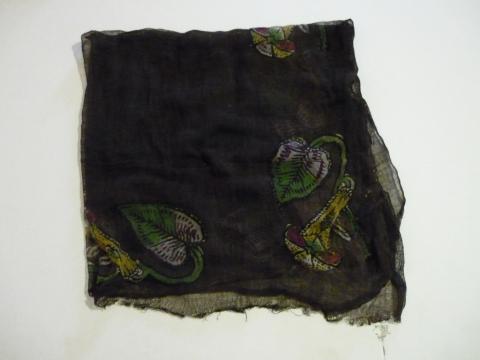
Kerchief, printed, made of fine cotton material called koroukla, of brown colour. All around the edges, it is decorated with a row of printed floral motifs, each one consisting of a lily and a broad leaf. The outlines of the pattern are printed in black colour (karakalemi), and the flowers and leaves in red, green, white, blue and yellow colour.

Translator: 
Euphrosyne Rizopoulou-Egoumenidou
Author: 
Euphrosyne Rizopoulou-Egoumenidou
Description: 

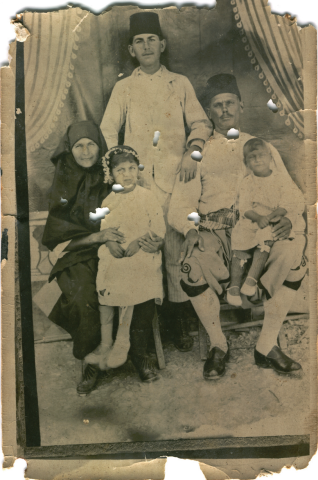
Photograph of Kunturacı Mus­tafa Yeşiltaş with his family. It is a studio photograph, as shown by the painted background with drawn-back curtains, and was taken in 1922. Mustafa and his wife Emine are sitting with their children on their knees, the girl in her mother’s lap and the young boy on his father’s left knee. In the centre of the photo­graph, between the pair, is standing Nuri, Emine’s brother. Mustafa, the older man, wears an Ottoman fes (fez), a loom-woven cotton gömlek (shirt), şalvar, (baggy trousers) made of broadcloth (çufa turk. çuha) and deco­rated with spirals and other curvi­linear motifs of twisted black braids sewn onto it, a polychrome silk guşak (sash, turk. kuşak) The silk polychrome sash around his waist was imported from Tripoli (tarab­lus turk. trablus) around the waist, white çorap (stockings) tied below the knee, and black elastic gus­set ‘Cambridge’ shoes. As an accessory he has a köstekli saat (watch with chain). Emine Hanım wears the typical for Muslim women long black dress with çarşaf (veil this is a two- or three-piece); the veil covers the head and part of the forehead, and the front part of the çarşaf has buttons. Her front lace shoes or boots are also black. The young girl, her daughter Pembe, wears a yemeni (headscarf) ornamented with handmade lace with the motif of narcissus (nergiz) all around the edges; also a dress made of white cotton flannel cloth (bazen kumaş), handmade çorap (stockings) with tassels and bow-ties (püsküllü çorap fiyonklu) and white shoes, probably with a strap over instep, or boots. The young boy, Salih Yeşiltaş, wears a dress made of loom-woven striped cloth (alaca), hand-knitted lastikli çorap (elastic stockings) and button bar shoes. Nuri Erbaş wears an Ottoman fes (fez), a gömlek (shirt) made of loom-woven coarse cloth, probably made of cotton and silk (idare, in Gr.C.itares = fine cotton yarn, silk-cotton fabric with warp of fine cotton yarn; see Papademetriou 1991, 125), striped trousers of three quarters length, a white jacket and gonçlu potin (ankle boots).  

Translator: 
Euphrosyne Rizopoulou-Egoumenidou
Author: 
Euphrosyne Rizopoulou-Egoumenidou
Description: 

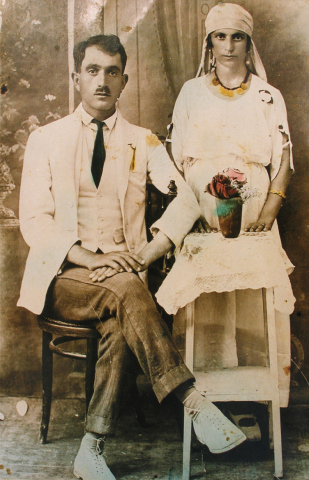
Studio photograph taken in 1914. It depicts a young couple, Ekrem Ovgorozlu, an inspector in the British administration, and his wife Pembe Ovgorozlu. The man is sitting on a chair of Viennese type, with his legs crossed and hands resting on his knee one over the other. His left arm is placed partly around the back of the chair, which appears at his elbow. He has short hair and a short moustache. He is dressed in western style; his cos­tume is composed of a white gömlek (shirt) with collar, around which is tied a black tie. Over the shirt he wears a white cashmere waistcoat and a jacket of the same material. His trousers are of brown striped cloth and end with a wide double turned hem. He also wears knitted çorap (stockings) and front lace ankle boots (the side seam is the more formal style, continuous from sole to sole – ‘closed tab’). The lady is standing next to her husband with her hands on a high corner table in front of her. She wears a ‘modern’ long white dress with sleeves down to the elbows. The sleeves have vertical openings with two horizontal strips. There is a round opening around the neck and a belt at the waist. Thin black çorap (stockings) are combined with white kundura (shoes, turk. kuntura) with a narrow strap at the front. Her head above the eyebrows is covered with the traditional çarşaf which is made of white silk and hangs down the back. Her appearance is complemented with jewellery. The earrings consist of two round elements, one on the ear and the other hanging. Around her neck she wears a traditional necklace made of gold Ottoman coins (turk. Mahmudiye) tied onto a black ribbon, and on her left wrist twisted bracelets. The white tablecloth has a handmade band all around the edges; the repeated pat­tern consists of the white flowers of the tree Sambucus nigra. On the table stands a vase of flowers.  

Translator: 
Euphrosyne Rizopoulou-Egoumenidou
Author: 
Euphrosyne Rizopoulou-Egoumenidou
Description: 

The clothing of the Christian elite is best represented in icons and wall paint­ing decorating churches.

 The Dragoman of Cyprus Christophakis Constantinou, is here seen leading his family group with hands out towards the model of the church, which is collected by St. George himself. In between the buttresses of the model is recorded the date 1745, when the church was erected.

 Christophakis is dressed in garments of a leading member of the society of the time, bearing strong Ottoman influence. As an over coat he wears a tzouppe (long robe), lined with grey fur shown as a broad collar and down the opening in the front, at the cuffs and the side-pocket.  Under the tzouppe is visible the lower part of the red baggy breeches, the tzaktziria, onto which were sewn the mestia or meskia, footwear made of Morocco leather in the priv­ileged yellow colour. The head-gear is a black kalpaki (fur cap). Similarly dressed, in the fashion of their father, are the two youths in the front row.

Behind Christophakis stands a colourfully dressed lady, wearing a red foustani (dress) cut down the front in a U-shape to show her white shirt. Over all she wears a tzouppe (long robe), lined with ermine fur, which is visible all the way down the opening in the front, in patches at the shoulders and the side(s) slit(s) for the hands. The tzouppe is made of a precious fabric (brocade) decorated with flowers on a green background and has long sleeves with turned-out cuffs.  On her head she wears a red fesin (flat-shaped cap, fez) over which is thrown a green scarf with stamped (or embroidered) flowered decoration. In her clasped hands she holds a red handkerchief and a pouch.

An elderly woman standing immediately behind her shows a long robe clasped at the neck and trimmed with ermine down the opening in the front and at the cuffs. On her head she wears a red kerchief under a scarf which covers the back of the head and the neck.

Immediately behind her appears a female child wearing a red fesin (flat-shaped cap, fez) with a turban. Her tzouppe (overcoat), with sleeves to the elbows, has a white collar of ermine which continues down the opening in the front. From the under-garment, made of red-striped white material, only one sleeve is visible.

Next, stands a grown-up woman of about the same age and similarly dressed as the lady behind Christophakis. She wears the same headdress consisting of a richly decorated red fez over which is thrown a scarf with printed flower decoration. Her tzouppe is of the same type, lined again with ermine fur, but the brocade fabric has flowers on a red background instead of green. Similar is also the cut of the white shirt. On the other hand, there seems to be a difference between the upper and the lower part of the garment over the shirt.  It seems that here we have a combination of a zimbounin (waistcoat) and a red skarpetta (pleated skirt), which recalls the  alla Cipriotta (Cypriot style) dress mentioned by Giovanni Mariti (1760-1767).

Immediately behind her kneels a young girl wearing an anteri (gown) made of red-striped material. Over the anteri (gown) she wears a short white tzouppe (overcoat) open down the front and clasped at the neck. It has sleeves to the elbows and is trimmed or lined with fur seen around the neck, down the open front and at the edge of the sleeves. She wears a red fesin (cap, fez) with a scarf around it, the ends of which fall on to her shoulders. It repeats in miniature the headdress of the other two ladies who wear fez and scarf.

Another sister, the last of the group, is depicted behind the girl. She wears the same type of red-striped anteri as the young girl before her. The anteri is closed at the waist with a belt fastened with a pair of round buckles. Her ermine-lined robe (tzouppe), made of fine colourful brocade, is open down the front and not clasped at the neck, so that it allows the U-shaped cut at the chest of the upper-garment to show, revealing a white shirt underneath. On her head she wears a turban-like cap. 

Pages