Pierides Museum - Bank of Cyprus Cultural Foundation
3D object:
3D object
Translator:
Euphrosyne Rizopoulou-Egoumenidou
Author:
Euphrosyne Rizopoulou-Egoumenidou
Description:
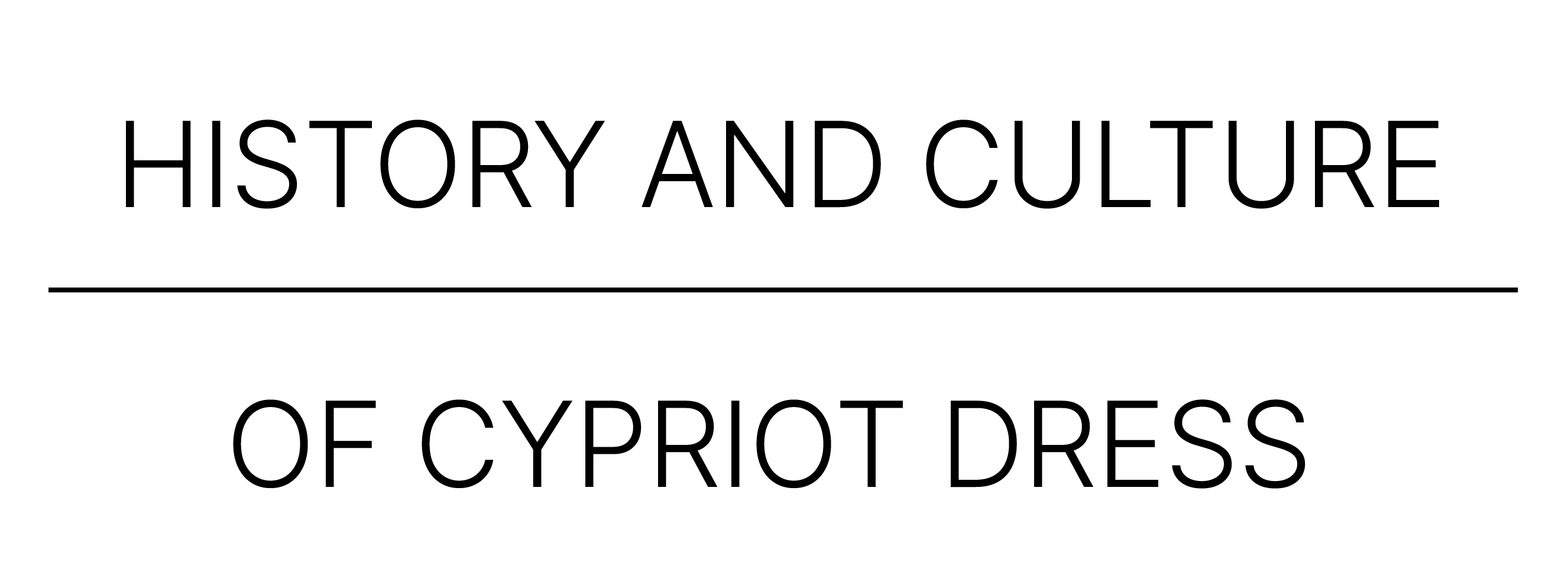
Ind. no. 107: Tripartite clasp consisting of two discs, each with a central boss, and an oval element in the middle. At each end, there is a cast two-headed eagle attached with a hinge joint. The clasp is set with stones and further decorated with applied elements: filigree motifs, small lozenges and granules. Partial gilding is discernable. This is a small chest clasp that formed part of the Karagouna costume, and was imported to Cyprus. Among other examples of the same type, there is an identical specimen in the Museum of Greek Folk Art in Athens (Kaplani 1997, 119, no. 4167) and another in the Ethnographical Historical Museum of Larissa (Ethnographical Historical Museum of Larissa 1996, 48, no. 87).
Dimensions: Total length 20.5 cm. Diameter of the discs: 5.3 cm. Height of the central part: 5 cm.
3D object:
3D object
Translator:
Euphrosyne Rizopoulou-Egoumenidou
Author:
Euphrosyne Rizopoulou-Egoumenidou
Description:
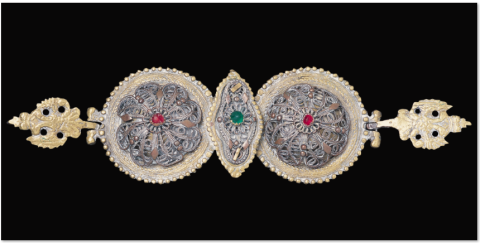
Ind. no. 218:Kilaniotiko square, silk headscarf decorated with the "tie-dye" technique.
As in all known specimens, which are very rare, the primary motif is a cross that divides the surface into four squares, each containing different lozenge designs. The peculiar, dotted outline of the designs is due to the practice of tying knots before each dyeing with a different colour, so as to maintain the colour of the tied parts. The bright yellow/gold colour that stands out most strongly in these handkerchiefs came from the initial dye, when the headscarf was boiled together with pieces of local Rhuscotinus (for the method of dyeing kilaniotika headscarves, see Egoumenidou 1997, 41-42, fig. 12). It ends in fringes.
It belonged to Loukis Pierides.
Dimensions: 77 x 77 cm.
3D object:
3D object
Translator:
Euphrosyne Rizopoulou-Egoumenidou
Author:
Euphrosyne Rizopoulou-Egoumenidou
Description:
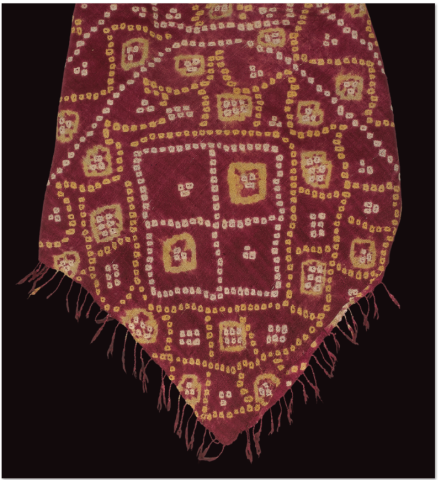
Ind. no. 221: A rectangular piece of cotton, woven textile with dense fythkiotika patterns and a series of stylised trees at the upper end. The principal colours of the embroidered decoration are red and blue, with a little yellow and light green in the fills, which illuminate the design. This piece of textile served as the lower end of women's pantaloons (povratzin, underpants). A selvedge is discernible at one end (for a similar design, see a 19th century povratzin of Karpass in Papadimitriou 1996, 13, fig. 17).
Dimensions: 46 x 30 cm. Embroidery height: 25 cm.
The povratzia inv. nos. 222, 220 and 221 were bought by Loukis Pierides from Mrs. Lewis.
3D object:
3D object
Translator:
Euphrosyne Rizopoulou-Egoumenidou
Author:
Euphrosyne Rizopoulou-Egoumenidou
Description:
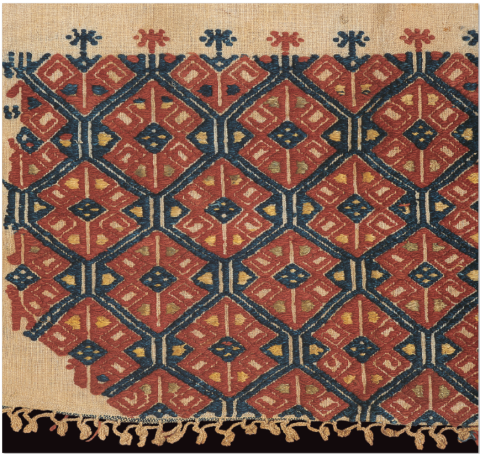
Ind. no. 220: A rectangular piece of cotton woven textile with dense, pefkoto embroidery, typical of the Karpas (karpasitiko) style, with a series of stylised trees at the upper end. It adorned the lower part of a pantaloon. The predominant colours are red and blue, namely the oldest colours used in such embroideries, with a touch of olive green and yellow. One edge is finished with thick crochet lace (pipillasmiliou) (see a similar design in a povratzin from Fyti, in Pierides 1980, pl. I:b).
Dimensions: 47.5 x 28.5 cm. The embroidery extends to a height of 24 cm.
3D object:
3D object
Translator:
Euphrosyne Rizopoulou-Egoumenidou
Author:
Euphrosyne Rizopoulou-Egoumenidou
Description:
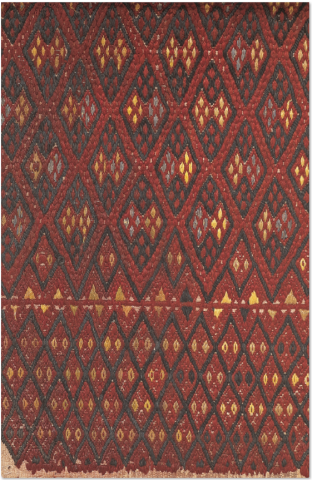
Ind. no. 222: Piece of thick cotton, woven textile, covered with dense, pefkoto embroidery made on the loom. The design consists of two different compositions of consecutive lozenges in black and red. Yellow/gold and silver threads, used in a lesser extend for the fillings, illuminate the dark-coloured embroidery. The fabric is rectangular in shape. On one side, there is a finish of thick decorative braid, roughly made of blue thread. This textile piece comprises the lower end of women's pantaloons (povratzin), a characteristic element of the costume of Paphos and Karpass. The embroidered lower part of pantaloons was visible under the chemise and the sayia (for similar examples see Pieridou 1976, pl. III).
Dimensions: 57 x 24.5 cm.
3D object:
3D object
Translator:
Euphrosyne Rizopoulou-Egoumenidou
Author:
Euphrosyne Rizopoulou-Egoumenidou
Description:
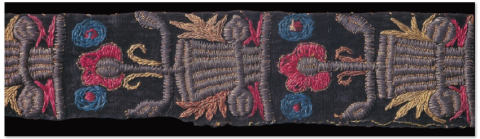
Ind. no. 28: Black velvet belt lined with black fabric, embroidered with a design similar to that of belt no. 20. The shape of the central flower in the pot differs, as do some of the colours. The design is repeated nine times. Α velvet belt with an identical design and with a silver clasp attached to its ends is depicted by Magda Ohnefalsch-Richter ((1913) 1994, fig. 67), who compares it to an ancient articulated belt of metallic plaques. Therefore, the belts in the Pierides Collection could be dated to the end of the 19th century and it is possible that they are even older.
Dimensions: Width of each compartment: 4.5 x 7.5 cm. Length: 71.5 cm.
These belts were used as part of an urban Cypriot costume. They were owned by Eleni Nikoli Tavernari, the grandmother of Theodora Z. Pieridou.
3D object:
3D object
Translator:
Euphrosyne Rizopoulou-Egoumenidou
Author:
Euphrosyne Rizopoulou-Egoumenidou
Description:
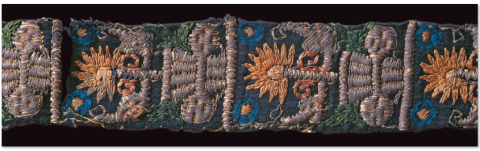
Ind. no. 20: Belt made of black, silk fabric, embroidered with silk and metallic threads. It is divided into 11 sections, each featuring a pot with leaves, and a flower with petals in a radial arrangement. Above this central flower there are two smaller ones, one in each corner. The dividing line is embroidered with gold thread in satin stitch, as is the flowerpot that sits on this line, as well as the large leaves and the stem. Vertical ribs compose the relief surface of the pot. The central flower and two spirals below are embroidered with stem stitch in light brown/honey, as is the pollen of the small blue flowers. Deep green leaves on the sides of the pot are faintly visible on the black background. The design is simple and symmetrical. The theme of the flowerpot was very popular in Greek folk art. The belt would close with a metallic clasp.
Dimensions: Width of each compartment: 4.5 x 7 cm. Length: 75 cm.
3D object:
3D object
Translator:
Euphrosyne Rizopoulou-Egoumenidou
Author:
Euphrosyne Rizopoulou-Egoumenidou
Description:
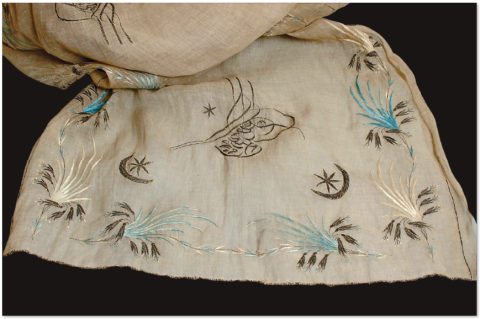
Ind. no. 301: Long and narrow shawl or belt made of thin, transparent silk fabric, embroidered with metallic and silk threads in a satin stitch. All around the edges there are branches with alternating off-white and light blue, stylised leaves with gold flowers. The slender hair-like stamens of the flowers have white and light-blue ends. The dominant motif at the two narrow sides is the tuğra (sultan's monogram) accompanied by a star, while there is also a star and crescent symbol in each corner, all gold-embroidered. A metal thread finish extends all around. This is an Ottoman work of extremely delicate craftsmanship.
It was bought by the descendants of the Sivitanides family in Limassol.
Dimensions: Width: 60 cm. Length: 234 cm.
Loukis Pierides bought belts with tsevres embroidery from Mrs. Lewis.
3D object:
3D object
Translator:
Euphrosyne Rizopoulou-Egoumenidou
Author:
Euphrosyne Rizopoulou-Egoumenidou
Description:
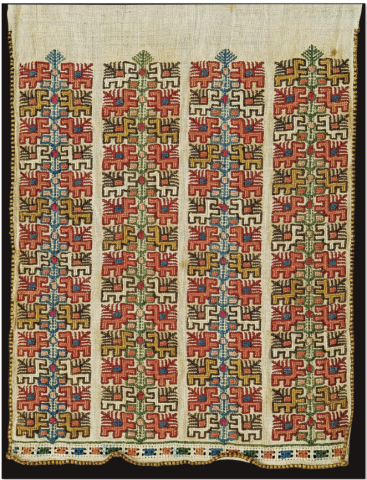
Ind. no. 31: Belt with double-sided embroidery on both narrow sides. The design consists of four columns with stylised, almost geometric flowers in a vertical arrangement. At the end of the outer narrow side, there is a thin band of embroidery in alternating colours, while along its three outer sides the embroidery is defined by a narrow border that reaches a little above its height. The standardisation of the design is in contrast with the polychromy.
Dimensions: Width: 21 cm. Length: 208 cm.
3D object:
3D object
Translator:
Euphrosyne Rizopoulou-Egoumenidou
Author:
Euphrosyne Rizopoulou-Egoumenidou
Description:
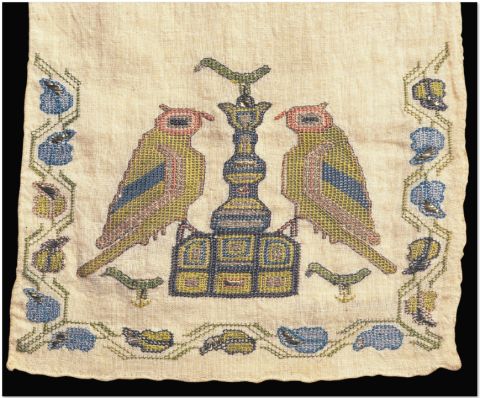
Ind. no. 30: Belt made of two pieces of linen, joined in the middle. The same composition of two facing birds with similar plumage, standing on the base of a tall fountain, is embroidered on both ends. The fountain standing between the birds, constitutes the central axis of the composition. A small, stylised bird is sitting on top of the fountain, accompanied by two other, similar birds, one under each larger bird. This central design is bordered on three sides by a wavy garland featuring flowers with colours alternating per pair, light blue and oil green. These colours also dominate the central composition, along with pink, pomegranate, beige, gold thread and metallic thread. The tight stitch gives the impression of filtiré. The same design is found with minimal variations and a range of colours in belts from Bursa (Ther 1993, 212, 213).