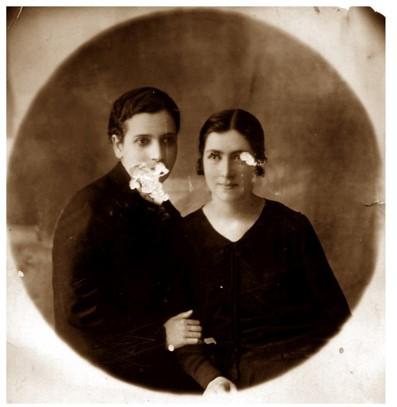
This portrait features Maria Angelinidou-Potamiti on the right and Maria Rousou on the left. Maria Rousou, a trailblazer as the first female doctor of Cyprus, was Yiangos Potamitis’ first cousin and the wife of Heracles M. Michaelides (known as Michalos), a lawyer and landowner. Maria Angelinidou-Potamiti, on the right, is dressed in a dark, elegant dress with a simple design. Her hair is styled neatly, parted in the center and pulled back. Maria Rousou, on the left, is similarly attired in a dark dress, tailored with a high neckline and a smooth silhouette. Her hair is styled in soft waves. The portrait features a soft-focus oval frame.
Translator:
Euphrosyne Rizopoulou-Egoumenidou
Noly Moyssi
Author:
Euphrosyne Rizopoulou-Egoumenidou
Noly Moyssi
Description:
CYLHA.10.059 (23)
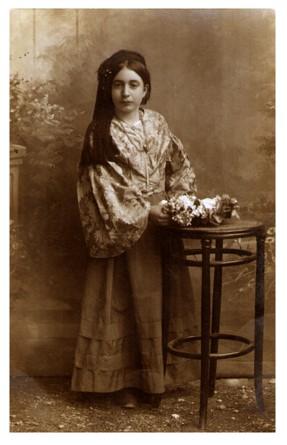
This portrait photograph features Maria Angelinidou-Potamiti’s friend, Christina Christoforou. Christina was the sister of Zinonas, Cleanthis, and Takis Christoforou, and the daughter of Fexis. Her family home was located on Saripolou Street, behind the current Town Hall. The portrait captures Christina in a formal studio setting. Christina is dressed in a traditional, full-length outfit typical of the early 20th century. Her blouse features an intricate floral pattern and wide, flowing sleeves. The blouse is paired with a long, tiered skirt, accented by subtle ruffles. On her head she wears a traditional fez adorned with small decorative embellishments. She stands next to a round wooden table, which holds a small arrangement of flowers.
Translator:
Euphrosyne Rizopoulou-Egoumenidou
Noly Moyssi
Author:
Euphrosyne Rizopoulou-Egoumenidou
Noly Moyssi
Description:
CYLHA.10.059 (20)
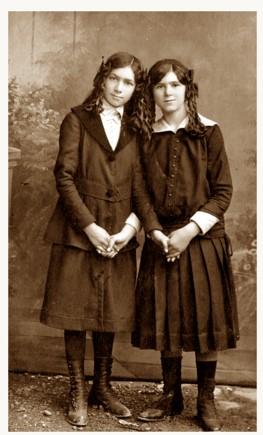
This studio portrait photograph features Maria Angelinidou-Potamiti on the left and her close friend, Elisavet Christodoulidou Vassilara on the right. Both young women are dressed in elegant early 20th-century attire. Maria, on the left, wears a dark, tailored dress with a fitted waist and a peplum-style jacket. The jacket features a wide collar and is worn over a high-neck blouse with a delicate bow at the neck. Her knee-length skirt is modestly styled, and she pairs the ensemble with lace-up boots. Her hair is styled in long curls, adorned with ribbons. Elisavet, on the right, is dressed in a similarly dark ensemble, featuring a blouse with a pointed white collar and a row of buttons down the front. She wears a pleated skirt that falls below the knee. Her shoes are also lace-up boots. Elisavet's hair is styled in soft curls, also adorned with ribbons. Both young women stand close together, holding hands.
Translator:
Euphrosyne Rizopoulou-Egoumenidou
Noly Moyssi
Author:
Euphrosyne Rizopoulou-Egoumenidou
Noly Moyssi
Description:
CYLHA.10.059 (18)
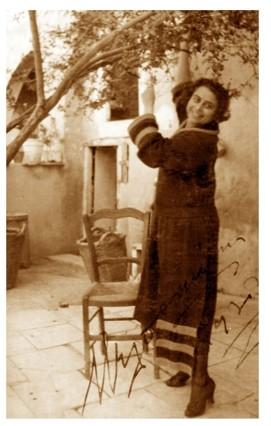
This photograph captures Melpomeni Koliva in her yard, accompanied by a personal dedication to the young Maria Angelinidou. Melpomeni is elegantly dressed in a long, dark coat or dress, featuring distinctive horizontal stripes along the hem and cuffs. Her shoes, with modest heels, complement the overall formal yet comfortable look.
3D object:
3D object
Translator:
Euphrosyne Rizopoulou-Egoumenidou
Noly Moyssi
Author:
Euphrosyne Rizopoulou-Egoumenidou
Noly Moyssi
Description:
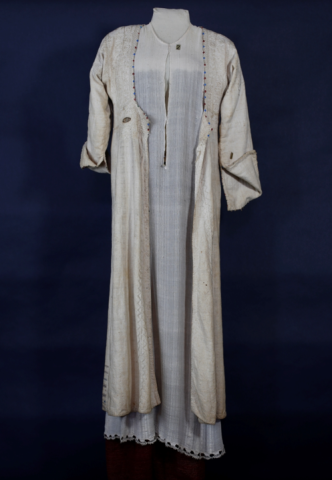
Part of a female costume consists of a sayia and a white shirt. The festive sayia from Karpasia, made of thick cotton cloth. The garment is adorned with white embroidery and threaded beads. It was worn over a chemise. The back and front parts consist of a single fabric panel. At the front, a vertical slit extends all the way down. A deep opening is also formed at the bust, leaving a large part of the chest uncovered. Just below the chest, the sayia closes with loops and buttons. The long and narrow sleeves, sewn vertically to the shoulders, have two additional triangular pieces joined diagonally below each armpit to facilitate movement. The back part below the neck is lined with white cotton fabric; the same applies for the part surrounding the chest opening, which is embellished with white embroidery in delicate scrolls or zigzag patterns, enriched with threaded red and green petroues (beads). The same embroidery covers the seams of the sleeves at the shoulders and, in a thinner band, the shistres (side openings) of the sayia. Threaded beads decorate also the openings of the sleeves.
3D object:
3D object
Translator:
Euphrosyne Rizopoulou-Egoumenidou
Noly Moyssi
Author:
Euphrosyne Rizopoulou-Egoumenidou
Noly Moyssi
Description:
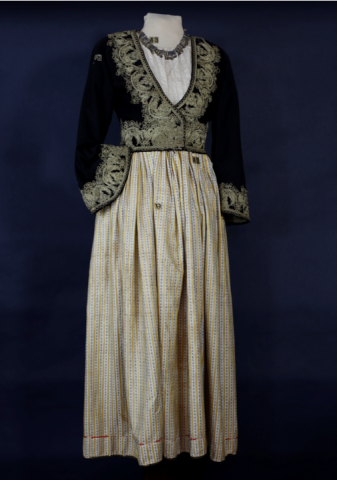
Cypriot costume of the “Amalia” type. It consists of the following pieces: Off-white silk chemise with a V opening at the chest, decorated with handmade pipilla (needle lace), which also adorns the edges of the sleeves.The puple skirt is ankle-length with rich folds at the waistline. Sarka made of black felt with straight, long sleeves sewn vertically onto the shoulders, and a low upright collar. It closes above the waist, forming a large V opening at the bust. The collar, the sleeves and all the edges have a rich decoration of sewn-on gold cords. On both sides of the chest, the decoration extends into a paisley design. Even the seams of the sleeves are accentuated with gold decorative braid. The outfit is completed with a silver necklace. The “Amalia” costume was established in Cyprus before the mid-19th century. It was initially the formal attire worn by women in the urban centres, where it was preserved until the adoption of European dress. Later it was adopted in rural areas, where it was used as a festive or bridal outfit even as late as the first decades of the 20th century.
3D object:
3D object
Translator:
Euphrosyne Rizopoulou-Egoumenidou
Noly Moyssi
Author:
Euphrosyne Rizopoulou-Egoumenidou
Noly Moyssi
Description:
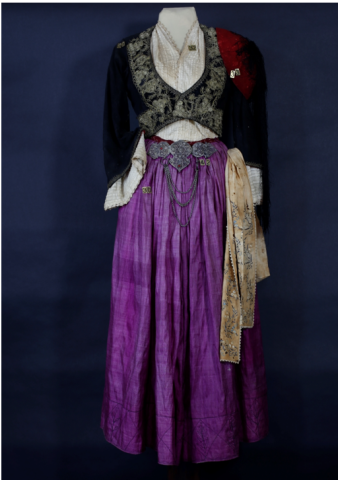
Cypriot costume of the “Amalia” type. It consists of the following pieces: Off-white silk chemise with a V opening at the chest, decorated with handmade pipilla (needle lace), which also adorns the edges of the sleeves.The puple skirt is ankle-length with rich folds at the waistline. Sarka made of black felt with straight, long sleeves sewn vertically onto the shoulders, and a low upright collar. It closes above the waist, forming a large V opening at the bust. The collar, the sleeves and all the edges have a rich decoration of sewn-on gold cords. On both sides of the chest, the decoration extends into a paisley design. Even the seams of the sleeves are accentuated with gold decorative braid. A red fez with a long thick tassel made of black silk threads. This dangling tassel falls on the chest, while a second tassel is fixed on the top of the fez, forming the tepeliki. The outfit is completed with a clasp. The “Amalia” costume was established in Cyprus before the mid-19th century. It was initially the formal attire worn by women in the urban centres, where it was preserved until the adoption of European dress. Later it was adopted in rural areas, where it was used as a festive or bridal outfit even as late as the first decades of the 20th century.
3D object:
3D object
Translator:
Euphrosyne Rizopoulou-Egoumenidou
Noly Moyssi
Author:
Euphrosyne Rizopoulou-Egoumenidou
Noly Moyssi
Description:
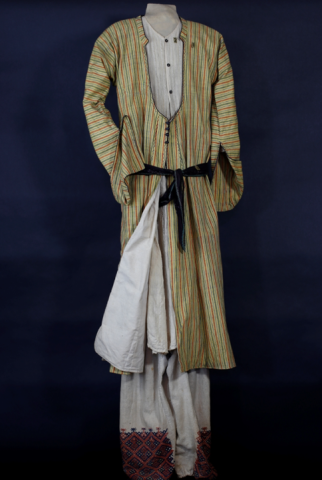
Costume with sayia. It consists of a woven shirt embellished with silk pipilla (needle lace) and fine embroidery of light blue flowers at the visible part of the chest. The sayia is worn on top of the shirt. It is made of silk-cotton striped alatzia with alternating white and yellow stripes, and has brown thread decoration at the edges. The garment is long-sleeved and open at the front. The lower part of the sleeves is lined with a colourful printed fabric, which is visible in the opening of the sleeves and on the small pocket on the right side of the chest. The sayia is long enough to cover the knees, revealing the rich loom embroidery on the lower part of the cotton pantaloons, which are worn as underwear. The sayia closes at the waist with a colourful sash made of striped fabric. (for sayies made of a similar striped fabric, see Cypriot Costumes 1999, 133, and Papadimitriou 1995, 112).
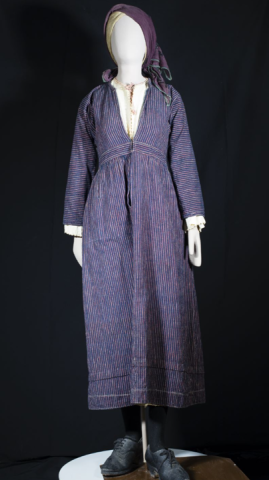
The costume consists of ypokamison (chemise), foustani (dress), a headscarf and and black shoes. The chemise is short and made of taiston cotton fabric (woven material with crinkled stripes running lengthwise). The fustani is made of striped cotton alatzia, with white and blue stripes. It is entirely hand-sewn and has a body with a large V-shaped opening, passing beneath the breast, which is covered by the chemise. The long sleeves are attached to the body by sleeve-seams, as in modern garments. The long skirt is gathered at the waist. The head is covered by a brown square kerchief. The shoes are made of black leather.
3D object:
3D
Translator:
Euphrosyne Rizopoulou-Egoumenidou
Noly Moyssi
Author:
Euphrosyne Rizopoulou-Egoumenidou
Noly Moyssi
Description:
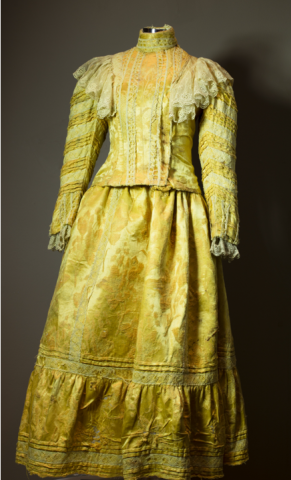
A two pieces garment inspired by Levantine or Eastern Mediterranean historical styles influenced by european dress. It features a fitted bodice that transitions into a loose and flowing lower section, designed for comfort and practicality. The neckline is modest, roun, and the sleeves are either long and fitted indicative of the era. The material appears lightweight silk which were commonly used fabrics in warm climates. Its texture suggests a plain weave, with decorative elements like simple embroidery, trims and lace patterns, enhancing its aesthetic appeal. The color palette is subdued, predominantly neutral or earthy tones such as beige, brown, or soft pastels, reflecting the natural dyes. This dress exemplifies traditional attire designed for functionality while maintaining elegance, harmonizing with the cultural and environmental influences.