Coloured

Translator: 
Euphrosyne Rizopoulou-Egoumenidou
Author: 
Euphrosyne Rizopoulou-Egoumenidou
Noly Moyssi
Description: 

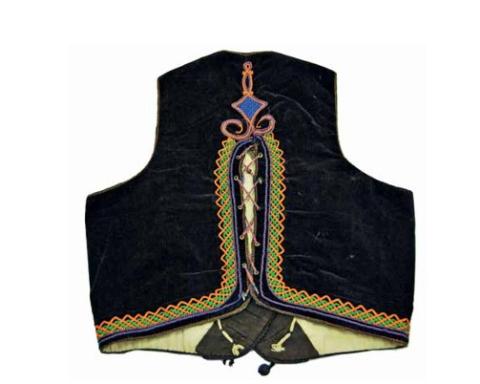
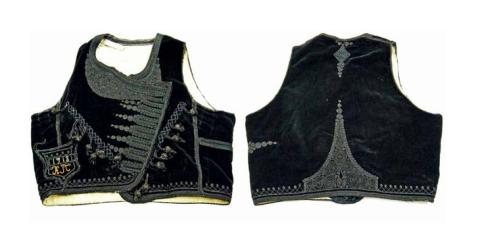
Men’s double-breasted vest. The front consists of two pieces of burgundy velvet, with sewn-on black decoration. On each side, there are eight buttons made of black silk arranged diagonally, with tassels at the end (one button is missing). The loops of the buttons are affixed to a lattice pattern of double black thread, and reinforced internally with off-white cord, also arranged diagonally. The buttonholes are decorated with soutache and twisted cord, which extends into spiral patterns. The opening of the chest is adorned on both sides with dense sewn-on embroidery forming a black lattice pattern, which is surrounded by series of soutache and twisted cord with small spirals. The embroidery ends in a series of loops of twisted cord. The four middle buttonholes on the right side are decorated with more complex sewn-on embroidery in black, each ending in a row of four spirals. Below, the edge of the front side is adorned with quadruple soutache and lattice embroidery with spirals. On the right side, there is a vase-shaped pocket of black velvet with a curvilinear outline of black soutache and four rows of tricolour cord. The pointed base ends in a tassel. The year 1900 is embroidered in the centre of the pocket, and decorated above and below with green and orange cords in a chain-like design, with spirals at the tips. The right side of the chest features a small, colourful and elaborate decorative motif in a triangular shape, finished at the bottom end with a triple spiral of blue cord, while the top end features five small spirals around the perimeter.


The back consists of two pieces of black velvet with a seam above the central, vertical opening, which is crowned with a decorative lozenge design ending in curvilinear and spiral patterns, similar to those of the vest 3459. The lozenge is covered with lattice embroidery of blue cord. The entire motif is made of three cords in orange, blue and tricolour (black, orange and burgundy).

The opening of the back closes with a braid, made of red, blue and yellow cord which crosses through pairs of eyelets. Nine out of the 13 eyelets are preserved. The opening is surrounded by a double row of blue and tricolour thread, and a band of lattice patterns made of orange and green cords, which extend to the bottom edges on both sides. On the inside of the lattice patterns is a double row of blue and tricolour thread. The bottom edge and the opening are decorated with black soutache and tricolour cord.


The vest is lined with off-white cotton fabric. Behind the buttonholes on both sides, there is a reinforcing piece of brown woollen fabric, 1 – 6.5 cm. wide. The inside of the opening of the chest/neck has a reinforcing band with dark blue, white and purple stripes.  


On the left and right side, the off-white cotton lining features a circular ink stamp, with ΛΕΥΚΩΣΙΑ ΚΥΠΡΟΣ (LEFKOSIA CYPRUS) written in the centre and ΓΕΩΡΓΙΟΣ ΦΙΛΗΣ ΠΑΡΑΓΩΓΟΣ (GEORGIOS FILIS MANUFACTURER) around the perimeter. On the right side, there is an additional oval stamp with the words ΚΩΝΣΤΑΝΤΙΝΟΣ ΛΕΥΚΩΣΙΑ (KONSTANTINOS LEFKOSIA). 2 AA are written in ink.


Dimensions: height 39.5 cm., width 42.5 cm.


Donation: Ch. Koutlidou

Translator: 
Euphrosyne Rizopoulou-Egoumenidou
Author: 
Euphrosyne Rizopoulou-Egoumenidou
Noly Moyssi
Description: 

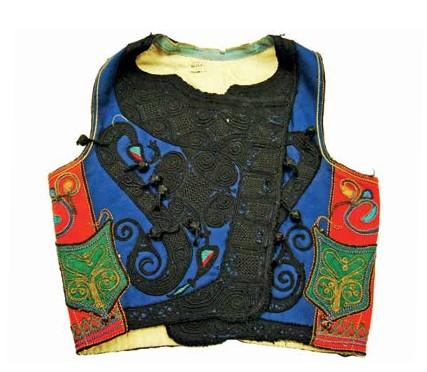
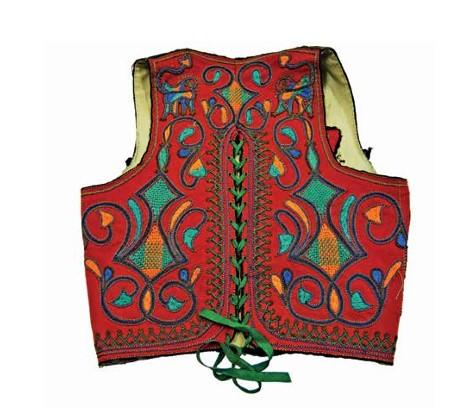
Two identical men's double-breasted vests with exceptionally rich and elaborate decoration. The two front pieces are made of light blue felt, while the back is made of a single piece of red felt. The vests close across the chest on both sides. Eight buttons made of black silk hang from loops with corresponding buttonholes, the first of which is incorporated into the embroidered part. The buttons are arranged diagonally and fixed with black cords on the inner side. There is a vase-shaped pocket on each side, made of light green velvet and embroidered with curvilinear and spiral motifs using sewn-on cord of yellow/orange colour. These designs cover most of the surface of the pocket and are contained within a frame of red and light blue cord. The outline of the pocket consists of tricolour cord and black soutache, a ready-made double cord, which is applied at the joints during fabrication. The cord of the outline extends to the upper edges of the pocket, forming curvilinear designs at the ends. The cords end in a tassel at the bottom edge of the pocket. The pockets are similar to one another. The opening of the neck and chest is lined with rich sewn-on embroidery of black silk thread featuring a variety of curvilinear motifs, arabesques, spirals, lozenges and squares. The finish consists of twisted cord and soutache. At the bottom part of the vest, the same pattern extends to the side seams, which are finished with loops of twisted cord. Both sides of the chest feature large S-shaped designs made of black cords, the top end of which terminates in a leaf filled with embroidery floss in yellow and coral colours, while the bottom end terminates in curvilinear and spiral designs. The leaf motif is repeated on the right side of the chest, where it is formed in the extension of a lozenge surrounded by double spiral motifs.


The back is made of red felt and consists of two pieces of fabric with a central vertical opening, which closes with a green ribbon which crosses through pairs of metallic eyelets. On either side of the opening there are elaborate motifs of double lozenges with lattice filling. The lozenges extend into curvilinear and spiral designs with leaf-shaped endings.

The same pattern, but with only one lozenge, is repeated in a smaller version above the opening of the back, flanked by two facing lions with eyes formed of double spirals, and long tails that end in arrows. The figure of facing lions is common in folk art, and is found in stone carvings, wood carvings and elsewhere (see Rizopoulou-Egoumenidou 2006, 174-175).


The opening and the edges of the back are lined with a chain-like design, featuring small spirals at its upper end and two rows of cord at its bottom edge. The whole of the back has a cord finish. The outline of the designs on the back is of made of thin cord, while the filling consists of floss thread in the same colours of orange, light blue and green. The decorative motifs show an Islamic influence, and are also found as engraved designs in copper vessels dating to the 18th and 19th centuries.


On the inside, the opening of the chest and the neck are reinforced with a braid with yellow and olive-green stripes. On both sides, the buttonholes are reinforced internally with two pieces of blue felt, with a width of 6-9 cm. On the left and right, the off-white cotton lining features a circular ink stamp, in the centre of which is written ΛΕΥΚΩΣΙΑ ΚΥΠΡΟΣ (LEFKOSIA CYPRUS) and ΓΕΩΡΓΙΟΣ ΦΙΛΗΣ ΠΑΡΑΓΩΓΟΣ (GEORGIOS FILIS MANUFACTURER) around the perimeter. 


This item is similar to the vest which is part of the costume of the Turkish Cypriot. This costume was included in the collection of Georgios Frangoudis, which was presented in the “Cypriot Exhibition” in Athens, organised in 1901  by the Patriotic Association of Cypriots.  The collection of the costumes was later donated to the National Historical Museum (Gangadi et al. 1999, 121-123). Very similar vests, combined with baggy trousers and featuring similar ornamentation, are included in the Collection of Aziz Damdelen.


Dimensions: (CMLE 6093) height 44.5 cm., width 48 cm. (CMLE 6094) height 45 cm., width 42 cm.


Donation: Chr. Koutlidou.
Translator: 
Euphrosyne Rizopoulou-Egoumenidou
Author: 
Euphrosyne Rizopoulou-Egoumenidou
Noly Moyssi
Description: 

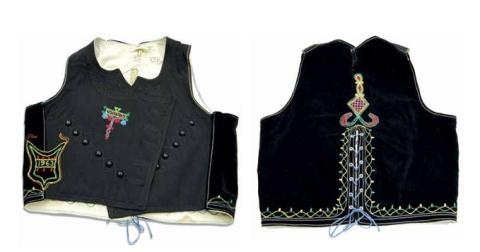
Men's double-breasted vest. The front part consists of two pieces of grey silk fabric, while the back is made of a single piece of black velvet. On the right front side, there is a vase-shaped pocket outlined by orange, yellow, green and red threads. The date 1963 is embroidered in yellow thread in the centre of the pocket’s surface. The vest is fastened across the chest with six buttons. It is adorned all around with black braid, which also surrounds the buttonholes, while a wide sewn-on decorative trim accentuates the neck opening. There is a decorative rectangular design on the right side of the chest, with a zigzag pattern on the inside and tiny spirals all around, embroidered with red, light blue, green, and yellow threads. The back of the vest has a central vertical opening with 12 white metallic eyelets arranged in facing pairs, through which cross light blue cords. Around the opening and edges, the vest is decorated with a machine-embroidered chain-like design in yellow and green colours. At the top of the opening, there is an elaborate embroidered decorative pattern consisting of a lozenge extending upwards and downwards with stylised floral motifs. Similar colourful decorative elements characterise traditional Cypriot vests.


Dimensions: height 42 cm., width 46 cm.


Donation: I. Papantoniou.

Translator: 
Euphrosyne Rizopoulou-Egoumenidou
Author: 
Euphrosyne Rizopoulou-Egoumenidou
Noly Moyssi
Description: 

Men’s double-breasted vest (yelekkin) made of black velvet. The front part consists of two pieces that cross over the chest on both sides, with rows of black buttons arranged diagonally. There are eight buttons on one side, while only six are preserved on the other side. It features rich sewn-on decoration made of grey cord, forming spiral and lattice patterns in different combinations, including: a dense composition of spirals creating a wide band around the neck opening, various spiral patterns at the openings that correspond to the buttons, lattice pattern at the base of the buttons, and a simpler design in the form of a series of lozenges around the bottom edge of the vest. Internally, the opening of the neck/chest is reinforced with braid. On the right side of the chest, there is a vase-shaped pocket outlined by sewn-on double cord, with the year 1918 embroidered in off-white, along with the initials ΚΠ (KP) in orange. The waistcoat has an inner pocket opening on the left side, which is reinforced all around with sewn-on black cord. The back consists of a single piece of fabric without an opening but with sewn-on decoration at the top and bottom. At the bottom, there is a curved triangular motif inspired by Oriental art, covered with a composition of spirals, while the top of the back features a small lozenge with mat design filling and spiral-shaped endings above and below. Internally, the opening of the neck/chest is reinforced with braid. On the lining, the name Κυριάκος Γ.Χ. Σταυρή (Kyriakos G.X. Stavri) and ΕΠΟΛ (EPOL) are written with ink, while the name Τρίκωμο (Trikomo), a village in the Famagusta District, is embroidered in red thread. Similar vests are included in the Collection of the Folklore Historical Museum of Corinth. Two identical “sklavounika” velvet waistcoats, dating from 1910, are part of family heirlooms from Peristeronopigi, a village in Mesaoria (Michalopoulou-Charalambous, 1993, 202, 203).


Dimensions: height 39 cm., width 43 cm.

Donation: K. Ioannidis.

Translator: 
Euphrosyne Rizopoulou-Egoumenidou
Author: 
Euphrosyne Rizopoulou-Egoumenidou
Noly Moyssi
Description: 

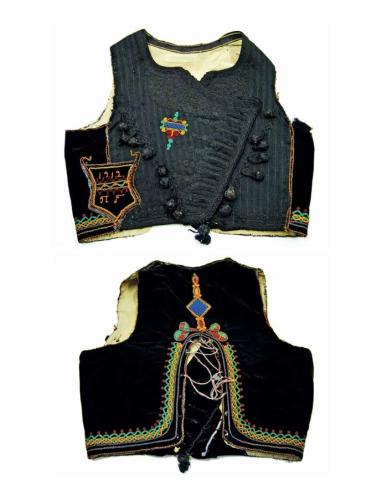
Men’s double-breasted vest (yelekkin). The front is made of ready-made striped black fabric, and the back of black velvet. The front consists of two pieces of fabric that cross over the chest on both sides. This is also apparent in the arrangement of the buttons. On the right side of the chest are eight buttons and nine buttonholes, arranged diagonally. On the left, there are also eight buttons, fastened diagonally. Cord is sewn on the inside, and further up there is a single button. All the buttons are black, as is the decoration, which consists of a design along the base of the buttons, continuous spirals arranged diagonally on the chest, dense sewn-on cords forming a wide band around the opening of the neck, and a mesh pattern at the lower edge. On the right side of the front, there is a vase-shaped pocket with an outline of coloured cords. A horizontal embroidered band divides the pocket’s surface into two parts. On the top part, the date 1912, the year the waistcoat was made, is embroidered in orange, and on the bottom part, also in orange colour, the initials ΠΓ (PG), belonging to the owner. On the chest, above the pocket, sewn-on cords form a small, colourful decorative pattern, rectangular in shape with a mat design filling, surrounded by tiny spirals in yellow/orange, blue, and burgundy colours. This peculiar decorative motif is characteristic of other vests in the collection of the Costume Museum of the Lykeion ton Ellinidon, as well as other Cypriot collections, such as that of the Folklore Historical Museum of Corinth.


The back is made of a single piece of black velvet, which extends below the armpits and is joined with coloured seams to the front pieces. In the centre of the back, there is a vertical opening that would have been closed with some kind of ribbon passing through the remaining eyelets for a better fit on the body. The opening is bordered with sewn-on cord in blue, green, and orange, forming a decorative band of lattice pattern, which extends around the sides of the vest. The ends of the decorative band are adorned with tiny burgundy spirals.


A pair of leaf-shaped motifs in green and burgundy adorn the top of the opening on the back of the vest. The decoration continues with a lozenge filled with a mat design, as well as stylised floral patterns in a vertical arrangement. The vest is lined with off-white cotton fabric, and the neck opening is reinforced with braid.


Dimensions: height 35 cm., width 41 cm.


Donation: N. Triantafyllou.


Translator: 
Euphrosyne Rizopoulou-Egoumenidou
Noly Moyssi
Author: 
Euphrosyne Rizopoulou-Egoumenidou
Noly Moyssi
Description: 

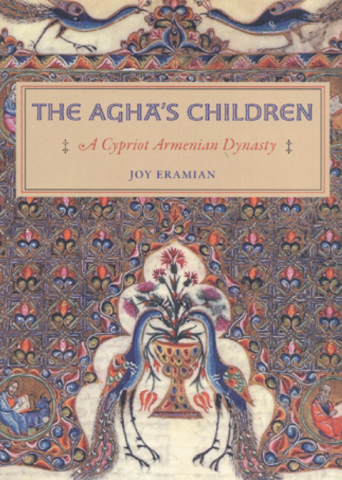
The Agha’s Children traces the adventurous history of the Eramian dynasty in Cyprus over the last two hundred and fifty years.

Around the middle of the eighteenth century, in the face of Ottoman oppression of the Armenians, Stepan Eramian Agha bought land in Cyprus for his second son, Boghos-Berge, and sent him away from the family’s ancestral estate in Turkey. Although life was safer on the island, this, too, was a troubled land. The stories of the Agha’s descendants are tales of love and hatred, cruelty and compassion, murder, piracy, slavery, tragedies and triumphs. Through it all the family survived and prospered and the Agha’s decision to move to Cyprus secured the future of his line when so many perished in the genocide of the Armenians.

The accounts in this book of the lives of the Eramian family members are based on the memories and traditions of their descendants, many of whom live in Cyprus to this day.

Translator: 
Euphrosyne Rizopoulou-Egoumenidou
Noly Moyssi
Charlotte Steffen
Author: 
Euphrosyne Rizopoulou-Egoumenidou
Noly Moyssi
Description: 

Engagement purse and photograph


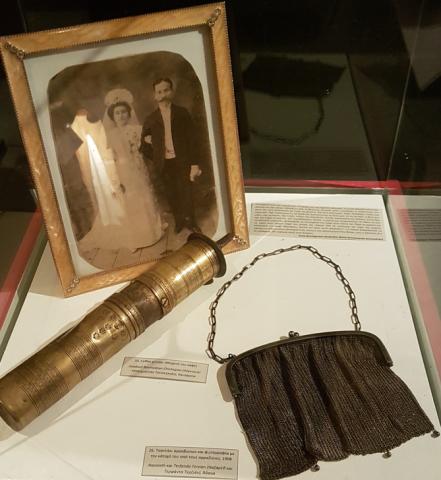
Engagement purse and photograph of Nazareth and Terfanda Terzian (Ναζαρέθ και Τερφάντα Τερζιάν) from Adana, in Asia Minor. The small metallic object is a mesh chain purse, typical of Art Nouveau. This fine accessory is made of sterling silver and is provided with a chain attached to a metallic frame with a kiss closure.


Engagement photograph of Mr. Nazareth and Mrs. Terfanda Terzian from 1908. The bride wears a European-style white wedding gown and an impressive white veil. She holds a  small purse which accompanied them from Adana to Damascus, then back to Adana, and finally to Cyprus. The purse was inherited by their daughter, Mrs. Honor Terzian Kooshgeman, and is currently in the possession of their granddaughter, Mrs. Sona Keoshgerian Kesterlian.

Translator: 
Euphrosyne Rizopoulou-Egoumenidou
Noly Moyssi
Charlotte Steffen
Author: 
Euphrosyne Rizopoulou-Egoumenidou
Noly Moyssi
Description: 

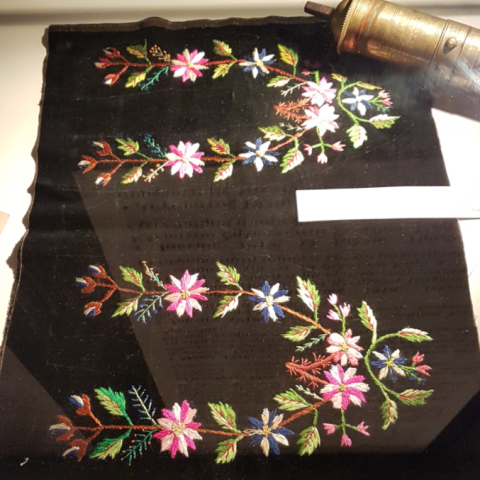
Two pieces of embroidered fabric for slippers, part of the dowry of Antaram Chichegian (Ανταρος Τατσιγιάν), Mara. Antaram Tavitian Chichegian intended to make a pair of slippers for her fiancé Canabed Chichegian. The embroidery on the black fabric, which would form the upper part of the slippers, consists of colourful -red and white- flowers with green leaves. The young girl brought the two pieces of fabric with her from the village of Germir in Kayseri to Marash, and from Mersin to Mara, where she was married. Due to the massacres, the slippers were never completed. During the massacres, both the girl and her fiancé died of typhus, but the slippers came to Cyprus with Mrs. Antaram's mother, Mrs. Maritsa. They were later inherited by Mrs. Antaram's son, Hasop Chichegian, and are now in the possession of Mrs. Sirvart.

Translator: 
Euphrosyne Rizopoulou-Egoumenidou
Noly Moyssi
Charlotte Steffen
Author: 
Euphrosyne Rizopoulou-Egoumenidou
Noly Moyssi
Description: 

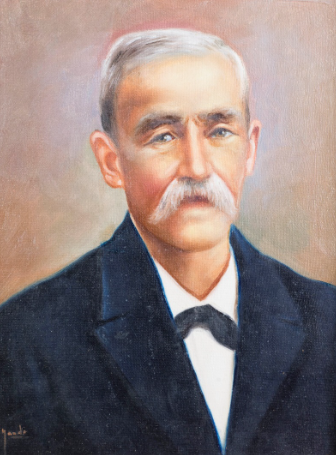
Artin Melikian is depicted in the painting wearing a dark blue, western-style suit with a matching bow tie. He is also wearing a white shirt, with his hair and facial hair styled in a western fashion.

Translator: 
Euphrosyne Rizopoulou-Egoumenidou
Charlotte Steffen
Author: 
Euphrosyne Rizopoulou-Egoumenidou
Noly Moyssi
Description: 

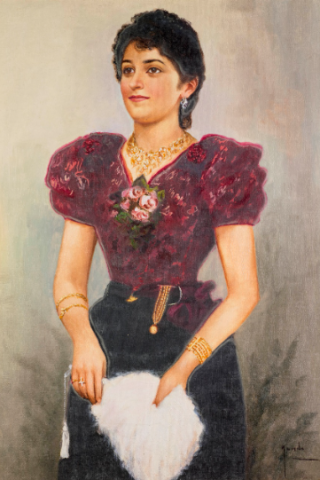
Painting of Elize Boursayeressian. She is depicted wearing a western style outfit consisting of a short red coloured blouse with puffy sleeves that has been decorated at the waist with a pocket watch and a belt. It has also been decorated at the décolleté with small pink flowers. Furthermore, she is wearing a floor-length skirt and has further accessorized with a fan made of ostrich feathers, two rings, several bracelets, a large golden necklace and diamond earrings. Her hair is also styled in a western way.

Pages